Value Chain vs Supply Chain Differences
In U.S. boardrooms, the terms value chain and supply chain are often seen as interchangeable. Yet, the distinction significantly influences how companies prioritize cost control, delivery speed, customer satisfaction, and profitability. This difference is critical in setting strategic goals.
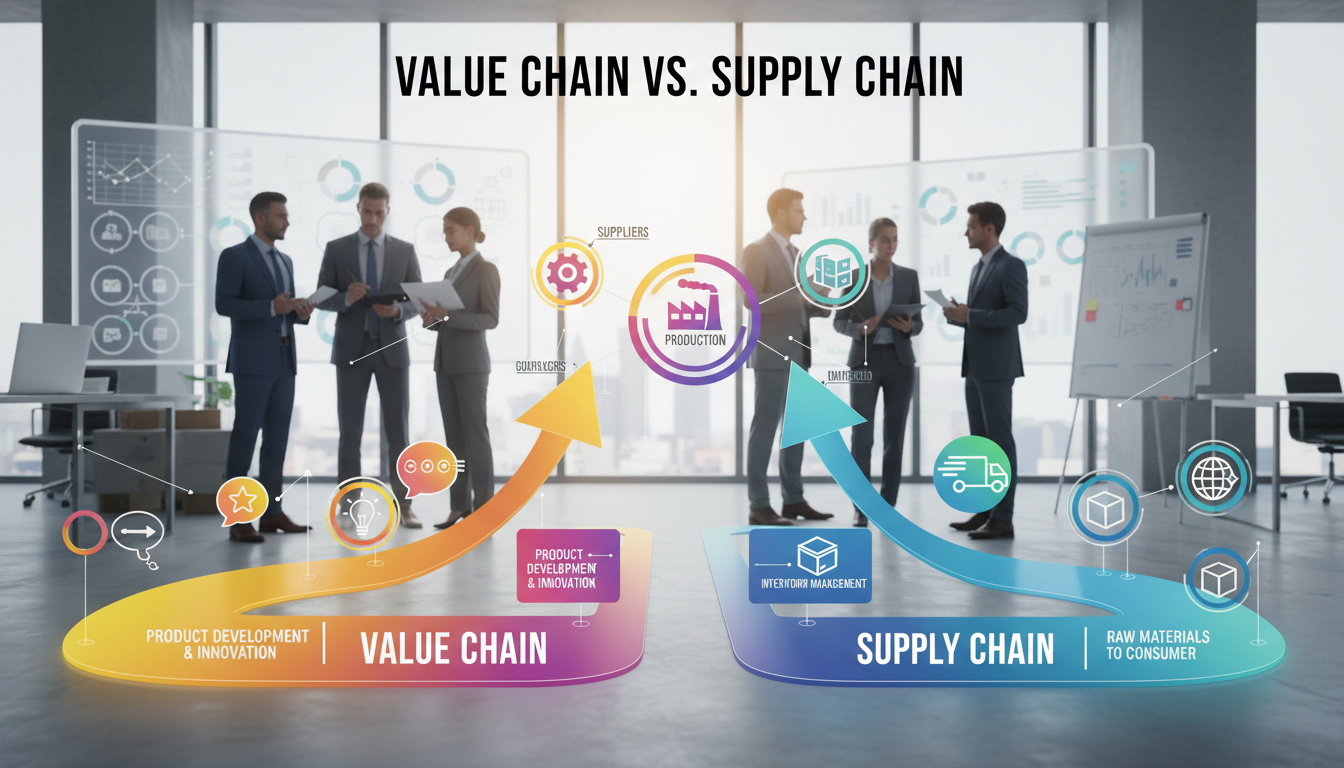
A supply chain focuses on sourcing inputs, transforming them into finished goods, and delivering them to customers. In contrast, a value chain encompasses a broader scope. It manages the entire value delivery process, from marketing to after-sales support, across the customer journey.
The distinction between value chain and supply chain is significant. The U.S. consumer economy is vast and vulnerable to disruptions. In 2022, Americans spent $5.9 trillion on consumer goods, each item traversing multiple steps from concept to delivery. The COVID-19 pandemic, followed by the war in Ukraine and complications in China, highlighted the fragility of supply chains.
Concentration risk further complicates planning and procurement. Ukraine and Russia, for instance, supplied 24% of global wheat exports. This constraint tightened supply, causing strain for food producers and retailers downstream.
This analysis posits that value chain and supply chain models are best when viewed as interconnected systems. A robust supply chain is essential for a value chain to thrive. Simultaneously, a well-managed value chain ensures that efficiently delivered products meet market expectations.
What Business Leaders Mean by a Supply Chain
Business leaders define a supply chain as the entire path a product takes from its origin to the end user. It encompasses sourcing, production, inventory management, transportation, and delivery. The goal of supply chain management is to execute these steps efficiently, ensuring high service levels while controlling costs.
The confusion often arises from the terms supply chain and logistics. Logistics focuses on the movement and storage of goods. In contrast, the supply chain involves planning, sourcing, and coordination across various firms. This broader scope is why supply chain management is often measured with finance-grade metrics like cash-to-cash cycle time and on-time delivery.
Supply chain definition: moving goods from raw materials to customer delivery
A supply chain starts with raw materials and components, then transforms them into finished goods. Products then move through the channel: from manufacturer to distributor, distributor to retailer, and retailer to end user. This logic also applies to services, such as repair parts, where delivery speed and availability are key to customer satisfaction.
Product journeys can vary from local to cross-border. For example, Wilson’s “The Duke” football is made in the United States, reducing transit time and border risks. On the other hand, many autos rely on globally dispersed components, increasing exposure to port congestion, tariffs, and supplier disruptions.
Core stages: procurement, manufacturing, distribution, and customer service
Procurement: selects suppliers, negotiates terms, and secures inputs that meet specification and lead-time targets.
Manufacturing: converts inputs into finished goods through scheduled production, quality controls, and capacity planning.
Distribution: positions inventory and ships product to retail and commercial channels using networks of warehouses and carriers.
Customer service: supports ordering, delivery accuracy, returns, and issue resolution tied to fulfillment performance.
These stages highlight the distinction between supply chain and logistics. Logistics is critical within distribution, but supply chain management links procurement and production decisions to inventory and delivery outcomes. Leaders often discuss resilience in the context of this end-to-end design.
Who’s involved: suppliers, manufacturers, distributors, retailers, and logistics partners
A supply chain is a network, not a single entity. It includes suppliers, manufacturers, distributors, retailers, and logistics partners. Suppliers provide materials, manufacturers build the product, distributors aggregate volume, and retailers reach consumers. Logistics partners manage freight, warehousing, and customs compliance when crossing borders.
| Role in the network | Main responsibility | Key data used in supply chain management | Operational handoff point |
|---|---|---|---|
| Suppliers | Provide raw materials and components to spec and lead time | Supplier OTIF, defect rate, lead-time variability, minimum order quantity | Inbound receipt at plant or contract manufacturer |
| Manufacturers | Convert inputs into finished goods and manage production schedules | Throughput, yield, capacity utilization, changeover time, work-in-process | Finished-goods release to distribution or direct ship |
| Distributors | Consolidate inventory and supply multiple channels efficiently | Fill rate, inventory turns, backorder rate, slotting accuracy | Outbound shipment to retailers or business customers |
| Retailers | Match shelf and online availability to demand signals | POS velocity, stockout rate, forecast error, return rate | Final sale and delivery to end user |
| Logistics partners | Operate transportation and warehousing execution across nodes | Transit time, damage rate, dock-to-stock time, freight cost per unit | Physical movement between all stages; central to supply chain vs logistics discussions |
This shared structure is why leaders emphasize governance, service-level agreements, and clear ownership. It also explains why supply chain vs logistics remains a frequent topic in board updates: logistics is visible, but supply chain management sets the rules that logistics executes.
What a Value Chain Is and Why It Matters
In management analysis, a value chain maps how a firm transforms inputs into outcomes customers value. It shifts focus from movement and handoffs to the business choices that enhance perceived benefits and protect margins.
This perspective aids in pricing strategy, operating discipline, and brand consistency. It explains why two firms with similar costs can differ significantly in the market.
Value chain definition and origin in Michael Porter’s value chain model
The value chain definition comes from Michael Porter of Harvard Business School. He introduced it in 1985 in
Competitive Advantage: Creating and Sustaining Superior Performanceand formalized it as the value chain model.
In practice, the value chain treats the business as a series of linked activities. Each activity can either add, dilute, or increase costs without improving customer experience.
Strategic purpose: increasing customer-perceived value and profitability
The value chain model is for strategic decisions, not just operational efficiency. It focuses on customer-perceived value, differentiation, satisfaction, and profitability, alongside cost control.
Common metrics include willingness to pay, conversion, repeat purchase, warranty claims, and cost-to-serve. These measures help pinpoint where investment boosts outcomes and where it adds complexity.
| Internal activity | How it can raise customer-perceived value | Business metrics often used |
|---|---|---|
| Product development and R&D | Improves fit, performance, and usability through features and design choices | Time-to-market, defect escape rate, customer retention |
| Operations and quality management | Delivers consistent performance and fewer failures across batches | First-pass yield, returns rate, warranty cost per unit |
| Marketing and sales | Clarifies positioning and sets expectations that match the product experience | Conversion rate, average selling price, churn rate |
| Service and support | Protects loyalty and reduces downtime after purchase | First-contact resolution, net revenue retention, cost-to-serve |
Where it happens: internal activities that shape product quality, brand, and customer experience
Unlike a process map focused on external handoffs, the value chain model looks inside the business. It examines functions such as development, operations, marketing, sales, and support that shape product quality, brand positioning, and customer experience.
This view also fits internationally traded goods. A product may be assembled abroad while domestic value is created through design, software, R&D, finance, compliance, and after-sales services across many occupations.
Used this way, the value chain definition becomes a practical audit tool for leaders. It connects everyday decisions to the customer’s experience and to the profit outcomes that follow.
Value Chain vs Supply Chain
In operations reviews, the distinction between value chain and supply chain is often a matter of scope. Yet, it impacts daily decisions significantly. Leaders must discern between product flow and customer value to make informed choices. This distinction influences budgets, KPIs, and who is responsible for the work.
Different focus: flow of goods versus value creation across the customer journey
A supply chain focuses on managing the flow of goods, ensuring inventory and finished products are delivered on time and in the right place. It encompasses sourcing, production, warehousing, transportation, and delivery across various firms. Here, lead times, service levels, and stock availability are critical.
A value chain, on the other hand, maps out how a company creates value throughout the customer journey. It includes product design, marketing, service quality, and after-sales support. The key difference lies in the value chain’s focus on customer experience and loyalty, extending beyond mere delivery.
Different orientation: externally coordinated execution versus internally aligned strategy
Supply chain work is typically externally coordinated, relying on suppliers, contract manufacturers, carriers, ports, and distributors. Its success hinges on multi-tier coordination. Planning and exception management are tactical, often involving trade-offs between speed, cost, and risk.
Value chain work, by contrast, is internally aligned, connecting product, finance, operations, sales, and customer support around customer-perceived value. Debates often arise when internal teams optimize features while external networks struggle to deliver reliably.
Different goals: cost and speed versus differentiation, satisfaction, and margins
Supply chain goals prioritize cost and speed across various stages. Metrics include cost per order, lead time, on-time delivery, and inventory turnover. These directly impact working capital and cash conversion cycle pressure.
Value chain goals, on the other hand, focus on differentiation, satisfaction, and margins. Metrics such as product margin, customer retention, repeat purchase rate, and brand perception are key. A notable difference is that a fast network can fail if the offer lacks relevance or service quality. Strong design and support can also be undermined by slow or unreliable fulfillment.
| Operational lens | Supply chain emphasis | Value chain emphasis |
|---|---|---|
| Primary objective | Availability at the right time and place through coordinated flow of goods | Higher customer-perceived value across the customer journey, including service and support |
| Coordination model | Externally coordinated execution across suppliers, logistics partners, and channels | Internally aligned strategy across product, operations, marketing, and customer care |
| Typical performance metrics | Cost per order, lead time, inventory turnover, on-time delivery | Customer retention, product margins, satisfaction, brand perception |
| Common breakdown point | Stockouts, late deliveries, excess inventory, high freight and handling costs | Weak differentiation, low adoption, poor service experience, margin erosion |
Supply Chain Management in Practice
In daily operations, supply chain management involves disciplined execution across various stages. It focuses on cycle time, service level, and landed cost. The debate between supply chain vs logistics often revolves around accountability. Logistics handles physical movement, while supply chain management aligns planning, suppliers, and inventory policy with demand.
Structure reduces errors through standard work and clear roles. Speed is achieved through short decision paths and accurate data. Cost control is maintained through rate management, inventory turns, and network design.
Modern supply chain management relies on cloud-based platforms for shared data. Big data and machine learning are used for demand sensing and supplier risk scoring. Here, supply chain vs logistics is a systems question. Logistics execution feeds real-time status, while supply chain management uses that visibility to rebalance inventory and capacity.
Global complexity is common, not rare. YETI drinkware is a good example. Demand forecasting and order processing are managed in the U.S., while manufacturing partners are in China, Malaysia, Mexico, and Thailand. Products then face cross-border documentation, container availability, and port constraints before reaching distribution points.
Transportation reliability can significantly impact cost and service. International carriers like Deutsche Post AG handle movements into U.S. distribution centers. Lead time variability affects safety stock and reorder points, making supply chain vs logistics critical.
Disruption risk has increased operating discipline. Pandemic stoppages caused retail shortages, and geopolitical shocks added volatility in energy and transit lanes. These events highlight the importance of multi-party coordination and tiered supplier mapping.
| Operational area | Execution focus in supply chain management | Typical logistics touchpoint | Decision metric used by finance teams |
|---|---|---|---|
| Sourcing | Supplier lead times, tier visibility, and purchase order governance | Inbound routing, delivery appointments, and receiving readiness | Material cost variance and supplier performance penalties |
| Manufacturing | Capacity planning, schedule adherence, and work-in-process control | Plant-to-warehouse transfers and packaging compliance | Unit cost, yield loss, and overtime expense |
| Inventory | Reorder points, safety stock, and allocation rules by channel | Put-away accuracy, cycle counts, and pick rates | Inventory carrying cost and obsolescence reserve |
| Transportation | Mode strategy, lane design, and carrier portfolio risk | Freight booking, tracking events, and claims management | Freight cost per unit and on-time delivery rate |
| Distribution | Network design, order priority rules, and service-level targets | Warehousing, last-mile handoff, and returns processing | Cost-to-serve and fill rate by customer segment |
Value Chain Activities That Create Competitive Advantage
Creating a competitive edge often hinges on managing value chain activities as a unified system, not as isolated tasks. By mapping out value chain components, firms can pinpoint areas where costs escalate, quality wavers, and customer value increases. This insight empowers leaders to allocate resources more strategically, safeguarding the quality that customers experience.
R&D and design: developing prototypes and optimizing products for customer needs
R&D and design are instrumental in shaping the tangible aspects of a product that customers can measure and feel. These activities are critical for new product launches, feature enhancements, and design choices that resonate with real-world applications. By integrating these steps into the core of their value chain, companies can leverage prototype testing as a tool for cost optimization, transcending its role as a mere creative endeavor.
YETI exemplifies this approach by having U.S.-based staff develop and test prototypes. They then validate these prototypes with brand ambassadors in the U.S. and select international markets. This feedback loop minimizes rework and ensures that product specifications align with customer preferences before entering mass production.
Production and quality: improving efficiency while raising consistency and sustainability
Production transforms design into a consistent output, making quality assurance an integral part of daily operations. This includes process control, defect prevention, and throughput planning. By treating these activities as essential components of the value chain, companies can safeguard their profit margins by reducing waste, returns, and warranty claims.
Decisions on sustainability also fall within this realm, impacting both cost-to-serve and brand reputation. Many companies experiment with sustainable packaging and evaluate the use of recycled materials, balancing availability, performance, and cost-effectiveness. The aim is to maintain quality while minimizing resource loss throughout the production process.
Sales, marketing, service, and after-sales support: extending value beyond the sale
Effective go-to-market strategies translate product benefits into compelling reasons to purchase, relying on consistent messaging. YETI employs a mix of traditional, digital, and social media marketing, along with product ambassadors and original short films. Their efforts are concentrated in the U.S. and extend to Europe, the English-speaking Pacific, and Japan, requiring seamless coordination across teams.
Service and after-sales support are vital in maintaining customer relationships post-purchase. By treating these activities as integral to the value chain, support teams can enhance customer retention through swift issue resolution and continuous service. As such, these interactions boost customer lifetime value by reducing churn and encouraging repeat purchases.
| Stage | Operational focus | Typical metrics used | How customer-perceived value is reinforced | How overhead is controlled |
|---|---|---|---|---|
| R&D | Strategy testing, feature evaluation, prototype iteration | Cycle time, test pass rate, development cost per project | Better performance and usability in real conditions | Fewer redesign loops and clearer product requirements |
| Design | Specification accuracy, manufacturability, fit to customer preferences | Engineering change orders, time-to-market, costed bill of materials | More consistent experience and easier adoption | Reduced complexity and lower material variability |
| Production | Process control, capacity planning, labor and equipment efficiency | Yield, throughput, unit cost, downtime | Reliable availability and consistent build quality | Lower scrap, better utilization, fewer expediting costs |
| Quality assurance | Incoming checks, in-process inspection, corrective actions | Defect rate, return rate, warranty cost | Trust in durability and performance claims | Less rework and fewer returns to process |
| Sales & marketing | Positioning, channel mix, message discipline across media | Conversion rate, CAC, revenue per channel | Clear product meaning and stronger willingness to pay | Higher targeting precision and reduced wasted spend |
| Customer service | Issue triage, resolution speed, knowledge management | First-contact resolution, handle time, CSAT | Smoother ownership experience and fewer frustrations | Lower repeat contacts and improved agent productivity |
| After-sales support | Retention programs, warranty workflows, service continuity | Retention rate, repeat purchase rate, customer lifetime value | Confidence to repurchase and recommend | Lower churn costs and more predictable demand |
Difference Between Value Chain and Supply Chain in Scope and Ownership
In operational planning, the distinction between value chain and supply chain hinges on responsibility boundaries. Supply chains are often viewed as a subset of value chains. This is because value creation extends beyond mere sourcing, production, and delivery.
This distinction helps differentiate between execution workflows and the broader activities that influence customer-perceived value. These include brand, service quality, and long-term support.
Scope: delivery endpoints versus lifecycle performance
The scope clearly delineates the value chain from the supply chain. Supply chains encompass the entire end-to-end flow: from procurement to manufacturing, inventory, transportation, and delivery to the buyer.
On the other hand, the value chain covers the full lifecycle and experience. It includes operations and logistics, alongside product design, marketing, pricing strategy, customer onboarding, after-sales support, and the firm’s infrastructure that governs performance.
| Dimension | Supply chain scope | Value chain scope |
|---|---|---|
| Primary focus | Material and information flow from suppliers to customer delivery | Customer-perceived value across the lifecycle, from design through renewal and support |
| Typical start point | Supplier qualification, contracting, and inbound supply | Market needs, product strategy, and design requirements |
| Typical end point | On-time, in-full delivery and returns processing | Retention, service outcomes, brand equity, and willingness to pay |
| Key metrics | Lead time, fill rate, freight cost, inventory turns | Margin, customer satisfaction, customer lifetime value, cost-to-serve |
Ownership: partner networks versus internal accountability
Ownership defines the management approach between value chain and supply chain. Supply chains heavily rely on external partners for material, logistics, and distribution. Performance is measured by contracts and service standards.
Value chains, in contrast, are driven by internal teams responsible for demand shaping, design, operations, marketing, finance, and customer service. This internal focus is reflected in the U.S. labor market, where exports support 9 million jobs, about 6% of the workforce, with only a quarter in manufacturing.
This job profile highlights the importance of professional services, transportation, and finance roles in value creation, alongside manufacturing.
Why it matters: speed cannot replace product-market fit
A swift supply chain can fail if the product misses buyer needs, support is inconsistent, or positioning is unclear. Rapid fulfillment does not rectify weak product relevance or poor service design, which fall within the value chain.
Conversely, strong value creation can be undermined by late delivery, damaged goods, or unreliable replenishment. Such issues erode trust and increase the cost to serve.
Value Chain Components and the Value Chain Model
Executives often employ the value chain model to dissect work into activities that influence price, cost, and customer perception. The aim is to map out value chain components, enabling finance, operations, and commercial teams to measure them. This map also highlights where handoffs lead to delays, rework, or unnecessary expenses.
Mapping activities across development, operations, go-to-market, and support
Development encompasses R&D, prototyping, design refinement, and tooling decisions, such as molds and fixtures shared with manufacturing partners. These decisions early on determine unit economics through material specifications, tolerances, and packaging design. They also impact lead times and defect rates later in production.
Operations involve production execution, quality assurance, throughput, and sustainability decisions like reducing scrap and conserving energy. Go-to-market activities include the marketing mix, sales enablement, and channel strategy across retail, owned stores, and online marketplaces. Support encompasses customer service and after-sales processes that influence retention, returns, and warranty costs.
| Activity group | What the work includes | Where value is commonly added | Where value is commonly lost | Metrics used in reviews |
|---|---|---|---|---|
| Development | R&D, prototypes, design iteration, tooling and mold readiness, manufacturing partner onboarding | Design-to-cost discipline, fit and finish, durability targets, packaging efficiency | Late engineering changes, supplier misalignment, slow prototype cycles | Time-to-market, engineering change orders, target cost variance, first-pass yield at pilot |
| Operations | Production scheduling, QA, line balance, productivity, sustainability and waste controls | Stable quality, high utilization, lower cost per unit, fewer defects | Rework, scrap, downtime, inconsistent supplier inputs | Overall equipment effectiveness, defect rate, scrap rate, cost per unit, on-time completion |
| Go-to-market | Pricing architecture, promotion planning, sales training, channel mix, distribution strategy | Clear product positioning, stronger conversion, better shelf execution, channel fit | Discount leakage, stockouts in key channels, weak sales collateral | Gross margin, sell-through, price realization, return rate, customer acquisition cost |
| Support | Customer service, warranty handling, repairs, returns, service content and self-help tools | Faster resolution, lower churn, higher repeat purchase, lower returns through guidance | Slow response times, inconsistent policies, high cost-to-serve | First contact resolution, net retention rate, warranty cost rate, repeat purchase rate, customer lifetime value |
Using analysis to find where value is added or lost
Value chain analysis asks a simple question: does it increase customer willingness to pay more than it increases cost? This framing keeps discussions focused on trade-offs, not opinions. It also helps pinpoint whether margin pressure stems from input costs, process waste, or weak differentiation.
This method becomes clearer when tracing price across contributors. A consumer paying $38 for a YETI tumbler funds a wide range of roles across the lifecycle, including Thai manufacturers, American designers, German logistics companies, and Dutch warehousing staff. In practice, value chain components span functions and borders, even when brand ownership remains centralized.
Linking each activity to willingness to pay and lifetime value
In the value chain model, willingness to pay is influenced by attributes customers can see and trust, such as performance, durability, and service reliability. Differentiation efforts in development and go-to-market tend to manifest in product margins and brand perception metrics. Operations choices, on the other hand, tend to show up in cost-to-serve and defect-related returns.
Support directly links to customer lifetime value through retention and repeat purchase behavior. Value chain analysis connects service costs to outcomes like fewer refunds, higher net retention, and lower complaint volumes. This connection allows leaders to compare service investments against a measurable cash-flow profile over time.
Supply Chain vs Logistics: Clearing Up a Common Confusion
In corporate reporting, the terms supply chain vs logistics are often used interchangeably, but they are not synonymous. This confusion can lead to misallocation of resources and incorrect performance metrics. It’s essential to understand the distinction as it affects budgeting and accountability.
Supply chain management oversees the entire flow of goods and information, setting the overall strategy and governance. Logistics, on the other hand, focuses on executing a specific part of this plan, managing the movement of inventory through various nodes in the network.
Logistics as a subset: inbound and outbound movement, warehousing, and transportation
Logistics encompasses the movement of goods, storage, and transportation. It deals with the execution of shipments, dock operations, and storage capacity. It also involves carrier selection, load planning, and controlling freight costs.
For example, Deutsche Post AG handles the transportation of finished goods into multi-country distribution centers. The success of this operation depends on several factors, including lane capacity, customs clearance, and network reliability.
Supply chain vs logistics: broader coordination across sourcing, production, inventory, and distribution
The supply chain management operates at a higher level than logistics, encompassing sourcing, procurement, manufacturing, inventory management, transportation, and distribution. It ensures that demand forecasts align with production schedules and replenishment rules.
Supply chain management also involves making strategic trade-offs. Companies can choose to reduce freight costs but increase the risk of stockouts. Alternately, they can increase safety stock to maintain service levels, albeit at the cost of tying up working capital.
| Area | Logistics scope | Supply chain management scope | Common KPI examples |
|---|---|---|---|
| Inbound flow | Receive, unload, put-away, schedule carriers | Supplier strategy, lead-time targets, inbound inventory buffers | Dock-to-stock time, inbound on-time rate, supplier OTIF |
| Warehousing | Storage, slotting, picking, packing, cycle counts | Network design, inventory positioning, capacity planning | Pick accuracy, lines per hour, inventory turns |
| Transportation | Mode selection, routing, tendering, track-and-trace | Cost-to-serve policy, lane strategy, service tier design | On-time delivery, cost per shipment, claims rate |
| End-to-end coordination | Execute shipments between nodes | Align demand, supply, production, and distribution decisions | Perfect order rate, total landed cost, cash-to-cash cycle |
Where logistics touches value: delivery speed, reliability, and service experience
Logistics plays a critical role in delivering value to customers by ensuring timely and reliable delivery. Late shipments can lead to customer dissatisfaction, returns, and additional costs, even if the product quality is high.
Warehouse automation can significantly improve the delivery experience. Exotec’s solutions have shown that automation can increase fulfillment productivity, enabling faster delivery times such as next-day shipping. This is achieved by reducing order cycle times and improving throughput.
How Value Chain Thinking Improves Supply Chain Outcomes
Operations teams achieve better results when strategy and execution are aligned. The debate between value chain and supply chain often overlooks a key point: both benefit when decisions align with what customers are willing to pay. By focusing on value chain activities, supply chain management can enhance customer satisfaction and profitability simultaneously.
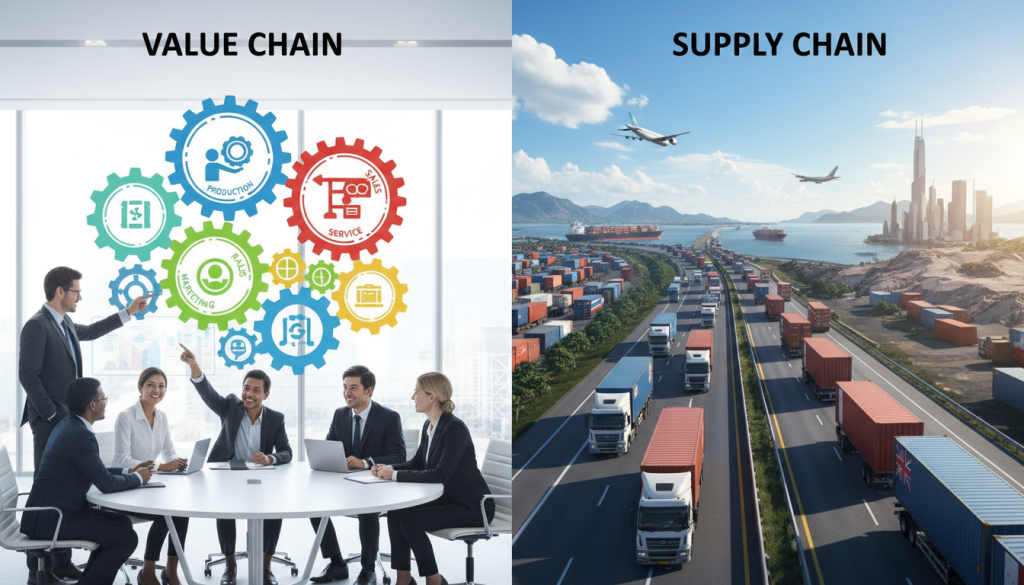
This method transforms daily trade-offs into strategic choices. It links service levels, cost-to-serve, and quality targets to business value, moving beyond mere habit or silo goals. It also facilitates cross-functional planning, as teams share common metrics.
Inbound logistics
Inbound performance improves with supplier alignment for just-in-time delivery and inventory optimization. A value-focused approach reduces the risk of overstock and stockouts, lowering carrying costs and avoiding lost sales. It also alleviates pressure on receiving and warehousing by reducing handling and storage needs.
Procurement and logistics can establish common standards for lead times, pack sizes, and inbound appointment windows. These controls ensure materials flow at the production pace needed. This logic strengthens supply chain management by reducing variability at the network’s start.
Manufacturing
Manufacturing gains are maximized when value chain activities focus on both cost and quality. Automation and plant data can increase throughput while tightening quality control, reducing scrap and rework. Many firms also incorporate recycled inputs or sustainable packaging where it meets product specifications and margin goals.
Ariat’s adoption of Exotec’s Skypod® AS/RS exemplifies how execution and value creation reinforce each other. The system employs robots to move goods between high-density racks and ergonomic picking stations, reducing worker walking distances. Ariat saw a 4x increase in storage capacity, a 10x gain in fulfillment productivity, and the ability to offer next-day shipping with later order cut-off times.
Work design also evolved. Ariat reported that 80% of picking staff moved into higher-value roles, including quality control and customer service. This demonstrates the operational synergy between value chain and supply chain, with labor redirected to activities customers value.
Outbound logistics
Outbound logistics improves when distribution choices reflect the customer promise. Route optimization and last-mile delivery design can enhance on-time rates without increasing shipping costs. Fulfillment center placement is also critical, setting the baseline for delivery speed and transportation zones.
Many networks combine insourcing and outsourcing to maintain service during peak demand. Collaboration across brick-and-mortar and digital channels can reduce split shipments and returns friction. In this stage, value chain activities lead to faster, more predictable delivery, supporting brand loyalty and repeat purchases.
| Stage | Value chain activities focus | Supply chain management lever | Operational outcome | Customer outcome |
|---|---|---|---|---|
| Inbound logistics | Supplier alignment tied to service targets | Just-in-time delivery and inventory optimization | Lower carrying cost, fewer shortages | Better product availability |
| Manufacturing | Quality built into process design | Automation, data-driven quality control, cost-to-serve tracking | Higher throughput, less rework | More consistent product performance |
| Outbound logistics | Service promise matched to distribution design | Route optimization, last-mile strategy, fulfillment center placement | Improved on-time delivery, fewer expedites | Faster delivery and easier ordering |
Conclusion
The distinction between value chain and supply chain is critical in daily operations. Supply chains focus on optimizing cost, lead time, and availability through external partnerships. On the other hand, value chains aim to enhance customer-perceived value, differentiation, and profitability by focusing on internal activities and customer touchpoints.
Management decisions should align with these priorities. Supply chain execution ensures the delivery of materials, capacity, and reliability. Value chain analysis, in contrast, evaluates if what is delivered meets customer expectations and maintains profit margins. Poor performance in either area can lead to lower service levels, increased costs, or reduced profitability.
In the United States, these choices have significant economic implications. U.S. exports support about 9 million jobs, accounting for 20% of manufacturing and 13% of transportation and warehousing employment. The design of global networks, inventory policies, and service standards can influence outcomes for businesses and the labor market.
For U.S. operators, value chain analysis should be a continuous governance tool. It aids in prioritizing investments in automation, network design, and service capabilities to enhance supply chain performance and customer satisfaction. This approach ensures resilience and growth by making informed value chain vs supply chain decisions.
FAQ
What is the difference between value chain and supply chain?
The value chain and supply chain differ in their objectives and scopes. A supply chain focuses on managing the flow from raw materials to customer delivery, aiming for cost control and efficiency. In contrast, a value chain extends beyond sales to manage the entire customer journey. It includes product development, marketing, service, and after-sales support, focusing on customer value and profitability.
Why do U.S. business leaders often conflate value chain vs supply chain?
Leaders often mix up the terms because of the overlap in daily operations. Activities like inbound logistics and distribution are common to both. They might discuss delivery speed or inventory using value chain terms, or supply chain metrics. This confusion affects decisions on delivery, customer satisfaction, margins, and competitiveness.
What is the supply chain definition in operational terms?
Operationally, a supply chain is the entire process from raw material to customer delivery. It encompasses procurement, manufacturing, inventory management, and distribution. Supply chain management aims to optimize these steps for efficiency and speed across a network of suppliers and partners.
What is the value chain definition, and where did the concept originate?
The value chain refers to internal business activities that create value from the customer’s viewpoint. Michael Porter introduced the term in 1985 in *Competitive Advantage*. Porter’s model helps evaluate how each activity impacts differentiation, satisfaction, and profit.
What are common value chain activities and value chain components?
Value chain activities include development, operations, go-to-market, and support. These aim to enhance product quality, brand positioning, and customer experience. The goal is to increase customer willingness to pay while reducing costs.
How does value chain analysis differ from supply chain performance tracking?
Value chain analysis assesses whether each activity increases customer willingness to pay. It links choices to outcomes like margins and customer retention. Supply chain tracking focuses on execution metrics like cost and lead time. Both are essential: a strong value proposition can fail without reliable fulfillment.
How is supply chain vs logistics different, and why does the distinction matter?
Logistics deals with the execution of movement, warehousing, and transportation. Supply chain coordination, on the other hand, includes sourcing, production planning, and distribution network design. Logistics performance impacts value outcomes by influencing customer experience and brand perception.