
Top Emerging Trends in Supply Chain Management
Supply chain management is undergoing a significant transformation due to shifting demand patterns and rapid technology adoption. For U.S. businesses, agility, sustainability, and resilience are now essential, not just optional. This section explores the emerging trends in supply chain management that are reshaping planning, service, and cost control.
In today’s volatile global economy, companies are reconfiguring their networks to ensure continuity and protect margins. They are moving beyond focusing solely on cost and speed. Now, they prioritize risk management, transparency, and reliable service across the entire supply chain. This shift is critical as lead times shorten and disruption risks increase.
The analysis that follows delves into the leading supply chain innovations. It covers AI and machine learning in planning and execution, blockchain for traceability, IoT for real-time monitoring, and digital twins for scenario testing. It also examines automation and robotics in warehouses, network designs focused on resilience, and sustainable models that mitigate regulatory and customer pressures.
Why the Future of Supply Chain Management Is Changing Fast
The future of supply chain management is evolving rapidly due to global network stress tests. The pandemic revealed weak buffers, while geopolitical tensions introduced new constraints. Digital transformation has also raised expectations for planning systems to deliver results in weeks, not quarters.
These challenges have exposed the limitations of legacy planning, visibility, and risk management. Many firms struggle with fragmented data, delayed updates, and manual exceptions. This gap has elevated supply chain optimization to a top priority for executives, focusing on inventory, service levels, and working capital.
Success metrics are evolving. Leaders now view “smart, resilient, sustainable supply chains” as essential for growth and risk management. Supply chain innovation is measured by faster recovery, fewer stockouts, and improved supplier performance.
Market expectations demand quicker decision-making. Harvard Magazine highlights the importance of maintaining information channels in supply chains. Analytics, data governance, and real-time event management are now critical for supply chain planning.
| Pressure on Supply Networks | What It Exposed in Legacy Models | Management Priority Now |
|---|---|---|
| Pandemic aftermath: demand swings and labor constraints | Static forecasts, slow exception handling, and poor end-to-end visibility | Supply chain optimization for service reliability and inventory precision |
| Geopolitical tensions: shifting trade rules and transport risk | Over-reliance on single regions and limited contingency playbooks | Resilience planning with multi-tier supplier risk controls |
| Rapid digital transformation across industries | Disconnected systems and inconsistent master data | Supply chain innovation focused on integrated data and faster decisions |
Management priorities are shifting towards agility, resilience, and sustainability. Companies are reevaluating policies for safety stock, supplier segmentation, and network design. This approach aims to enhance disruption readiness and reliable service, shaping the future of supply chain performance.
Emerging Trends in Supply Chain Management
In this analysis, “emerging” refers to capabilities that have moved beyond pilots and narrow point tools. They are being embedded into planning and execution systems, then scaled across sites and partners. The result is measurable impact on service levels, compliance controls, and operating cost.
Many emerging trends in supply chain management share a common pattern: wider use of shared data, faster decision cycles, and tighter process governance. This shift favors repeatable workflows over one-off heroics during disruption. It also raises the bar for audit trails, master data, and exception management.
Across industries, supply chain digitalization is showing up as connected networks. Firms are linking demand signals, inventory positions, transportation status, and supplier performance into near real-time views. This foundation supports stronger controls when lead times swing and constraints hit multiple tiers.
Technology in supply chain is also expanding from analytics add-ons into core platforms. AI and machine learning are being operationalized in forecasting, allocation, and risk sensing. IoT supports condition monitoring and asset health, while blockchain and digital twins strengthen traceability and scenario testing.
Recurring themes will appear throughout the sections that follow:
Supply chain digitalization through cloud platforms, integration layers, and shared data models
Technology in supply chain, including AI/ML, IoT sensing, blockchain, and digital twins
Sustainability execution, focused on decarbonization metrics, supplier engagement, and circular flows
Automation in warehouses and fulfillment, using robotics, goods-to-person systems, and advanced WMS logic
Optimization in routing, inventory buffers, network design, and exposure to disruption risk
The business rationale is practical. Companies are using these approaches to close visibility gaps, reduce logistics friction, and manage labor constraints under higher wage and fuel pressure. Real-time data and analytics also help teams respond faster to demand shifts and capacity limits, without adding layers of manual work.
|
Theme |
What scales beyond pilots |
Operational pressure it addresses |
Where it shows up day to day |
|---|---|---|---|
|
Supply chain digitalization |
Integrated planning and execution data flows across ERP, WMS, TMS, and supplier portals |
Visibility gaps, slow handoffs, inconsistent KPIs |
Unified order status, shared inventory views, faster exception routing |
|
Technology in supply chain |
AI-driven decision support, IoT telemetry, digital twin simulation, and traceability controls |
Demand volatility, quality risk, compliance requirements |
Alerts on late shipments, predicted stockouts, automated root-cause workflows |
|
Automation and robotics |
Goods-to-person picking, automated storage, and rule-based task orchestration |
Labor shortages, throughput targets, error rates |
Higher pick accuracy, stable cycle times, safer material handling |
|
Sustainability execution |
Emissions tracking tied to lane, mode, and supplier activity, plus circular reverse flows |
Rising energy costs, customer requirements, reporting scrutiny |
Mode shifts, packaging changes, supplier scorecards, returns optimization |
In practice, emerging trends in supply chain management are less about single tools and more about operating-model change. Teams are standardizing data definitions, tightening controls, and shifting decisions closer to real time. This creates a baseline for the deeper technology and process moves covered next.
Artificial Intelligence and Machine Learning Move From Experiments to Embedded Platforms
Artificial intelligence is transitioning from pilot projects to everyday use in planning and procurement. The focus has shifted from demos to tangible improvements in cycle time, service levels, and cost control. This evolution relies on clean data, clear decision-making, and models that can be audited.
Signs of adoption are becoming more evident. EY-referenced research shows 40% of supply chains are investing in generative AI for various tasks. This leads to a faster path to sustainable supply chain innovation, not just one-off experiments.
AI-driven forecasting and demand planning
Machine learning models analyze large datasets to uncover patterns and anomalies that humans might miss. This enables teams to identify early warning signs and predict disruptions more accurately. The result is better inventory alignment and fewer stockouts and overstocks.
Supply chain optimization improves when demand sensing is integrated with item-level constraints. This includes lead times, minimum order quantities, and capacity limits. The same analytics can also support proactive maintenance by identifying abnormal equipment or carrier performance before service failures occur.
AI for design, routing, and dynamic network decisions
Network planning is evolving from static studies to adaptive models that update with real-time data. With current information on orders, capacity, weather, and port or lane conditions, routing and inventory positioning can adjust more quickly than traditional quarterly resets. This transformation turns resilience into a habitual operating practice.
AI also enhances disruption detection and response by prioritizing mitigation actions. By evaluating cost-to-serve, promised delivery dates, and risk exposure together, supply chain optimization becomes a continuous decision loop, not just a spreadsheet exercise.
Scaling to “Connected Intelligence” across the enterprise
By 2026, many firms aim to integrate AI into platforms like Source-to-Pay, along with planning and risk tools. “Connected Intelligence” links supply chain data with procurement, finance, ESG, HR, and CRM for tighter governance and faster execution. This expansion requires prior investment in shared platforms, connected data, and leadership commitment.
Procurement is also evolving from analysis to action with agentic AI. In Source-to-Pay, Contract Lifecycle Management, and Third-Party Risk systems, agents can evaluate suppliers, monitor risk, review contract terms, issue and manage RFPs, and trigger onboarding workflows. They can also flag upcoming renewals and draft negotiation scripts aligned to pre-approved playbooks, supporting supply chain innovation without adding headcount.
| Embedded AI use case | Primary decisions supported | Operational metric impact | Data required for reliable results |
|---|---|---|---|
| Demand sensing and forecasting | Reorder points, safety stock, allocation by channel | Lower stockout rate; reduced excess inventory; improved forecast accuracy | POS signals, order history, promo calendars, lead times, capacity constraints |
| Dynamic routing and execution | Carrier selection, route changes, delivery promise updates | On-time delivery stability; lower expedite spend; fewer late shipments | Lane performance, real-time capacity, weather and disruption feeds, service rules |
| Network design with adaptive scenarios | Facility location trade-offs, inventory placement, multi-echelon policies | Lower cost-to-serve; faster recovery time after disruption | Demand by region, transportation rates, plant and DC constraints, risk exposure |
| Agentic AI in Source-to-Pay | Supplier evaluation, RFP management, contract review, renewal timing | Shorter sourcing cycle time; improved compliance; reduced supplier risk incidents | Supplier master data, contract clauses, performance scorecards, risk indicators, policy playbooks |
End-to-End Supply Chain Visibility Becomes a Competitive Baseline
In the U.S., end-to-end visibility is now seen as a fundamental capability. Industry surveys show that global supply chain professionals rank visibility as the most important trend for daily performance. Gartner also highlights end-to-end visibility as a key investment area, essential for quicker decision-making and tighter control.
End-to-end visibility ensures real-time status updates across all supply chain stages. It relies on advanced technologies like cloud control towers and API-based data exchange. These tools help identify delays and exceptions promptly, aiming to reduce blind spots without increasing manual work.
Real-time tracking offers significant operational benefits. It allows for immediate location and condition updates of high-risk shipments. This enables faster rerouting, better appointment scheduling, and tighter exception management. Such workflows lead to more reliable delivery commitments and enhanced customer support, key aspects of supply chain optimization.
Visibility also enhances governance in complex supply chains. It improves readiness for audits and product holds, critical when ownership changes among logistics partners. For many companies, this has become a primary driver of digitalizing their supply chains, not just an IT upgrade.
| Visibility capability | Operational data captured | Decision supported | Business impact |
|---|---|---|---|
| Milestone tracking across modes | Pickup, departure, arrival, dwell time, appointment adherence | Expedite, reroute, rebook capacity, adjust labor plans | Fewer late deliveries and lower premium freight exposure |
| Shipment condition monitoring | Temperature range, shock events, humidity, door open/close events | Quarantine, replace, prioritize inspection, file claims faster | Reduced spoilage and stronger service levels for sensitive goods |
| Supplier and inventory status sharing | Commit dates, production status, ASN accuracy, inventory positions | Reallocate supply, adjust order promising, trigger alternate sourcing | Higher fill rates and improved planning stability |
| Compliance-ready traceability | Lot/batch IDs, chain-of-custody events, documentation timestamps | Respond to audits, manage recalls, verify origin and handling | Lower compliance risk and faster issue containment |
Visibility programs thrive when partners agree on data standards, event timing, and escalation protocols.
Adoption of platforms increases when alerts are directed to specific owners with clear service expectations.
As data quality improves, companies often move from tracking to prediction, reinforcing supply chain optimization through fewer disruptions.
Digital Supply Networks Accelerate Supply Chain Digitalization
Linear supply chains are evolving into digital networks. In these networks, manufacturers, carriers, suppliers, and retailers exchange data in real time. This shift reduces silos and enhances coordination across different stages.
In the U.S., the focus is on efficiency. The goal is to minimize delays, ensure clean data, and handle exceptions swiftly. Supply chain innovation now hinges on seamless data exchange between partners.
Cloud-based orchestration platforms for partner collaboration
Cloud-based platforms are the backbone for multi-party collaboration. They standardize data, automate approvals, and keep plans updated. This helps bridge gaps between procurement, logistics, and contract manufacturers.
Orchestration streamlines operations by aligning key events. It reduces slow handoffs, providing a clear overview without forcing all partners onto one system. This supports tighter cycle times in supply chain planning.
Digital twins for real-time simulation and scenario testing
Digital twins are virtual replicas of supply chain systems. They combine data from various sources to simulate changes and predict disruptions. This approach helps identify bottlenecks without affecting live operations.
Walmart used digital twins in over 1,700 locations to enhance store layouts and operations. This technology supports innovation by turning complex trade-offs into measurable options.
| Capability | Cloud orchestration platforms | Digital twins |
|---|---|---|
| Primary role | Coordinate partners and workflows across the network | Simulate operations and stress-test scenarios using live and historical data |
| Common data inputs | Orders, inventory positions, shipment status, compliance milestones | Facility throughput, routing constraints, labor capacity, demand signals |
| Typical decisions supported | Exception resolution, allocation updates, tendering and appointment scheduling | Network design changes, bottleneck removal, disruption response playbooks |
| Business value measured | Faster handoffs, fewer manual touches, higher on-time performance | Lower risk in change management, better service-level stability |
Why digitization investment slowing can be risky
After initial efforts, many firms are reducing their investment in digitalization. The World Economic Forum reports a significant drop in investment from 7% to 2% in 2024. This slowdown can hinder the adoption of new technologies, even as market volatility increases.
Stagnation in modernization can lead to higher risks. Older systems may fail during peak times, and analytics may degrade. The World Economic Forum emphasizes the need for ongoing evaluation to maintain supply chain resilience.
Blockchain Improves Traceability, Trust, and Security
Blockchain stands as an immutable, decentralized ledger that records transactions. It allows authorized parties to verify product authenticity and trace items from origin to consumer. This technology enhances supply chain controls by standardizing what gets recorded, when it is approved, and how it can be audited.
Adoption is strongest where compliance and quality assurance are non-negotiable. This is true for food, pharmaceuticals, and high-value manufacturing. These sectors require documented chain-of-custody, lot integrity, and time-stamped handoffs. Auditability is essential, not just an add-on.
In multi-tier supplier networks, trust and slow reconciliation are major issues. Blockchain addresses this by creating tamper-resistant transaction records. These records are shared with permissioned participants, reducing duplicate checks and disputes.
Stronger traceability also enhances risk management. Consistent data across tiers enables faster fraud prevention, recall readiness, and supplier qualification. It also supports sustainability in supply chain disclosures, improving documentation beyond immediate tier-one relationships.
| Operational area | Common pain point in multi-tier networks | How blockchain helps | Business value supported |
|---|---|---|---|
| Chain-of-custody tracking | Handoffs recorded in separate systems, creating gaps during audits | Shared, time-stamped transactions that cannot be altered after validation | Faster audits and clearer accountability across partners |
| Product authenticity | Counterfeit risk and inconsistent provenance documentation | End-to-end provenance records tied to lots, batches, or serials | Brand protection and reduced fraud exposure |
| Recall readiness | Slow lot tracing across suppliers, co-packers, and distributors | Granular event history that improves trace-back and trace-forward speed | Lower response time and reduced scope of impacted inventory |
| Compliance documentation | Manual document collection and version conflicts | Permissioned access to validated records and supporting certificates | Stronger quality assurance controls and simpler verification |
| Environmental and social reporting | Limited visibility beyond tier-one suppliers | Improved data continuity across tiers when paired with digital network systems | More defensible sustainability in supply chain reporting |
Internet of Things Sensors Enable Real-Time Tracking and Condition Monitoring
IoT sensors are transforming supply chain operations. They capture vital data on location and condition at the shipment, asset, and facility levels. This data helps optimize supply chains by turning delays and damage risks into measurable signals.
As digitalization grows, more teams are leveraging sensor telemetry for shared logistics data. The greatest value comes when data prompts action, like alerts, exception workflows, and controlled handoffs.
Shipment condition monitoring in transit
Sensors track temperature, humidity, and location for sensitive goods like cold chain items. This reduces spoilage and limits claims due to exposure. It also strengthens chain-of-custody records during transit.
Real-time alerts enable intervention when thresholds are hit. Dispatch can then reroute, expedite, or quarantine freight before it reaches customers. This approach enhances reliability without manual scans.
Asset health, predictive maintenance, and anomaly detection
IoT data supports fleet and equipment uptime. It tracks vibration, engine diagnostics, battery status, and run-time hours. These insights feed analytics and machine learning models, flagging anomalies early for maintenance planning.
This strategy improves maintenance planning and parts readiness. It reduces unplanned downtime, which can cause missed appointments and capacity gaps. Many view this as a core part of supply chain optimization, not a side project.
Higher visibility to reduce operational disruptions
Continuous data collection enhances network responsiveness. It surfaces exceptions sooner, supporting quicker decisions and fewer disruptions. As sensor coverage expands, digitalization becomes more consistent across partners and lanes.
Adoption is expected to rise as shippers seek agile operations with fewer blind spots. In practice, IoT feeds are becoming standard inputs for planning, execution, and performance measurement in supply chain technology.
| IoT signal | Common capture point | What teams monitor | Operational response | Business impact |
|---|---|---|---|---|
| Temperature | Pallet or trailer sensor | Threshold breaches and time out of range | Expedite, re-ice, move to alternate facility, quarantine | Lower spoilage, fewer claims, better service levels |
| Humidity | Container or tote sensor | Condensation risk and exposure duration | Change packaging plan, adjust storage zone, prioritize unloading | Reduced damage to electronics, paper goods, and pharmaceuticals |
| GPS location | Trailer, chassis, or device beacon | ETA variance, dwell time, route deviation | Reroute, reassign dock appointments, notify customer service | Higher on-time delivery and improved labor scheduling |
| Vibration and shock | Pallet sensor or forklift-mounted unit | Impact events and handling exceptions | Inspect loads, adjust handling SOPs, target carrier coaching | Lower returns and tighter quality control |
| Equipment diagnostics | Truck, reefer unit, or conveyor PLC | Fault codes, runtime, battery health | Schedule maintenance, stage parts, shift capacity | Better uptime and fewer last-minute disruptions |
Supply Chain Automation and Advanced Robotics Reshape Warehousing and Fulfillment
Warehouses and distribution centers are increasingly adopting advanced robotics to enhance speed and accuracy. Supply chain automation now plays a key role in sorting, packing, and inventory management. It ensures consistent scan-based workflows, reducing mis-picks and short shipments. This helps maintain order fill rates.
These systems also contribute to supply chain optimization by improving cycle counts and location accuracy. When inventory records match physical bins, planners can safely reduce safety stock. This leads to steadier replenishment and fewer manual checks.
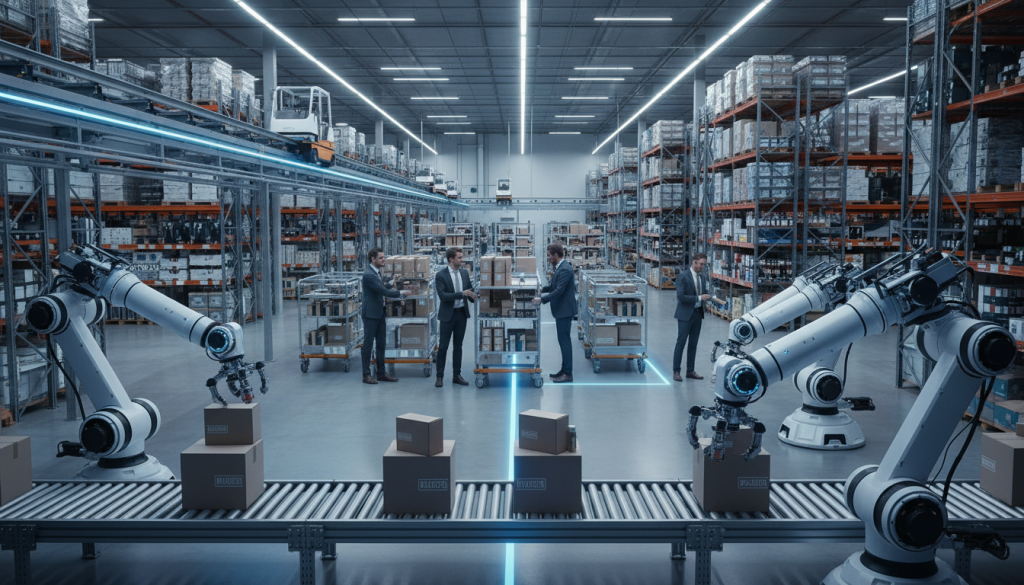
Labor economics drive investment in automation. UK retailers have adopted automation to address rising labor costs and improve efficiency. This trend reflects broader pressure on warehouse budgets. For U.S. operators, the same cost curve strengthens the case for capital projects that stabilize unit costs per order.
Supply chain innovation is also transforming how facilities handle peaks. Automated conveyors, goods-to-person stations, and robotic palletizing increase throughput without the need for extensive training. This supports service levels during demand spikes or when inbound flows become uneven.
| Warehouse Activity | Typical Automated Approach | Operational Effect | Risk and Safety Impact |
|---|---|---|---|
| Sorting | Automated sortation with barcode or vision reads | Higher throughput and consistent lane accuracy | Less manual lifting and fewer conveyor pinch-point exposures |
| Packing | Automated carton sizing, print-and-apply labeling, checkweighing | Lower error rates and tighter shipping compliance | Reduced repetitive motion and fewer mislabeled hazardous shipments |
| Inventory management | RFID, autonomous cycle counting, WMS-directed putaway | Improved inventory accuracy and faster exception resolution | Fewer forklift miles and fewer aisle conflicts |
| Peak-capacity management | Modular automation cells and flexible labor scheduling around fixed automation | Scalable output with more stable cost per unit | Less congestion during high-volume shifts |
Supply chain automation supports safer operations by reducing manual handling in high-velocity zones. It also improves slotting, travel paths, and dock-to-stock cycle time as data quality rises. Supply chain innovation builds on this foundation, using performance data to refine workflows and maintain consistent fulfillment under volatile demand.
Resilience-First Supply Chain Strategies Expand Beyond Cost-Only Thinking
Resilience is now a fundamental aspect of business operations, not just an afterthought. In the evolving landscape of supply chain planning, leaders are now evaluating continuity risk alongside traditional metrics like unit cost and service levels. This shift emphasizes the importance of inventory cash flow.
This change impacts procurement, network design, and capacity decisions profoundly. It nudges supply chain optimization towards stress tests, scenario planning, and quicker response times across suppliers and carriers. This approach ensures the supply chain can adapt swiftly to disruptions.
Multi-sourcing to reduce dependency risk
Adopting multi-sourcing strategies helps mitigate the risks associated with relying on a single supplier. When disruptions occur, having multiple sources ensures that production and inventory replenishment continue with minimal interruption. This method is critical for maintaining supply chain continuity under tight timelines.
Recent studies by the Federal Reserve highlight the dangers of concentrated supply chains. Such systems are more susceptible to disruptions caused by capacity constraints and geopolitical tensions. As a result, supply chain innovation now encompasses qualifying multiple sources, focusing beyond mere price negotiations.
| Resilience lever | Operational mechanism | Primary risk reduced | Typical trade-off |
|---|---|---|---|
| Dual or multi-sourcing | Split volumes across approved suppliers with shared specs and quality plans | Single-point-of-failure disruptions | Higher qualification and management effort |
| Contracted surge capacity | Pre-negotiated options for extra output or expedited logistics | Demand spikes and short-term shortages | Premium pricing during activation |
| Supplier financial and capacity monitoring | Ongoing risk scoring using delivery, quality, and lead-time signals | Silent deterioration before a failure | More data integration work |
Nearshoring and regionalization for responsiveness
Nearshoring and regionalization strategies aim to reduce lead times and minimize exposure to long-distance routes. These approaches are essential for quick inventory replenishment during demand shifts, port congestion, or trade policy changes.
U.S. Census Bureau data underscore the growing demand for rapid fulfillment in key consumer segments. This demand highlights the importance of regional capacity. Flexible facilities and modular processes enable scalable output, improving responsiveness without requiring a complete network overhaul.
As companies reconfigure their footprints, supply chain optimization focuses on total landed cost, variability, and service risk by region. The operational playbook increasingly incorporates contract manufacturing, postponement, and regional distribution to meet evolving performance targets.
Balancing cost vs. resilience
Executives face a significant challenge: balancing resilience spending with margin goals. The cost vs. resilience balancing act is a critical aspect of leadership, as it involves justifying investments that treat supply chains as more than mere cost centers. This includes funding diversified networks, flexible infrastructure, and innovation.
AI plays a vital role in resilience design. It enhances risk sensing, forecasting, and network scenario modeling, strengthening the business case for resilience-enhancing changes. This ensures supply chain optimization remains disciplined and measurable.
Sustainability in Supply Chain Shifts From Reporting to Redesign
Sustainability in supply chain is evolving from annual reports to daily operations. In the United States, there’s growing pressure from regulators, investors, and consumers to reduce emissions. This includes transport, energy use, and materials. Now, environmental performance is tracked alongside cost, service, and lead time.
A Rutgers report highlights that 97% of investors review supply chain sustainability before investing. This scrutiny makes climate and human rights exposure essential in daily operations. It also emphasizes the need for robust audit trails, supplier controls, and verified data.
The United Nations Global Compact notes that supply chain practices are the biggest hurdle to sustainability. The complexity and scale of supply chains make it challenging to monitor beyond tier-one suppliers. Supply chain digitalization helps by extending data capture and monitoring across multiple tiers.
Circular economy demands introduce direct operational constraints. It requires changes in sourcing, packaging, production, and end-of-life management. These changes also spur innovation in reverse logistics, repair workflows, and the use of recycled materials.
Data-driven methods are key to executing these changes at scale. AI and predictive analytics help identify emissions hotspots and prioritize supplier actions. Digital twins test scenarios before implementation. This, combined with optimization and resilience planning, enables teams to weigh cost, service, and sustainability trade-offs.
| Design lever | What changes in operations | Data required | Where supply chain innovation shows up |
|---|---|---|---|
| Supplier tier expansion | Multi-tier onboarding, monitoring, and remediation workflows | Tier mapping, facility attributes, audit results, incident logs | Shared supplier scorecards and standardized corrective-action cycles |
| Transport and network choices | Mode shifts, consolidation rules, and lane redesign tied to carbon targets | Shipment telemetry, carrier performance, fuel and emissions factors | Optimization that balances cost, on-time delivery, and sustainability in supply chain |
| Circular material flows | Returns grading, refurbish routing, and recycling partnerships | Serial-level traceability, condition data, recovery yield rates | Profitable reverse logistics supported by supply chain digitalization |
| Product and packaging standards | Redesigned specs for recycled content, lower weight, and safer materials | BOM data, supplier certificates, lifecycle metrics, defect rates | Faster design-to-sourcing cycles aligned with circular economy goals |
Last-Mile Delivery Innovation Becomes Central to Customer Experience
Last-mile delivery now shapes how buyers judge reliability, speed, and value. Many logistics teams treat it as the most visible part of technology in supply chain, where service promises meet real-world constraints. This focus is also pushing supply chain innovation, as small gains can protect margin and brand trust.
In the U.S., the math is clear. The U.S. Department of Transportation reports the last mile can account for more than 50% of shipping costs. This makes last-mile redesign a direct lever for supply chain optimization across labor, miles driven, and failed delivery attempts.
Why last-mile economics are driving change
Urban density, higher parcel volumes, and tighter delivery windows increase stop costs and route complexity. Carriers also face rising wages, insurance, and fuel volatility, which amplifies the cost of each additional minute at the curb.
Retailers are responding with new cutoff times, pickup options, and tighter delivery slot controls. These moves signal supply chain innovation aimed at lowering re-deliveries and improving drop density.
Drones, autonomous vehicles, and AI route optimization
Drones are being deployed where roads slow service, including congested corridors and hard-to-reach areas. They also support monitoring tasks such as inventory checks and infrastructure observation using real-time imaging data, extending technology in supply chain beyond delivery alone.
Autonomous vehicles and delivery robots target efficient, contactless handoffs at scale, with benefits for cost control and safety. In parallel, AI route tools evaluate traffic, weather, and demand signals to adjust sequences in near real time, supporting supply chain optimization while also reducing emissions from idling and detours.
| Last-mile approach | Best-fit operating conditions | Primary cost driver addressed | Operational trade-offs to manage |
|---|---|---|---|
| AI-powered dynamic route optimization | High stop density, variable traffic, tight time windows | Miles per stop, driver time, missed delivery costs | Data quality, integration with dispatch and proof-of-delivery systems |
| Drones for targeted drops and monitoring | Congested areas, remote delivery points, urgent small parcels | Travel time to hard-to-reach addresses, inspection labor | Payload limits, airspace rules, weather sensitivity |
| Autonomous vehicles and sidewalk robots | Repeat routes, campuses, planned neighborhoods, retail districts | Labor per stop, contactless delivery handling time | Edge-case safety, supervision needs, local permitting |
Delivery performance as a retention lever
Customer tolerance is limited when delivery fails. Research cited in industry reporting shows 84% of customers would abandon a retailer after a single poor delivery experience, tying last-mile execution directly to retention risk.
Service design also affects sustainability outcomes in dense U.S. metros. Better routing, fewer failed drops, and redesigned delivery models can cut emissions while keeping delivery promises consistent, reinforcing supply chain innovation and practical technology in supply chain without changing the buyer’s checkout flow.
Conclusion
Supply chain management is undergoing a significant transformation, shifting from periodic planning to continuous execution. AI and machine learning are now integral, enabling better forecasting, dynamic routing, and swift responses to disruptions. IoT sensors provide real-time data on location and condition, while predictive maintenance minimizes unplanned downtime.
Blockchain is also a key player, ensuring traceability and audit integrity across the supply chain. Cloud platforms and digital twins further enhance this by facilitating partner orchestration and scenario testing. This combination forms a robust technology stack, built on connected data and continuous optimization.
The way we operate is evolving, with a focus on resilience over cost savings. Strategies like multi-sourcing, nearshoring, and flexible capacity aim to reduce dependency risks. Leaders are now expected to quantify the cost-resilience tradeoff, using data on risk exposure and service-level impacts.
There’s also a growing emphasis on sustainability in supply chain management. Investor scrutiny is increasing, with 97% of investors demanding corporate disclosures on sustainability. The UN Global Compact has highlighted the need for stronger supplier data and controls due to visibility limitations. Circular economy practices are reshaping sourcing, production, and end-of-life decisions, underscoring the importance of continuous improvement in supply chain innovation.
FAQ
What are the top emerging trends in supply chain management right now?
The latest trends in supply chain management include AI/ML, end-to-end visibility, and cloud-based digital supply networks. Digital twins, IoT tracking, and blockchain traceability are also key. Supply chain automation, resilience-first network design, and sustainability through decarbonization and circular economy models are also emerging. These trends are moving from pilots to scaled operating standards, affecting planning, execution, compliance, and customer service.
Why is the future of supply chain management changing so quickly?
Recent stress tests have exposed limits in legacy planning, visibility, and risk response. The pandemic, geopolitical tensions, and digital transformation have accelerated these changes. Harvard Magazine notes that supply chains now rely heavily on data infrastructure and analytics. Leaders are expanding success metrics to include risk governance, transparency, and service reliability.
How is AI improving demand forecasting and inventory decisions?
AI-driven forecasting analyzes large datasets to detect patterns and anomalies, signaling disruptions early. This improves inventory alignment and reduces overstocking and stockouts. Research shows 40% of supply chains are investing in generative AI for optimization in key areas.
What does “Connected Intelligence” mean for supply chain and procurement teams?
“Connected Intelligence” refers to AI that links supply chain operations with procurement, finance, and other areas. By 2026, AI is expected to scale into embedded platforms for planning and risk management. Agentic AI will execute tasks like supplier evaluation and contract review, improving efficiency.
Why is end-to-end supply chain visibility now treated as a baseline?
Global supply chain professionals see end-to-end visibility as the top trend. Gartner highlights it as a key investment area. It means knowing conditions and status across the supply chain through real-time data sharing. This improves exception management and strengthens delivery commitments.
How do digital twins and cloud orchestration platforms improve supply chain performance?
Cloud-based orchestration platforms enhance partner collaboration and data sharing. Digital twins simulate supply chain systems to test scenarios and predict disruptions. Walmart has implemented digital twin technology to optimize store layouts and operations.
Why can slowing investment in supply chain digitalization increase risk?
Investment in supply chain digitization has slowed from 7% to 2% in 2024. Slower investment can leave organizations exposed to disruption and competitive disadvantage. Modernization that stalls can widen visibility gaps and weaken response capability.
Where does blockchain deliver the most value in supply chain management?
Blockchain is most valuable in industries with strict compliance and quality assurance. It supports product authenticity and traceability from origin to consumer. In multi-tier supplier networks, blockchain reduces trust friction and process inefficiencies.
How does IoT condition monitoring reduce disruptions and claims?
IoT sensors track location, temperature, and humidity in transit. This reduces spoilage, damage, and customer claims. IoT data feeds analytics and ML models for anomaly detection and predictive maintenance.
What is driving supply chain automation in warehouses and fulfillment centers?
Advanced robotics and automated systems are being deployed for sorting, packing, and inventory management. Labor constraints and rising operating costs drive adoption. UK retailers are adopting automation to address rising labor costs and improve efficiency.
How are resilience-first strategies changing network design decisions?
Resilience-first design emphasizes multi-sourcing, nearshoring, and flexible capacity. Forbes notes the need to justify investment in supply chain as a growth and risk-management function. AI supports dynamic network decisions like routing and location choices.
Why is sustainability in supply chain shifting from reporting to redesign?
Sustainability is now a core operating metric alongside cost and speed. Investors review supply chain sustainability when making decisions. The United Nations Global Compact highlights the challenge of visibility beyond tier-one suppliers in achieving sustainability.
Why is last-mile delivery innovation a core supply chain priority?
The last mile accounts for more than 50% of shipping costs. AI route optimization and drones/autonomous vehicles are key technologies. Performance directly affects revenue retention, with 84% of customers abandoning retailers after a poor delivery experience.