

Custom Logistics Software Development Solutions
In the United States, logistics leaders face significant challenges. They must navigate tighter delivery windows, volatile freight rates, and rising labor costs. Logistics software development has evolved from an IT project to a governance tool. It aims to improve speed, control costs, and enhance service performance.
The objective is clear: reduce friction in purchasing, warehousing, transportation, and customer delivery. This must be done without sacrificing auditability.
Custom logistics and supply chain platforms are tailored to an organization’s unique processes and data. Unlike packaged systems, they don’t force teams into preset workflows. Instead, they are engineered to align with carrier rules, SKU logic, yard constraints, and customer SLAs.
This alignment is critical, given that exceptions often drive a significant portion of daily work.
The focus remains on achieving business outcomes. This includes automating manual steps, streamlining approvals, and gaining real-time operational visibility. Such visibility reduces errors and enables faster decision-making.
The article also outlines the solution areas U.S. teams commonly address in logistics software development. These include inventory management, order processing, transportation optimization, demand forecasting, and warehouse management.
It extends beyond core execution systems to enterprise platforms and reporting layers. Finance and compliance teams rely on these. Readers will learn how industry-specific software solutions integrate ERP, HR, accounting, documentation management, analytics and BI, and sustainability platforms. This integration improves control from dock to ledger.
What Custom Logistics & Supply Chain Software Is and Why It Matters
Custom logistics and supply chain software is tailored to a company’s specific needs. It considers actual lanes, service rules, facility limits, and customer commitments. For U.S. operators, this means fewer manual workarounds and cleaner data from the start.
Unlike generic platforms, customized logistics applications are engineered to match specific decision logic. They can reflect how orders are released, how exceptions are handled, and how performance is measured. This precision is critical when volumes rise or network complexity increases.
How custom solutions differ from off-the-shelf logistics tools
Off-the-shelf tools are designed for broad use cases. They can “almost fit,” but the last 10% often creates friction in workflows, data structures, and approvals. Teams then rely on spreadsheets, email threads, or custom scripts to bridge gaps.
In contrast, supply chain software solutions built to order can encode specialized handling rules, EDI requirements, and customer-specific SLAs. This reduces mismatched fields, duplicate entry, and exception noise that slows execution.
| Decision Area | Off-the-Shelf Pattern | Custom Build Pattern |
|---|---|---|
| Workflow steps | Fixed screens and standard statuses; changes depend on vendor roadmap | Steps reflect actual dispatch, dock, and billing procedures; updates follow business change control |
| Data model | Pre-set master data; add-ons can fragment item, location, and customer records | Unified definitions for SKUs, locations, carriers, and accessorials aligned to reporting needs |
| Decision logic | Generic constraints; exceptions handled outside the system | Rules-based automation for cutoffs, capacity, temperature control, and priority routing |
| Scalability | Scaling may require module upgrades or platform migration | Architecture supports growth in volume, nodes, and channels with planned extensions |
Core capabilities: inventory management, order processing, transportation optimization, demand forecasting, and warehouse management
Most custom programs start with a functional baseline that supports daily execution. This baseline typically includes inventory management, order processing, transportation optimization, demand forecasting, and warehouse management.
Inventory management to improve stock accuracy, lot tracking, and replenishment signals.
Order processing to reduce rekeying, enforce validation rules, and manage exceptions early.
Transportation optimization to select modes, build loads, and balance cost with service targets.
Demand forecasting to align purchasing and labor plans with expected volume swings.
Warehouse management to control receiving, putaway, picking, packing, and shipping logic.
When these functions share a consistent data layer, analytics and KPI reporting become more stable. This allows planners and finance teams to compare performance across facilities, lanes, and customers without constant reconciliation.
How tailor-made software supports unique workflows and operational constraints
Many networks operate with constraints that standard tools do not model well. Examples include tight dock schedules, multi-leg transfers, customer-specific packaging rules, and regional carrier restrictions. Customized logistics applications can incorporate these constraints directly into validations and automated decisions.
From an economic view, custom systems are designed for flexibility over time. As nodes are added, service levels change, or product mix shifts, supply chain software solutions can be modified without forcing a disruptive migration. This supports continuity in training, data governance, and process control as the operating model evolves.
Key Business Benefits: Efficiency, Cost Reduction, and Customer Service
In U.S. logistics, speed and accuracy hinge on data flow across teams. Strong logistics software development ensures orders, inventory, and shipments stay in sync. A transportation management system enhances control by integrating planning, execution, and carrier updates into one workflow.
Improving efficiency with automation, streamlined workflows, and real-time visibility
Efficiency boosts when tasks move from email and spreadsheets to automated systems. Automation minimizes handoffs, standardizes approvals, and reduces rework due to errors. With a focus on exception handling, teams spend less time on status updates and more on solving real issues.
Real-time visibility aids in quicker dispatch decisions and tighter dock scheduling. A transportation management system highlights late pickups, capacity gaps, and dwell time. This shortens response times and limits avoidable service failures.
Reducing costs through better inventory levels, forecasting accuracy, and strategic routing
Cost pressure often begins with inventory. Better inventory targets reduce carrying costs while maintaining service levels, even when demand shifts. When logistics software development connects sales, replenishment, and warehouse signals, planners can adjust faster, reducing stockouts that trigger premium freight.
Transportation spend is influenced by routing discipline. A transportation management system supports lane optimization, mode selection, and load consolidation using consistent constraints. Automation, combined with these controls, reduces labor in planning and minimizes manual interventions.
Customer experience gains from real-time tracking and accurate delivery estimates
Customer service improves with updates before the customer asks. Real-time tracking and accurate delivery estimates enable proactive notifications and cleaner appointment management. A transportation management system also reduces exception-handling costs by routing issues to the right owner with clear timestamps and status codes.
McKinsey reports that high-performing logistics companies enhance service and reduce expenses by simplifying and standardizing procedures. Logistics software development supports this by enforcing standard workflows while capturing operational nuances.
What enhanced supply chain visibility can deliver, including reported 7% cost reduction outcomes
Visibility directly links to ROI modeling by reducing planning and execution uncertainty. One study found that enhanced supply chain visibility alone resulted in a 7% cost reduction. This frames visibility as a measurable lever, not just a reporting feature. A transportation management system contributes by improving event capture and shipment-level traceability across carriers and facilities.
For many teams, defining what “visible” means operationally is the first step. The table below maps common visibility signals to decisions that affect cost, speed, and service.
| Visibility signal | Where it comes from | Operational decision it supports | Benefit to measure |
|---|---|---|---|
| Shipment milestones (pickup, in-transit, delivered) | Carrier EDI/API updates within a transportation management system | Proactive exception management and customer notification timing | Fewer late deliveries and fewer inbound “where is my order” calls |
| Inventory availability by location | WMS/ERP feeds aligned through logistics software development | Order sourcing and replenishment prioritization | Lower stockouts and reduced expedited freight |
| Dwell and detention time at facilities | Gate events, appointment data, and mobile check-ins | Dock scheduling changes and carrier performance reviews | Lower accessorial charges and better trailer turn time |
| Forecast error by SKU and region | Demand planning outputs tied to execution data | Safety stock tuning and purchase timing | Reduced carrying cost with maintained fill rates |
| Lane cost and service variance | Historical tender, rate, and delivery data | Routing guide updates and mode selection thresholds | More stable transportation spend and better on-time performance |
logistics software development for US Logistics Teams: Build vs Buy Considerations
In the U.S., the decision between building and buying logistics software often hinges on speed versus fit. While packaged tools can quickly deploy, they may struggle with complex operations spanning multiple terminals and carriers. The hidden cost of such systems lies in the rework needed when they don’t align with real-world operations.
Industry-specific software solutions generally excel when they mirror the unique challenges of logistics, such as dock schedules and accessorial charges. The choice between these options becomes clearer when teams consider not just the initial cost but also the ongoing effort required for integration, training, and data flow across various systems.
When off-the-shelf software “almost fits” and where it typically breaks down
Standard platforms can handle basic tasks like dispatch and tracking. Yet, they often falter in handling unique scenarios, such as multi-leg moves and customer-specific SLAs. Each workaround introduces manual steps, which can compromise scan accuracy and cycle time.
Integration issues are another common problem. When APIs are limited or data definitions vary, teams may face duplicate data and delayed updates. In such cases, bespoke solutions might seem like a custom build, despite the higher costs.
Evaluating the tradeoff between cost and control for bespoke builds
Bespoke solutions require an initial investment but can streamline operations when processes are unique. Evaluating the total cost of ownership is key, including implementation, integrations, and ongoing support. Control over the software’s future development is also a significant factor, allowing for adaptability to new lanes and compliance rules.
| Decision factor | Buy (commercial platform) | Build (custom product) |
|---|---|---|
| Time to first rollout | Often faster for standard workflows; depends on configuration scope | Planned delivery cycles; early value can ship in two-week increments |
| Process fit | Strong for common use cases; exceptions handled by workarounds | Designed around operational constraints and customer contracts |
| Integration effort | Varies by API/EDI maturity; may require middleware and data mapping | Interfaces built to existing ERP, WMS, TMS, accounting, and telematics needs |
| Change control | Vendor roadmap and release cadence; customization limits apply | Full control of backlog, priority, and release timing |
| Cost profile | Lower upfront; recurring licenses and add-on modules | Higher upfront; spend concentrates on delivery and long-term enhancement |
Why understanding real user workflows can reveal more efficient processes
Direct observation of user workflows can uncover inefficiencies missed in meetings. By watching how dispatchers handle exceptions and how warehouse staff resolve shortages, teams can identify areas for improvement. This approach often leads to simpler interfaces, fewer handoffs, and more accurate data capture.
This method supports the development of industry-specific software that aligns with real-world operations. It reduces the risk of automating inefficient processes and locking them in.
How transparent delivery and budget tracking reduce surprises during development
Effective management of delivery processes can significantly reduce risk. Atomic Object advocates for interdisciplinary teams that combine design, development, and delivery leadership. This structure improves coordination, shortens feedback loops, and enhances overall efficiency.
Financial controls are equally important. Teams that track progress against their budget can identify scope changes early and adjust priorities before costs escalate. In logistics software development, delivering in two-week increments ensures that the work remains testable and adaptable to user feedback.
Supply Chain Software Solutions and Core Modules to Include
Effective supply chain software solutions are built around the execution loop: plan, execute, see what is happening, and resolve exceptions fast. Module selection works best when it is tied to measurable workflows, such as dock-to-delivery time, on-time delivery, and inventory accuracy. Teams also need fit-to-operations constraints, including service areas, customer cutoff times, carrier rules, and warehouse capacity.
Visibility is a shared requirement across modules. Real-time status, alerts, and clean audit trails support proactive customer updates and more accurate delivery estimates. This structure also supports exception handling, where late pickups, missed scans, and short ships are flagged early enough to fix.
Transportation management system features for route planning and delivery performance
A transportation management module should prioritize routing logic that reflects business rules, not just shortest distance. Common needs include multi-stop routing, time windows, driver hours, and zone-based pricing. Analytics-enabled routing is often used to reduce delivery times and fuel consumption while improving asset utilization.
Execution controls matter as much as planning. Dispatch workflows, proof-of-delivery capture, and automated exception alerts help teams respond when conditions change. Performance reporting should track on-time delivery, dwell time, and cost per stop to support operational reviews.
Freight management software for rating, tendering, carrier collaboration, and shipment visibility
Freight management software is typically evaluated on how well it supports rating, tendering, and carrier communication at scale. Contract and spot rate management should align to mode, lane, and accessorial logic. Tendering should support acceptance workflows, backup carrier rules, and clear rejection reasons to reduce manual follow-ups.
Shipment visibility improves when status updates are standardized and tied to milestones, such as pickup, arrival, and delivered. Carrier scorecards can then be based on consistent metrics like on-time pickup, claims rate, and invoice accuracy. This creates cleaner collaboration without adding extra steps for the operations team.
Inventory tracking system essentials for stock accuracy and replenishment planning
An inventory tracking system should focus on accuracy first: item master discipline, lot or serial tracking where needed, and real-time adjustments tied to scans and cycle counts. Stock accuracy supports better replenishment decisions and fewer expedited shipments. It also reduces write-offs caused by aging, damage, or mispicks.
Replenishment planning improves when forecasting and reorder logic reflect lead times, service levels, and supplier reliability. Better inventory levels can reduce carrying costs and lower the risk of stockouts. This is most effective when demand signals are shared across sales orders, transfers, and production needs.
Order processing software to reduce manual work and fulfillment errors
Order processing software should reduce rekeying and standardize data capture from order entry through fulfillment. Validations for addresses, item availability, and promised ship dates lower the error rate before work reaches the floor. Automation also helps when orders change, such as partial shipments, substitutions, or backorders.
Integration is a practical requirement, not a feature request. Order flows often touch ERP, customer portals, EDI transactions, and warehouse workflows. When the handoffs are consistent, teams spend less time reconciling discrepancies and more time meeting service targets.
| Module | Primary workflow supported | Operational KPIs influenced | Data and visibility requirements |
|---|---|---|---|
| Transportation management | Route planning, dispatch, delivery execution, exception handling | On-time delivery, cost per mile, cost per stop, dwell time | Stop-level milestones, geocodes, driver availability, capacity constraints, event timestamps |
| Freight management software | Rating, tendering, carrier communication, shipment monitoring | Tender acceptance rate, on-time pickup, claims rate, invoice accuracy | Lane and contract data, accessorial rules, carrier status messages, audit trail for changes |
| Inventory tracking system | Receiving, putaway updates, cycle counts, replenishment triggers | Inventory accuracy, fill rate, stockout rate, inventory turns | Scan events, location hierarchy, lot/serial attributes, lead times, safety stock parameters |
| Order processing software | Order capture, validation, allocation, fulfillment handoff | Order cycle time, error rate, perfect order rate, backorder volume | Customer rules, item availability, promise dates, change logs, integration events to downstream systems |
Warehouse Automation Technology and Warehouse Operations Optimization
Warehouse performance hinges on the precision of tasks executed on the floor. When cycle times increase, it often stems from variability in task execution. Implementing warehouse automation technology, combined with tailored logistics applications, can standardize tasks. This approach reduces rework in high-volume lanes.
Warehouse management workflows to target
Operational variance typically manifests in five stages: receiving, putaway, picking, packing, and shipping. Each stage introduces scan events, location moves, and exception paths. Customized logistics applications enforce rules for labeling, slotting, and cartonization. This reduces reliance on memory and tribal knowledge.
Receiving: confirm ASN quantities, capture lot/serial data, and route exceptions to a defined hold area.
Putaway: apply directed putaway based on velocity, cube, and hazard class to limit travel time.
Picking: use zone logic and pick-path sequencing to reduce steps per line.
Packing: validate items and quantities before close-out to reduce chargebacks and returns.
Shipping: confirm carrier service levels, print compliant labels, and lock trailer loads to stop last-minute swaps.
Automation opportunities that cut errors and speed throughput
Error rates increase when operators switch between paper, radios, and spreadsheets. Warehouse automation technology embeds validation into workflows. This includes scan-to-confirm steps, guided tasks on mobile devices, and automated exception routing.
Throughput gains come from fewer touches and shorter travel times. High-frequency tasks like replenishment triggers, pick confirmation, and pack verification are often the starting point. Customized logistics applications can also coordinate automation assets, such as conveyor sortation and print-and-apply labeling, without altering the upstream order system.
Real-time visibility for inventory and labor planning across the warehouse floor
Real-time visibility changes how supervisors allocate labor. Managers can rebalance staff based on queue depth by zone and open exceptions by type. This prevents service levels from degrading.
Warehouse automation technology strengthens this control loop by capturing time-stamped task events. Customized logistics applications translate these events into operational signals—backlog risk, aging orders, and labor utilization. This way, planning reflects actual conditions, not just end-of-shift reports.
| Workflow stage | Common variability source | Automation and software control | Operational metric affected |
|---|---|---|---|
| Receiving | Unverified quantities, missing lot/serial data, unclear exception handling | Scan-based validation, automated discrepancy flags, structured hold workflows in customized logistics applications | Dock-to-stock time, inventory accuracy |
| Putaway | Ad hoc slot choices, overfilled locations, poor velocity placement | Directed putaway rules, capacity checks, and task interleaving supported by warehouse automation technology | Travel time, space utilization |
| Picking | Mis-picks, long walking paths, unmanaged zone workload | Pick-path optimization, scan-to-confirm, wave or waveless orchestration through customized logistics applications | Lines per hour, pick accuracy |
| Packing | Wrong item in carton, incomplete orders, inconsistent dunnage use | Pack verification, cartonization rules, and automated label generation aligned with warehouse automation technology | Ship accuracy, damage and returns rate |
| Shipping | Late staging, service level mismatches, last-minute load changes | Gate checks, trailer load controls, and shipment status events managed in customized logistics applications | On-time ship rate, carrier compliance |
Enterprise Platforms: ERP, HR, Accounting, and Documentation Management in Logistics
Enterprise platforms streamline operations by reducing handoffs between teams and systems. This approach minimizes rework, enhances audit trails, and accelerates decision-making in logistics.
Supply chain software solutions now integrate operations and finance data. This allows managers to make decisions based on a unified set of numbers. The best solutions also reflect the real-world operations of freight, warehousing, and customer service.
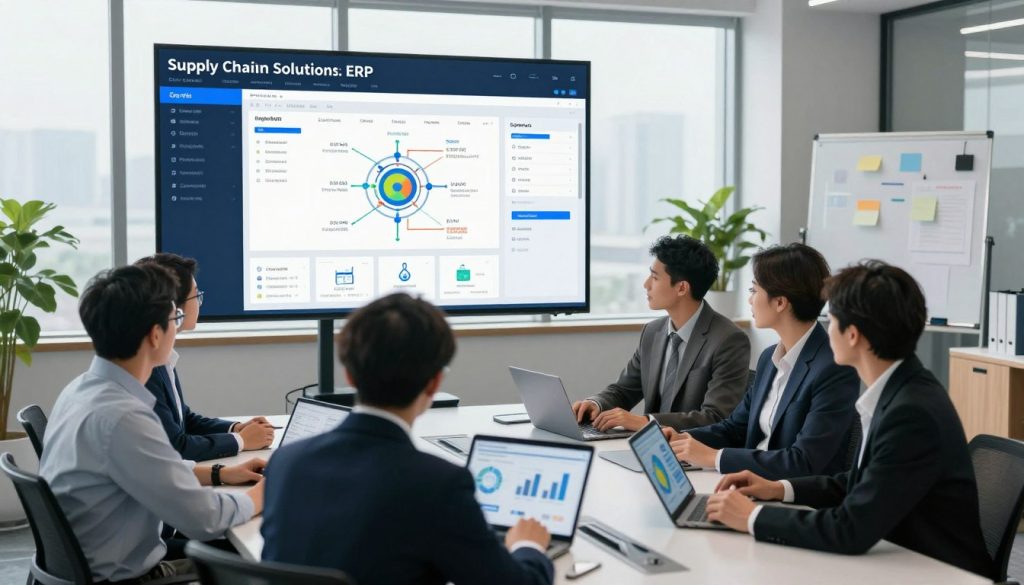
ERP for logistics service providers: centralizing fleet, warehouse, customer service, asset maintenance, HR, and accounting
An ERP platform centralizes management of fleet, warehouse, customer service, asset maintenance, human resources, and accounting. It uses a single data model to eliminate duplicate records and conflicting status updates.
This design supports governance through role-based access, standardized master data, and traceable approvals. It also limits spreadsheet drift, which can hide margin leakage and service failures.
Human resources management: optimized staff allocation and dynamic task assignment based on fulfillment needs
HR tools in logistics focus on shift coverage and throughput. Optimized staff allocation matches labor to demand based on order volume, pick density, and dock schedules.
Dynamic task assignment routes work to trained staff as constraints change. Many solutions also include performance monitoring and training management to support cross-functional roles.
Accounting automation: AP/AR, invoicing, bank reconciliation, tax reporting, and financial close management
Accounting automation targets repeatable finance work where errors are costly. It includes AP/AR calculation, invoicing, bank reconciliation, tax reporting, and financial close management.
When costs and revenue tie back to shipment, lane, and customer attributes, finance can evaluate operating margin with fewer manual adjustments. This linkage is a common requirement in supply chain software solutions used by U.S. logistics teams.
Documentation management for invoices, contracts, and bills of lading with metadata tagging, digital signatures, archiving, and search filters
Documentation tools manage the lifecycle of invoices, contracts, and bills of lading from draft to approval to storage. Metadata tagging improves retrieval speed during claims, audits, and customer disputes.
Digital signatures, automated archiving, and search filters support compliance and reduce cycle time. In industry-specific software solutions, document types and fields can be configured to match carrier rules, customer SLAs, and internal controls.
| Enterprise function | Operational focus in logistics | Controls and data features | Common outputs used by managers |
|---|---|---|---|
| ERP core | One workflow across fleet, warehouse, customer service, maintenance, HR, and accounting | Master data governance, role-based access, standardized statuses, approval routing | Unified order-to-cash view, asset utilization, service exceptions by location |
| HR management | Labor planning for shifts, waves, and dock appointments | Skills matrix, dynamic task assignment, performance metrics, training records | Coverage gaps, productivity by role, training needs by site |
| Accounting automation | Higher control over cash flow and cost attribution | AP/AR rules, invoice validation, reconciliation logic, close checklists, audit logs | Accrual accuracy, margin by customer or lane, faster period close |
| Documentation management | Faster creation, approval, and retrieval of shipment records | Metadata tags, digital signatures, retention policies, immutable archives, search filters | Claim support packets, audit-ready files, quicker dispute resolution |
Data Analytics, BI, and Sustainability Platforms for Modern Logistics
Modern logistics teams rely on analytics to turn raw events into measurable performance. A transportation management system and freight management software generate clean shipment, carrier, and cost records. These records are then modeled by BI tools for weekly planning.
Monitoring supplier KPIs to improve sourcing and procurement decisions
Supplier scorecards perform best when KPIs map to outcomes that procurement can control. These include landed cost, on-time delivery, damage rates, and claim cycle time. Freight management software captures tender responses and accessorial drivers, allowing teams to separate true price from avoidable cost.
Analysts track lead-time variance and fill rate alongside chargebacks and service credits. This mix supports sourcing decisions that balance price, service, and risk.
Demand forecasting to support smarter restocking operations
Forecasting links sales signals, promotions, and seasonality to reorder points and safety stock. When a transportation management system shares transit-time distributions by lane, planners can set buffers based on actual variability, not assumptions.
Better forecast accuracy reduces stockouts and prevents excess inventory that ties up working capital. It also stabilizes warehouse labor plans by smoothing inbound peaks.
Anomaly detection for predictive vehicle maintenance and fewer disruptions
Anomaly detection flags early shifts in engine temperature, vibration, fault codes, and fuel burn. Maintenance teams can schedule repairs before a roadside event disrupts service.
Asset utilization improves when downtime is planned and parts are staged. Dispatch data from a transportation management system helps quantify the cost of disruption by route and customer priority.
Data-driven routing to reduce delivery times and fuel consumption
Routing analytics weigh stop density, time windows, dwell time, and historical traffic patterns. A transportation management system can then apply those variables to build routes that protect service targets while reducing empty miles.
Freight management software adds carrier capacity signals and rate history, which helps teams avoid last-minute premium moves. Over time, lane-level performance data supports tighter bid strategy and fewer exceptions.
Sustainability platforms for life-cycle assessment, emissions measurement, and carbon accounting to support compliance goals
Sustainability platforms treat emissions data as operational reporting, not branding. They pull activity data from freight management software, apply emissions factors, and produce auditable logs for carbon accounting.
Life-cycle assessment expands the view beyond a single shipment, including packaging, returns, and warehousing energy use. Emissions measurement by mode, lane, and carrier supports internal controls and compliance reporting without slowing daily execution.
| Analytics Focus | Primary Data Inputs | Operational Use | What Gets Measured |
|---|---|---|---|
| Supplier KPI monitoring | On-time delivery, defect and damage events, tender acceptance, accessorial detail | Sourcing decisions, contract terms, performance remediation | Cost-to-serve, service level, variability, claims cycle time |
| Demand forecasting | Order history, promotions, seasonality, lead-time distributions, transit variance | Reorder points, safety stock, inbound labor planning | Forecast error, stockout rate, carrying cost exposure |
| Predictive maintenance | Telematics, fault codes, fuel burn, utilization, driver-reported issues | Planned shop scheduling, parts staging, reduced roadside events | Mean time between failures, downtime hours, maintenance cost per mile |
| Routing optimization | Stop times, time windows, historical traffic, dwell time, lane performance | Route builds, dispatch planning, exception management | On-time performance, miles per stop, fuel consumption per route |
| Sustainability and compliance | Shipment activity, mode and distance, facility energy use, packaging and returns data | Emissions reporting, audit trails, carbon accounting controls | CO2e by lane and mode, intensity per shipment, variance by carrier |
Custom Application Development Process for Customized Logistics Applications
Creating strong customized logistics applications begins with a clear process, not just a list of features. In logistics software development, teams start by mapping out how work is done today. They then shape what needs to change. This approach keeps the project’s scope and budget in check.
Idea validation
Idea validation is the foundation for understanding the project’s scope and return on investment. Teams document the requirements and review current workflows. They also note any constraints, such as time limits, carrier rules, and dock capacity.
Feasibility checks are conducted to ensure integration, data quality, and security needs are met. The outcome is a prioritized backlog. This backlog supports the development of customized logistics applications without introducing unnecessary delays.
Innovation and development
Innovation and development involve translating workflows into screens, roles, and approvals. Engineers then code services, build data models, and connect to existing tools like ERP, EDI, TMS, and telematics.
This stage also includes tailoring business rules. For example, rate logic, exception handling, and automated status updates are customized to match the network’s operating rhythm.
Software testing
Testing is critical to ensure reliability before deployment. Functional testing verifies each feature works as intended. User acceptance testing ensures that dispatchers, warehouse leads, and customer service can perform real tasks.
Load testing measures performance under peak conditions. Vulnerability assessments support security controls for customer data, driver identities, and shipment documents used in customized logistics applications.
Project governance
Governance ensures predictable delivery and high adoption rates. User training programs are scheduled by role. Support setup defines ticket routing, response targets, and release notes.
A feedback loop for continuous improvement captures defects, enhancement requests, and policy changes. Delivery transparency tracks progress against the remaining budget and identifies risks early to prevent financial surprises during logistics software development.
Iterative releases
Iterative releases reduce time-to-value by shipping usable increments. Atomic Object reports releasing software in two-week increments. This allows for user feedback incorporation while controlling scope drift.
This cadence also fosters a steady rhythm for testing, training refreshers, and change management. It’s often the difference between software that sits on a shelf and applications that are used daily.
| Phase | Primary goal | Key activities | Output used by operations | Main control point |
|---|---|---|---|---|
| Idea validation | Confirm feasibility and value | Requirements capture, current-state mapping, constraint review, ROI assumptions | Prioritized backlog and scope baseline | Feasibility gates for data, integrations, and security |
| Innovation and development | Build fit-for-purpose capability | UX design, coding, system integration, business-rule configuration | Working features aligned to workflows | Progress tracking versus remaining budget |
| Software testing | Reduce defects and risk | Functional testing, user acceptance testing, load testing, vulnerability assessments | Release candidate ready for production rollout | Pass criteria for performance and security |
| Project governance | Drive adoption and stability | User training programs, support setup, feedback loop for continuous improvement | Trained users, support runbook, improvement queue | Change control and incident response targets |
| Iterative releases | Deliver value faster | Two-week increments, backlog grooming, review demos, controlled scope updates | Frequent improvements delivered to users | Release readiness checks each sprint |
Conclusion
Custom logistics and supply chain platforms are now essential for U.S. operators. They face tight capacity, volatile demand, and higher service expectations. Well-scoped logistics software development aligns systems with real workflows. This reduces handoffs and improves data quality.
The payoff is clear. It shows up in faster execution, fewer exceptions, and stronger control over inventory and transportation decisions. Warehouse automation technology can cut picking and packing errors. Real-time status data supports better labor planning and more accurate delivery estimates.
In one reported study, enhanced supply chain visibility was linked to a 7% cost reduction. This was largely due to fewer delays and better inventory positioning. External research also supports centralized operations. A McKinsey review ties standardized, centralized business-service functions to improved customer service and lower expenses.
Logistics software development that integrates ERP, transportation management, and warehouse systems can reduce duplicate entry. It speeds up issue resolution. Results depend on disciplined delivery. Teams that validate requirements, build and integrate tailored modules, and run rigorous testing tend to avoid rework at launch.
Atomic Object highlights practical risk controls. These include human-centered workflow observation, iterative releases in two-week increments, and transparent budget and progress tracking. When paired with warehouse automation technology and ongoing training, this model supports predictable outcomes and continuous improvement.
FAQ
What is custom logistics and supply chain software, and why does it matter for U.S. organizations?
Custom logistics and supply chain software is tailored to meet a company’s specific needs. It’s essential in complex U.S. logistics networks. This approach boosts efficiency, controls costs, and enhances service quality.
Unlike generic tools, custom software reflects real conditions. It improves planning, execution, visibility, and handling of exceptions.
How do custom solutions differ from off-the-shelf logistics tools?
Off-the-shelf tools often require compromises. They don’t fit perfectly with nonstandard requirements. Custom software, built from scratch, aligns with actual operating models.
This ensures inventory logic, routing constraints, and service rules match real operations. It avoids vendor defaults.
What core modules are typically included in customized logistics applications?
Core modules include inventory management, order processing, and transportation optimization. Demand forecasting and warehouse management are also common. U.S. teams often add transportation and freight management software.
Module selection focuses on the execution loop. This reduces decision latency and error rates.
What business outcomes should organizations expect from custom supply chain software solutions?
Custom solutions aim to automate processes and streamline workflows. They provide real-time visibility. This reduces handoffs and standardizes procedures.
McKinsey found that simplifying procedures improves customer service and reduces expenses. This is a key benefit of custom software.
How does real-time visibility translate into cost reduction and ROI modeling?
Real-time visibility enhances exception response and resource allocation. It improves proactive customer communication. This leads to a 7% cost reduction.
For many, the value lies in fewer errors, faster decisions, and lower costs. This is evident in shipments and inventory movement.
When does the build-vs-buy decision favor logistics software development over purchasing a product?
Building is preferred for specialized operations and nonstandard processes. It’s also better for extensive integration needs. Buying is faster but may require ongoing workarounds.
The decision hinges on cost, control, scalability, and flexibility. It aims to reduce disruptive migrations as needs evolve.
What delivery practices reduce execution risk during custom application development?
Atomic Object emphasizes direct observation of workflows and interdisciplinary teams. Transparent progress tracking is also key. This reduces vendor-management overhead and financial surprises.
Releasing software in two-week increments accelerates value delivery. It incorporates user feedback early, limiting scope drift.
What transportation management system and freight management software features deliver measurable gains?
A transportation management system supports route planning and optimization. Freight management software handles rating, tendering, and carrier collaboration. Analytics-enabled routing reduces lead times and improves efficiency.
This results in faster delivery times and lower fuel consumption. Better routing decisions are a key benefit.
How do inventory tracking and order processing software reduce costs and errors?
Inventory tracking improves stock accuracy and replenishment planning. Demand forecasting aligns supply with demand. This reduces stockouts and lowers carrying costs.
Order processing software automates manual work and improves data capture. It reduces errors and rework, improving service consistency.
Which warehouse workflows should warehouse automation technology target first?
Automation targets core stages like receiving, putaway, and picking. Standardizing these workflows improves throughput and reduces errors. Real-time visibility supports better labor planning and coordination.
This enhances service consistency and reduces order cycle time.
How do ERP, HR, accounting, and documentation management fit into industry-specific software solutions for logistics?
ERP centralizes fleet management and warehouse operations. It improves governance by reducing fragmentation. HR features optimize staff allocation and task assignment.
Accounting automation streamlines financial processes. This reduces manual workload and strengthens financial controls.
What should documentation management include for logistics audits and faster retrieval?
Documentation management supports creating and storing invoices and contracts. It includes automated archiving and search filters. This improves auditability and retrieval speed.
It reduces document-cycle delays and strengthens governance in transportation and warehousing.
How do analytics, BI, and sustainability platforms support modern logistics operations?
BI and analytics monitor supplier KPIs and connect them to cost and service outcomes. Forecasting improves restocking operations. Anomaly detection enables predictive vehicle maintenance.
Data-driven routing reduces delivery times and fuel consumption. This improves asset utilization and efficiency.
What do sustainability platforms measure in logistics operations?
Sustainability platforms measure emissions and carbon accounting. They support compliance and provide auditable data. This aligns environmental reporting with logistics execution.
It helps manage sustainability requirements with the same discipline as cost and service performance.
What are the main stages in a custom logistics software development process?
The process includes idea validation, development, testing, and project governance. Idea validation assesses feasibility and identifies improvement opportunities. Development covers design, coding, and tailoring functionality.
Testing includes functional and user acceptance testing. It also includes load testing and vulnerability assessments.
What governance steps help ensure adoption and ongoing performance after launch?
Project governance includes structured training and support mechanisms. It ensures continuous improvement through feedback loops. Iterative delivery supports faster value delivery and user input.
This reduces the risk of late-stage rework. Ongoing performance management is strengthened by tracking progress and budget.