
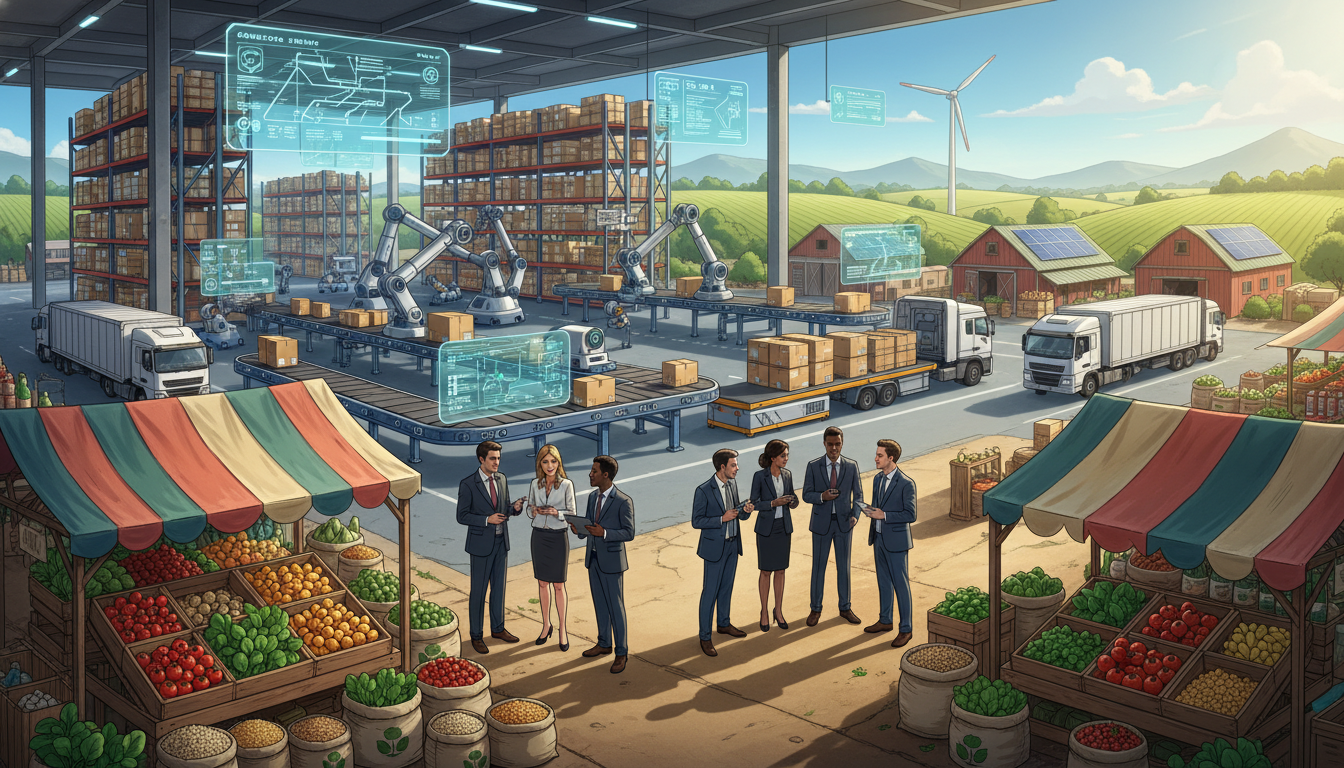
Navigating the Modern Food Supply Chain
In 2025, U.S. operators face a food supply chain where disruptions are common. Climate volatility, geopolitical shocks, and economic instability now influence daily decisions in sourcing, production, and distribution. For procurement and logistics teams, the main challenge is ensuring continuity of service for perishables under tighter cost and compliance constraints.
The cost of weak execution is significant. The Green Climate Fund estimates that about 30% of food produced for human use is lost or wasted annually along the supply chain. This level of loss is not just a sustainability concern. It directly impacts margins, increases write-offs, and adds service risk when shelves go empty.
This article explores practical levers in supply chain management that U.S. leaders consider essential. Resilience plans, end-to-end visibility, and verifiable traceability are now linked to working capital control and recall readiness. In food logistics, tools like ERP-TMS integration, RFID and IoT sensing, and blockchain are transitioning from pilots to scaled programs. Alongside, there’s a focus on redesigning carrier strategies, diversifying suppliers, and automating warehouses.
What’s Changing in the U.S. Food Distribution Network
The food distribution network in the United States is undergoing significant changes. Retailers, manufacturers, and carriers are now planning for frequent variability, not rare shocks. This shift is impacting routing, inventory buffers, and data sharing across the food supply chain.
Why disruption feels constant in food and beverage supply chains
Perishable categories navigate a complex web of growers, processors, cold storage, and last-mile fleets. A single delay can lead to temperature risks, missed appointments, and stockouts. The fragility in food logistics is heightened by peak-season congestion and labor gaps in warehousing and transportation.
Disruption drivers pile up. Droughts, floods, and hurricanes can hit harvest volume and trucking capacity simultaneously. Geopolitical conflict and demand spikes add volatility to packaging inputs, fuel, and import lanes. Maria Villablanca emphasizes that resilience is now essential under persistent uncertainty in food and beverage networks.
| Pressure point | What changes operationally | Impact on service and cost |
|---|---|---|
| Extreme weather events | Reroutes, alternate suppliers, tighter appointment windows | Higher spot rates, more shrink risk, lower on-shelf availability |
| Demand spikes | Faster replenishment cycles and surge labor in DCs | Overtime and expedited freight, higher picking error exposure |
| Input and fuel volatility | Frequent repricing and network re-optimization | Margin compression and more frequent contract resets |
| Cold chain constraints | More temperature-controlled capacity and monitoring checkpoints | Lower spoilage when executed well, higher compliance overhead |
How consumer expectations are reshaping speed, freshness, and transparency
Consumer demand is pushing the food supply chain toward faster delivery while maintaining quality. Expectations for fresh items and ready-to-eat foods shorten shelf-life windows, requiring more precise distribution. This pressure is critical for refrigerated and frozen categories, which rely heavily on environmental control.
Consumers also value how products move. Fast delivery and sustainable fulfillment have become key purchasing signals. For food logistics teams, this means improving scan accuracy, chain-of-custody records, and responsive customer updates when ETAs change.
Regulatory pressure and brand risk in modern supply chain management
Storage and handling failures can quickly lead to safety incidents, recalls, and reputational damage. This risk is concentrated in distribution centers and cross-docks, where time, temperature, and sanitation controls are tested at scale. As a result, operating discipline within the food distribution network now directly impacts brand equity.
Accredited protocols are becoming more important in vendor scorecards. British Retail Consortium (BRC) requirements are often used as a benchmark for food safety and quality management in storage and handling. These standards demand tighter documentation, stronger corrective-action routines, and clearer accountability across the food supply chain.
In response, many retailers are moving from standardized transportation buys to consultative partnerships. 3PLs are being asked to support network design, exception management, and multi-client governance as companies manage several brands under one commercial roof. This approach aligns food logistics execution with category needs, service-level targets, and risk tolerance.
How the food supply chain Works From Farm to Table
In the U.S., the food supply chain follows a series of steps, but outcomes vary by product and shelf life. The journey from farm to table seems straightforward, yet each transfer introduces time pressure, quality risks, and costs. Effective supply chain management begins with mapping processes to identify where perishables can degrade.
This map also clarifies decision-making roles. When inventory data is delayed or incomplete, teams shift from planning to firefighting. This often results in expedited freight, partial shipments, and avoidable waste in the food supply chain.
Key stages: sourcing, production, warehousing, transportation, retail, and foodservice
Sourcing establishes the foundation for quality, yield, and compliance, including temperature, pack style, and lot coding. Production transforms raw inputs into finished or semi-finished goods, influenced by sanitation and line scheduling. These early steps shape service levels downstream and reduce rework.
Warehousing and transportation handle the highest volume of touches. Pallet builds, slotting, and load planning determine dwell time, while routing and appointment windows govern on-time delivery. Retail and foodservice add their own constraints, from planogram timing to back-of-house storage limits, affecting the farm to table experience.
| Stage | Main objective | Typical control points used in supply chain management | Common perishable risk |
|---|---|---|---|
| Sourcing | Secure supply that meets spec and compliance needs | Supplier scorecards, lot requirements, lead-time targets | Spec drift and variable quality at origin |
| Production | Convert inputs to safe, consistent sellable units | HACCP plans, line rates, sanitation verification | Schedule slips that shorten remaining shelf life |
| Warehousing | Protect inventory and position it for fast fulfillment | FIFO/FEFO rules, cycle counts, dock-to-stock time | Extended dwell time and temperature exposure |
| Transportation | Deliver on time while maintaining product integrity | Appointment compliance, reefer set-point checks, seal control | Delays that trigger temperature excursions |
| Retail and foodservice | Convert availability into sales and safe consumption | Receiving checks, storage audits, shrink tracking | Backroom congestion and missed rotation |
Where handoffs fail: bottlenecks across the food distribution network
Most breakdowns occur at handoffs, where ownership changes and information can lag. Late inbound arrivals cause dock congestion, missed production slots, and rushed picking. Limited inventory visibility leads to reactive substitutions, increasing short shipments and stockouts.
Handling controls can slip during peak volume. Mixed loads, rushed staging, or incorrect pallet patterns raise damage rates and drive claims. Over time, these small failures accumulate, weakening the reliability of the food supply chain.
Cold chain dependencies for refrigerated and frozen products
Refrigerated and frozen items rely on a continuous cold chain to protect safety, texture, and taste. Even short delays at a cross-dock or store receiving door can reduce remaining shelf life. For many categories, the cost shows up as markdowns, shrink, and lost sales, not a single visible incident.
Operationally, temperature, humidity, and storage-condition monitoring support faster exception handling. Tools like Maersk’s Captain Peter IoT solution for refrigerated containers illustrate how telemetry can flag excursions and support consistent cold chain management. In mature supply chain management programs, these signals feed alerts, root-cause reviews, and carrier performance discussions, keeping the farm to table promise intact.
Food Sourcing Under Pressure From Climate, Geopolitics, and Inflation
Food sourcing in the U.S. market has evolved from a simple buying task to a complex risk management strategy. Weather, trade policies, and price fluctuations now interact, causing rapid changes in the food supply chain.
Operators face challenges in lead times, contract terms, and service levels. Food logistics teams are now involved in early decision-making. This is because routing options and capacity limits can significantly affect the cost of supply.
Climate volatility and crop shocks
In 2021, Brazil, the world’s largest coffee exporter, saw a 30% drop in production due to frost and drought. This led to a 10-year high in coffee prices, making it harder for roasters and retailers to secure supplies.
Climate-related issues have also affected wheat production in North America and olive oil supplies in Europe. As yields decrease, buyers face wider price ranges and more frequent substitutions. This increases planning complexity in the food supply chain.
Geopolitical instability and trade disruptions
Trade disputes, sanctions, and conflicts can drastically alter global supply routes overnight. The war in Ukraine strained grain markets and increased energy costs, adding to the challenges in food logistics.
Changes in trade alliances can lead to paperwork delays, inspection backlogs, and container imbalances. These issues often result in missed delivery windows and higher accessorial charges, even when products are available upstream.
Economic pressures: fuel, labor, and raw material costs squeezing margins
Inflation in diesel, wages, packaging, and ingredients is squeezing margins at every level. Higher interest rates also make financing more expensive, increasing the cost of carrying safety stock and long-term purchases.
Many companies are now focusing on maintaining supply continuity over finding the lowest cost. This requires procurement, operations, and finance to work together on service-level targets and cost-to-serve models that reflect real conditions.
| Pressure point | What changes in day-to-day operations | Measured impact to track | Coordinated response across teams |
|---|---|---|---|
| Climate-driven yield shocks | More spot buys, substitutions, and shorter contracting cycles | Price variance vs. contract; fill rate by SKU family | Procurement updates supplier mix; operations adjusts specs; finance revises hedging and working capital |
| Trade restrictions and conflict | Lane changes, port diversions, longer customs clearance, added compliance steps | Transit-time variability; detention/demurrage cost per load | Food logistics secures alternate routings; legal/compliance validates documentation; planners reset lead times |
| Fuel and labor inflation | Higher freight rates, tighter capacity, increased warehouse handling costs | Cost per case shipped; labor cost per pallet moved | Transportation re-bids carriers; DC leaders tune labor plans; finance updates budgets and surcharge policies |
| Higher interest rates | Reduced appetite for excess inventory and pre-buys, faster turns required | Inventory carrying cost; days of supply by category | Procurement sets reorder discipline; demand planning tightens forecasts; finance sets working-capital thresholds |
Food Waste and Loss: The Hidden Cost in Food Logistics
Waste is often seen as a sustainability issue, but it also affects the bottom line. In food logistics, every delay, missed temperature target, or damaged case results in a financial loss. This loss moves through the supply chain and impacts profit margins.
For many U.S. operators, the issue is most apparent at handoffs. The food distribution network includes growers, processors, carriers, distribution centers, and stores. Each transfer introduces additional time, handling risks, and documentation burdens.
Green Climate Fund estimate: about 30% of food produced for human use is lost or wasted annually along the supply chain
The Green Climate Fund reports that around 30% of food produced for human use is lost or wasted each year. This aligns with the widely cited benchmark that roughly one-third of food produced for human consumption is lost or wasted. This is equivalent to one billion meals daily.
In reality, this loss is not a single event. It’s a series of small failures across the food distribution network. These include late appointments, trailer dwell time, poor rotation, short shelf-life at receipt, and quality holds due to incomplete trace data.
Operational impacts: higher costs, stock shortages, and weakened consumer trust
Loss increases operating costs in several ways. It leads to higher disposal fees, more expedited freight, added quality inspections, and increased claims management across the food supply chain.
It also causes stock shortages. When product is out of specification due to spoilage or rough handling, inventory may exist on paper but not on shelf. This weakens order fill rates and service levels.
Consumer trust erodes when availability and quality are inconsistent. Consistent defects, shorter freshness windows, and substitutions can reduce repeat purchases. This is more noticeable in high-velocity categories where shoppers notice changes quickly.
Why “extra inventory” is a costly hedge against uncertainty
Many organizations carry extra inventory to buffer demand swings and transportation volatility in food logistics. For perishables, this hedge can be expensive. It increases carrying cost, shrink exposure, and working-capital drag while product ages in storage.
Holding more cases also increases touch points inside the food distribution network. More touches can mean more temperature excursions, more pallet damage, and more opportunities for mis-picks or poor FIFO execution.
Operators often reduce avoidable disposal by tightening execution instead of expanding stock. Common levers include real-time tracking for ETA discipline, cold chain monitoring for excursion alerts, and stronger warehouse control to protect rotation and keep product in specification.
| Loss driver in the food supply chain | Typical business impact | Operational lever used in food logistics | Primary node in the food distribution network |
|---|---|---|---|
| Temperature excursion during transit or staging | Write-offs, credits, and reduced remaining shelf life | Cold chain monitoring with alerts and exception workflows | Carrier lanes, cross-docks, store back rooms |
| Late deliveries and extended dwell time | Expedite spend, missed promotions, and service penalties | Real-time tracking for appointment adherence and rerouting | Inbound to DCs and high-volume retail docks |
| Inventory aging and weak rotation (FIFO/FEFO) | Shrink, markdowns, and higher disposal volume | Improved warehouse control for slotting, scan compliance, and cycle counts | Distribution centers and foodservice warehouses |
| Over-ordering as a buffer for uncertainty | Working-capital drag and higher spoilage risk | Demand planning with tighter reorder points and exception review | Procurement and replenishment across the network |
Building Resilience to Prevent Supply Disruptions
Building resilience in the food supply chain requires early warning systems and swift action. In the U.S., teams focus on monitoring risks across suppliers, lanes, and cold storage to prevent service failures. This proactive approach aims to maintain continuity, not just react to disruptions.
As disruptions become more common, making food sourcing decisions is more complex. These decisions now consider lead times, border exposure, and temperature risks. The goal is to ensure continuity, not just to recover from disruptions.
Risk assessment and scenario planning to pinpoint vulnerabilities early
Regular risk assessments are key. They use shipment history, supplier performance, and demand variance to identify weak points. Many rely on analytics in supply chain management tools to detect patterns before fill rates decline.
Scenario planning adds a predictive layer. Teams simulate events like port congestion, refrigeration outages, or raw material shortages. They then set triggers for alternative inventory and transport plans.
Supplier diversification and regional sourcing to reduce overreliance on long routes
Diversifying suppliers reduces single points of failure in the food supply chain. A broader supplier base also enhances negotiating power when capacity is tight.
Regional sourcing and nearshoring can shorten replenishment cycles and reduce cross-border delays. For food sourcing, shorter routes mean less handling, fewer transfers, and tighter quality control.
McDonald’s uses local suppliers in each market, aligned to global standards. This multi-tier approach supports product availability during downturns and disruptions, while maintaining consistent specifications.
Carrier strategy: selecting reliable, temperature-controlled partners to prevent spoilage
Perishables need carriers with temperature-controlled shipping and validated equipment. They must have disciplined procedures at pickup and delivery. In refrigerated and frozen categories, delays and improper handling can reduce shelf life and increase shrink.
Reliable transit protects order fill rates and supports product quality outcomes. In supply chain management, carrier scorecards track on-time performance, temperature excursion rates, and claims frequency to guide routing decisions.
| Resilience lever | Execution in U.S. networks | Primary benefit for the food supply chain | Key operational metric |
|---|---|---|---|
| Risk assessment cadence | Monthly lane and supplier reviews using analytics and exception reporting | Earlier intervention before service failures affect retail and foodservice | On-time in-full (OTIF) and backorder rate |
| Scenario planning | Mode swaps, alternate DC paths, and pre-approved substitution lists for food sourcing | Faster recovery when congestion or shortages hit | Time to reroute and recovery lead time |
| Diversified supplier base | Primary and secondary suppliers with audited specs and capacity checks | Reduced dependence on any single source or region | Supplier fill rate and lead-time variance |
| Regional sourcing | Nearshore or in-region producers to limit border exposure and long-haul variability | Shorter cycle times and fewer disruption-prone handoffs | Average transit time and damage rate |
| Cold-chain carrier strategy | Temperature-controlled partners with monitoring, SOPs, and trained drivers | Lower spoilage risk and more stable freshness | Temperature excursion rate and claims per load |
End-to-End Visibility With Real-Time Tracking and IoT
Real-time visibility has become essential for service and waste reduction in U.S. food logistics. Gaps in location and condition data can lead to significant losses. Many now view connected data as a critical part of the food supply chain and distribution network.
Connecting ERP with a Transportation Management System for shipment status, location, and ETA
ERP–TMS integration is a common visibility pattern. The ERP manages orders, item data, and delivery dates. The Transportation Management System oversees tenders, carrier events, and tracking milestones. When these systems share data, teams can monitor shipment status, location, and ETA in one place.
This setup enables quicker exception management. It alerts teams to late pickups, missed appointments, and detention risks. This is vital for the food supply chain, reducing manual calls and protecting fill rates when capacity is tight.
RFID and IoT sensors for inventory location and condition inside distribution centers
RFID and IoT solve the “where is it now” problem in distribution centers. Fixed readers at dock doors verify inbound and outbound moves. Handheld scans address gaps in mixed pallets and high-SKU lanes. This approach lowers mis-picks and keeps cycle counts accurate, reflecting actual stock levels.
IoT sensors also provide additional data, like dwell time at staging and door-open events. This information aids in labor planning, slotting decisions, and maintaining inventory buffers without increasing out-of-stocks.
Cold chain monitoring for temperature, humidity, and excursion alerts to reduce spoilage
Cold chain control requires more than just a trailer seal and a set point. IoT sensors track temperature, humidity, and storage conditions in real time. They alert for excursions before product quality declines. Alerts are tied to lane, carrier, and facility, enabling corrective actions like re-icing or cross-docking.
Maersk’s “Captain Peter” is an example of remote monitoring for refrigerated containers. It ensures consistent reefer performance during ocean moves and at port dwell. For perishable shipments, this monitoring strengthens compliance and reduces spoilage exposure across the food supply chain.
| Visibility layer | Data captured | Operational trigger | Effect on waste and efficiency | Where it fits in the food distribution network |
|---|---|---|---|---|
| ERP–TMS integration | Shipment status, location, ETA, appointment times | Late pickup, route delay, missed delivery window | Fewer manual updates; faster exception response helps prevent late spoilage | Transportation planning, customer service, order management |
| RFID at dock doors | Automated in/out confirmation, pallet movement timestamps | Mismatch between ASN and received items; unplanned dwell at staging | Lower receiving errors; reduced rework and chargebacks | Distribution centers, cross-docks, high-velocity lanes |
| In-facility IoT sensors | Zone temperature, door-open events, dwell time by location | Prolonged staging in ambient areas; repeated door cycling | Less temperature abuse; better labor and slotting decisions | Coolers, freezers, staging areas, picking zones |
| Cold chain remote monitoring (reefers) | Temperature, humidity, power status, excursion history | Set-point drift, power interruption, excursion threshold breach | Earlier intervention reduces spoilage risk and supports audit-ready records | Ocean containers, intermodal moves, port and yard dwell |
Blockchain Traceability and Faster Recalls for Food Safety Measures
In the U.S. food supply chain, a single weak record can significantly slow down recalls and increase costs. Blockchain systems address this issue by creating a time-stamped record of events across suppliers, processors, carriers, and distribution nodes. This shared data layer supports faster verification when quality issues arise, making supply chain management more efficient.
How blockchain creates an immutable chain of custody to reduce fraud and improve trust
Blockchain functions as an immutable ledger, making it difficult to alter transactions without detection. This structure enhances chain-of-custody records, reducing fraud and supporting audits tied to food safety measures.
Food fraud costs the industry billions annually, driven by adulteration, mislabeling, and counterfeit goods. Blockchain links lot IDs, certificates, and shipment milestones, narrowing the search area during incidents. This accountability can also reduce waste by isolating affected lots sooner in perishable inventory.
Walmart + IBM Food Trust example: tracing leafy greens reduced from seven days to 2.2 seconds
Walmart’s collaboration with IBM Food Trust is a benchmark for recall efficiency. The trace time for leafy greens was reduced from seven days to 2.2 seconds. This transformation changes the playbook for withdrawals, communications, and store-level holds in supply chain management.
Faster traceability does not replace inspections or preventive controls. It compresses the window between detection and action, essential for modern food safety measures and regulatory responses.
Customer-facing transparency: QR codes that verify sourcing and quality (used by companies like Carrefour and Nestlé)
Blockchain is also used at the shelf through QR codes that reveal provenance data. Carrefour and Nestlé have introduced customer-facing scans that confirm sourcing and quality attributes at purchase. This transparency strengthens brand credibility by aligning origin claims with authenticity, driving purchasing decisions.
Effective management of these programs aligns marketing claims with operational data. This alignment supports supply chain management goals such as tighter supplier compliance, clearer dispute resolution, and consistent documentation across trading partners.
| Use case | What is captured | Operational effect | Primary risk addressed |
|---|---|---|---|
| Immutable chain of custody | Lot IDs, handoffs, certificates, time stamps | Fewer manual reconciliations across parties | Fraud, mislabeling, incomplete records |
| Recall trace for leafy greens (Walmart + IBM Food Trust) | Farm source, processing steps, shipment events | Trace time reported to drop from seven days to 2.2 seconds | Slow withdrawal, broad product destruction |
| Consumer QR transparency (Carrefour, Nestlé) | Origin, batch details, selected quality attributes | Fewer disputes over provenance and claims | Erosion of trust, premium brand dilution |
Warehousing and Distribution: Automation, Robotics, and Digital Twins
Warehousing is evolving from static storage to a dynamic, controlled flow. Modern food distribution networks require facilities that are flexible and scalable. This ensures they can meet tight dispatch windows for perishables. Maintaining tight environmental control is also critical to protect quality and safety across food logistics.
Automation and AI are transitioning from pilot projects to everyday use. In supply chain management, these technologies reduce pick and pack errors, lower rework, and enhance slotting decisions. Robotics, RFID, and barcode systems support quicker receiving, cycle counts, and space utilization without slowing down operations.
Digital twins are used to manage space and volatility more effectively. Robots perform wall-to-wall scans to update a digital twin of the warehouse. This speeds up decision-making during seasonal peaks and uneven demand. As a result, the food distribution network operates more steadily, even with changing inbound timing and order mix.
Iron Mountain has integrated AI across its warehouses using Dexory’s AI-driven warehouse automation. This approach predicts stock locations, flags replenishment needs, and tracks productivity shifts. Iron Mountain also deployed an autonomous robot for daily scans, providing live inventory visibility. This supports food logistics teams that rely on accurate location data.
Automation choices include proven storage and retrieval designs. AutoStore is used as an automated storage and retrieval system to quickly respond to customer requests. This raises speed and reliability in supply chain management. These systems are often paired with goods-to-person picking to reduce travel time and limit handling for fragile or temperature-sensitive items.
Labor pressure is a key driver for automation planning. In 2024, 37% of European warehousing organizations reported significant labor shortages. 76% reported a noticeable shortfall. U.S. operators often view this as a comparable risk category for warehouse continuity planning in a food distribution network.
Network design remains as important as the technology inside the building. The “golden logistics triangle” concept is used to place sites near rail and air links. This lowers transportation costs and improves outbound service in food logistics. Rail becomes more relevant when goods are heavy and truck weight limits are binding, shifting lane economics in supply chain management.
| Capability | What it changes in warehouse execution | Operational value for perishables | Where it fits in the food distribution network |
|---|---|---|---|
| RFID + barcode workflows | Faster receiving, fewer mis-picks, cleaner traceable movements | Less handling time; better lot control and rotation discipline | Improves dock-to-stock speed and outbound accuracy for food logistics |
| Robotics-assisted scanning | Wall-to-wall inventory checks that refresh a digital twin | Reduces search time; supports tighter replenishment timing | Stabilizes inventory confidence during peak demand swings |
| AI-driven forecasting inside the warehouse | Predicts stock locations, replenishment needs, and productivity shifts | Helps protect service levels when labor or inbound timing is volatile | Strengthens supply chain management by aligning labor, slots, and waves |
| AutoStore (AS/RS) | Goods-to-person access with dense storage and fast retrieval | Shorter pick cycles; consistent performance under high order volume | Supports rapid response for customer requests across food logistics lanes |
| Golden logistics triangle siting | Locates nodes near rail and air corridors to improve service | Fewer delays and smoother outbound scheduling for time-sensitive loads | Reduces cost-to-serve and improves reach for the food distribution network |
Sustainable Food Supply Chain and ESG-Driven Logistics
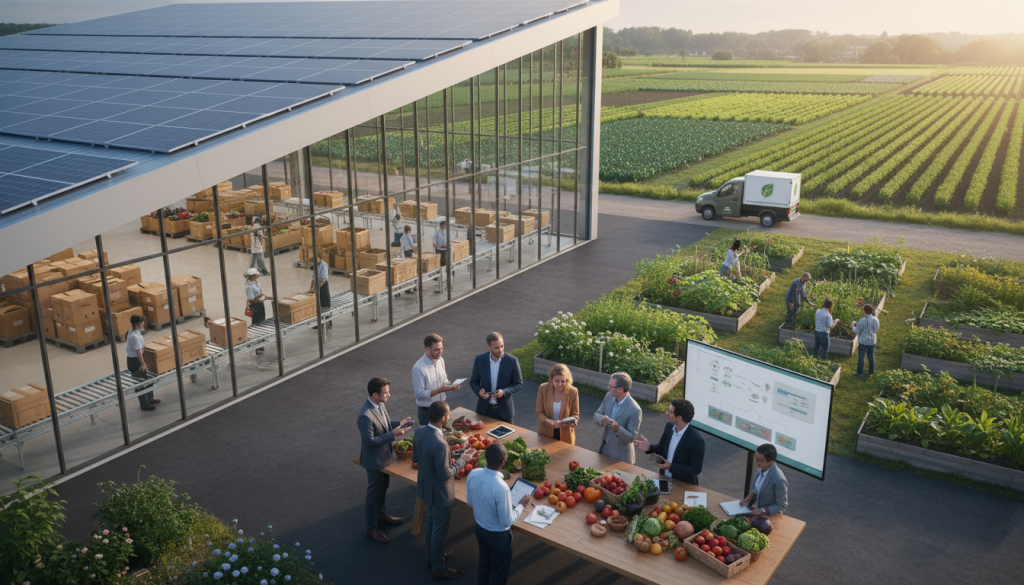
ESG targets are now integral to contracts, audits, and board reports. In U.S. distribution, a sustainable food supply chain hinges on measurable controls in transport, warehousing, packaging, and returns. For many operators, food logistics has evolved from a cost center to a compliance and brand-risk function.
UN SDG waste target and the operator impact
The UN Sustainable Development Goals mandate a significant reduction in global food waste by 2030. This goal transforms shrink reduction into a measurable ESG metric across the food supply chain. It encompasses forecasting, inventory rotation, and cold-chain handling at docks.
For carriers and 3PLs, this mandate elevates service expectations. Missed appointments, temperature excursions, and damaged pallets are now critical issues. They are seen as drivers of waste, cost, and reputational risk.
Scope 3 emissions measurement by mode and location
Transportation is a significant contributor to Scope 3 emissions. Reductions begin with disciplined measurement. Many firms now track shipment activity through TMS and ERP integrations. They calculate emissions by mode and location to pinpoint the most impactful lanes.
This method supports targeted decarbonization in food logistics. It distinguishes between long-haul truck routes and intermodal moves. It also highlights regional hotspots where congestion, empty miles, or low backhaul rates increase carbon intensity.
| ESG lever | What gets measured in food logistics | How it guides action in the food supply chain |
|---|---|---|
| Scope 3 transport emissions | CO2e by mode (truck, rail, ocean, air) and by origin-destination | Prioritizes lane changes, modal shift, and carrier standards where abatement is highest |
| Cold-chain waste drivers | Temperature excursions, dwell time, rejected loads, and damage rates | Supports tighter SOPs at handoffs and better performance management by node |
| Energy exposure | Facility kWh, peak demand charges, and fuel consumption by fleet segment | Builds the business case for solar-powered warehouses, EVs, and charging schedules |
| Packaging footprint | Material type, weight per unit, and recyclability by SKU family | Enables redesign to cut virgin input, reduce cube, and lower disposal fees |
Operational moves: packaging, routes, and renewable energy
Operators are implementing practical strategies to reduce emissions while maintaining service quality. These include using lighter, eco-friendly packaging and optimizing routes to minimize empty miles. They also redesign networks to reduce touchpoints for sensitive freight.
Facility upgrades are increasingly common in capital plans. Solar power, EV charging stations, and rainwater harvesting help stabilize operating costs during energy price fluctuations. They also enhance the sustainability of the food supply chain.
Circular economy practices that reduce virgin material demand
Circular programs aim to recycle and reuse materials. Initiatives like reusable totes, pallet recovery, and packaging take-back programs can decrease virgin material demand. They also reduce disposal costs across the food supply chain.
These efforts support brand protection and audit readiness. As ESG scrutiny intensifies, circular controls provide documented evidence. They link daily food logistics decisions to waste reduction and compliance.
Conclusion
The modern food supply chain is now evaluated by shrink, service level, and risk exposure, not just by distance and lead times. The Green Climate Fund reports that 30% of food meant for human consumption is lost or wasted annually. For U.S. businesses, this translates to narrower profit margins, more stockouts, and increased recall risks. While large inventory buffers can mitigate shocks, they also increase carrying costs and spoilage risks.
Building resilience begins with strict operating controls that safeguard freshness and food safety. Top programs focus on risk assessment and scenario planning to identify vulnerabilities before disruptions occur. They also diversify suppliers and source regionally to lessen reliance on long supply chains and single points of failure. Carrier choice is critical, as it impacts temperature-controlled shipments where a single deviation can nullify the entire shipment’s value.
Technology transforms policy into daily practice, enabling faster decision-making in the food supply chain. ERP-TMS integration enhances shipment status and ETA accuracy. RFID and IoT sensors monitor location and condition within facilities and during transit. Maersk’s refrigerated-container monitoring exemplifies how visibility can minimize temperature-related losses.
Blockchain has transitioned from pilot to practical application, with Walmart and IBM Food Trust reducing trace time for leafy greens from seven days to 2.2 seconds. Carrefour and Nestlé employ QR-enabled transparency to expedite responses. Automation in warehousing, robotics, and digital twins boosts inventory accuracy and picking efficiency. Simultaneously, investment is shifting towards sustainable food supply chains, influenced by ESG targets and network design.
The UN aims to halve food waste by 2030, and there’s a growing push to measure Scope 3 emissions by mode and location. For U.S. decision-makers, the imperative is clear: maintain service levels, enhance food safety measures, and forge a sustainable food supply chain that can withstand volatility without incurring unnecessary costs.
FAQ
Why does disruption feel constant in the U.S. food supply chain in 2025?
The food supply chain is inherently prone to disruptions. It involves perishables moving through a complex network with strict rules. Climate changes, geopolitical tensions, and economic instability often overlap, causing frequent disruptions and higher costs. Maria Villablanca emphasizes that resilience is now essential due to ongoing uncertainty in the food and beverage sectors.
Where do losses typically occur from farm to table, and why do handoffs fail?
Losses occur throughout the supply chain, from sourcing to retail and foodservice. Each transfer point introduces risks. Handoffs often fail due to delayed deliveries, inadequate refrigeration, and limited inventory visibility. In perishables, small errors can lead to spoilage, stockouts, or safety issues.
How large is the business impact of food loss and waste across the supply chain?
The Green Climate Fund estimates that 30% of food produced for human use is lost or wasted annually. This results in direct margin loss and service risks. Industry reports suggest that about one-third of food is lost or wasted, equating to one billion meals daily. For U.S. operators, this translates to higher costs, stock shortages, and weakened consumer trust.
Why isn’t holding extra inventory a reliable strategy for perishable food logistics?
Extra inventory acts as a buffer but increases carrying costs and working-capital drag. It also raises the risk of shrink and spoilage. In cold chain logistics, longer storage times increase the chance of temperature excursions and quality degradation. A better strategy focuses on reducing variability through control, visibility, and sourcing design.
What core capabilities are U.S. operators prioritizing to improve resilience and performance?
Decision-makers focus on resilience, end-to-end visibility, and traceability. They combine operational redesign with digital tools like ERP–TMS integration, RFID/IoT sensing, and blockchain. This approach supports faster exception management, better inventory accuracy, and stronger food safety measures.
How does ERP–TMS integration improve execution across a food distribution network?
ERP–TMS integration provides real-time shipment status and location. This visibility improves exception management for late or at-risk loads, critical for temperature-controlled shipping. It also supports tighter scheduling, fewer expedited moves, and more reliable order fill rates.
What role do RFID and IoT sensors play in cold chain logistics and inventory control?
RFID and IoT sensors enhance inventory accuracy and reduce manual errors. They monitor temperature, humidity, and storage conditions in real-time, alerting for excursions. Maersk’s “Captain Peter” uses IoT for refrigerated container monitoring, reducing spoilage in transit.
How does blockchain improve food safety, recall speed, and anti-fraud controls?
Blockchain strengthens traceability, reduces fraud, and accelerates recall execution. Walmart’s blockchain system using IBM Food Trust reduced trace time to 2.2 seconds. Carrefour and Nestlé use blockchain-enabled QR codes for consumer verification, supporting transparency.
How are climate volatility and geopolitical shocks changing food sourcing and global food logistics?
Climate shocks reduce yields and drive price spikes, tightening supply. Brazil’s 30% coffee production drop in 2021 due to frost and drought pushed prices to a 10-year high. Trade disputes and conflicts, like the war in Ukraine, strain global food supply chains, causing shortages and higher costs.
Why are 3PL relationships shifting toward consultative logistics partnerships for perishables?
Retailers manage multiple brands with distinct supply chains, increasing complexity. 3PLs are now chosen for their consultative capabilities, including network design, risk management, and analytics. This model supports tailored cold chain needs and disciplined cost management.
What warehousing changes matter most for perishables, and why is automation accelerating?
Warehouses need to be flexible and scalable for fast delivery while maintaining environmental control. Automation and AI reduce labor costs, improve accuracy, and increase throughput during demand spikes. Iron Mountain uses AI for real-time inventory visibility, and AutoStore systems quickly respond to customer requests.
How do accredited protocols like BRC reduce food safety and brand exposure?
Storage and handling failures can quickly lead to safety incidents, recalls, and reputational damage. Accredited protocols like British Retail Consortium (BRC) set strict controls for hygiene, temperature, and documentation. These standards reduce liability and strengthen compliance in the distribution environment.
What does a sustainable food supply chain require in practice, beyond claims?
The UN Sustainable Development Goals aim to halve global food waste by 2030. Reducing transportation-related Scope 3 emissions requires measurement and targeting high-impact lanes. Common strategies include route optimization, eco-friendly packaging, and circular economy practices like recycling and reuse.