

STG Logistics: Your Partner in Logistics Excellence
In U.S. freight networks, success hinges on port speed, inland capacity, and smooth transitions between transport modes. STG Logistics focuses on containerized freight, covering ports to doors. It aims for consistent throughput and reliable transit times. This overview explains STG’s market position and what businesses should consider in its operations.
Established in 1985 as St. George Logistics, the company boasts 40 years in logistics and supply chain services. Its long history is key for procurement and operations leaders. It signifies well-established terminal processes, strong carrier ties, and consistent cargo handling.
The article discusses how STG’s extensive network supports modern supply chain goals. These include reliable service and cost control. It also looks at STG’s logistics offerings, such as asset-based intermodal transport and warehousing.
Public materials highlight STG’s services, including marine and rail drayage, and over-the-road transport. STG is a Wind Point Partners, Duration Capital Partners, and Oaktree Capital Management portfolio company. Later sections use case studies, certifications, and executive insights to support its claims.
What Makes STG Logistics a Trusted U.S. Logistics Partner
In the U.S. freight market, trust is built on reliability, scale, and consistent performance. Shippers look for third-party logistics providers that offer consistent service across various locations. STG Logistics showcases its network and history as evidence of this reliability in transportation logistics.
Celebrating 40 years in logistics and supply chain (founded in 1985)
STG Logistics began in 1985 as St. George Logistics. It recently celebrated 40 years in the logistics and supply chain industry. This milestone is significant for procurement teams, indicating the company’s ability to endure through market changes.
In the world of third-party logistics, a long history is valuable when it’s backed by consistent service. Such a record helps in forecasting, managing carriers, and handling service disruptions. These are essential aspects of transportation logistics, not just marketing points.
From CFS warehousing roots to integrated port-to-door logistics services
The company expanded from CFS warehousing to offer integrated port-to-door solutions. This shift meets shipper needs for fewer handoffs, reducing the risk of delays. It also improves the flow of containers by minimizing dwell time and documentation issues.
STG Logistics has grown to include intermodal, drayage, transloading, contract logistics, and over-the-road services. This growth allows for better control over logistics events, appointment scheduling, and handling exceptions. Such control often leads to fewer delivery failures and smoother inventory turns in transportation logistics.
| Operating element | What STG states it provides | Why it matters to shippers |
|---|---|---|
| CFS warehousing foundation | Container freight station handling and deconsolidation | Faster freight availability when inbound containers must be broken down and staged |
| Port-to-door model | Integrated movement from port networks to inland destinations | Fewer handoffs, clearer accountability, and more predictable cycle times |
| Intermodal and drayage expansion | Rail-linked and port-connected container moves | Improved options for cost, capacity, and lane resilience in transportation logistics |
| Contract logistics and transloading | Inbound processing, palletization, and distribution readiness | Better fit for retail and manufacturing receiving requirements and store-ready flows |
National containerized freight focus with broad multimodal capabilities
STG Logistics is a national leader in containerized freight solutions, with access to major rail ramps and ports. This extensive network is critical for adapting to changes in freight plans. It also supports standardized processes, which many logistics users require for auditability.
Long-term intermodal relationships are a key trust indicator in capacity planning. STG Logistics has partnerships with CSX and Union Pacific Railroads. These relationships help maintain schedule discipline and reduce the need for spot-market exposure during peak periods.
Containerized freight specialization supports repeatable receiving, sorting, and outbound dispatch routines.
Multimodal coverage can reduce single-mode dependence when rail, port, or truck constraints tighten.
Partner continuity with CSX and Union Pacific Railroads supports network planning and service consistency.
stg logistics and the Evolution to Integrated Port-to-Door Solutions
Integrated port-to-door solutions rely on seamless handoffs between various stages. In the U.S. freight market, where capacity is tight and demand shifts, stg logistics focuses on coordinated moves. This approach supports supply chain management and aligns with shippers’ service standards.
Growth through strategic acquisitions and localized expertise
STG’s growth comes from strategic acquisitions, adding localized expertise in key markets. The goal is to reduce friction and improve control over container flows. This structure helps manage variability in freight movements across global logistics lanes.
2019 brand launch after acquisitions including Channel Distribution and Summit NW Corp
In 2019, STG launched the STG Logistics brand after acquiring Channel Distribution and Summit NW Corp. This consolidation marked a shift towards a unified operating footprint. STG Logistics now offers tailored transportation solutions, supporting customer growth while focusing on measurable service outcomes.
Company vision: “One Team. One Company. One STG Logistics.”
The company’s vision, “One Team. One Company. One STG Logistics,” sets a high standard for integration. Later deals expanded its scale and service breadth, focusing on end-to-end execution in global logistics networks. In 2022, the acquisition of XPO Intermodal added 15,000 intermodal containers across North America and Mexico.
In 2023, the acquisition of Best Dedicated Solutions expanded its over-the-road network nationwide. These moves highlight stg logistics’ focus on control, capacity access, and network design. For supply chain management leaders, the emphasis remains on efficient handoffs from port and rail interfaces to distribution delivery.
| Milestone | Reported addition | Operational emphasis for port-to-door execution | Relevance to supply chain management |
|---|---|---|---|
| 2019 brand launch | STG Logistics brand formed after acquisitions including Channel Distribution and Summit NW Corp | Unified processes across acquired operations to support coordinated port-to-door moves | More consistent service governance, SOP alignment, and performance reporting |
| 2022 acquisition | XPO Intermodal added 15,000 intermodal containers across North America and Mexico and included a leading National Drayage provider capability | Expanded container availability and drayage reach at port and rail interchange points | Stronger capacity planning options and reduced exposure to spot-market volatility |
| 2023 acquisition | Best Dedicated Solutions added an extensive over-the-road network with true nationwide coverage | Broader trucking coverage to connect rail ramps and distribution points with fewer carrier handoffs | Improved route design flexibility and tighter delivery appointment control |
| Operating vision | “One Team. One Company. One STG Logistics.” | Cross-functional coordination between terminals, dispatch, and delivery operations | Clear accountability for service KPIs used in global logistics performance reviews |
Core Logistics Services: Intermodal, Drayage, Transloading, and Trucking
STG Logistics focuses on steady capacity, quick handoffs, and predictable execution. Its model aims to reduce missed appointments and idle equipment at ports, rail, and inland nodes. This is vital for shippers relying on third-party logistics, ensuring smooth operations during tight labor markets and volatile peak seasons.
Asset-based intermodal transportation for resilient transportation logistics
Asset-based intermodal transportation enhances lane flexibility when truck capacity changes. In 2022, the XPO Intermodal acquisition added 15,000 intermodal containers across North America and Mexico. This move expanded equipment availability for urgent loads, supporting logistics planning by reducing reliance on spot-market swings.
STG’s service design addresses disruption risks like port worker strikes and snowstorms. Having control over assets can cut dwell time by enabling quicker re-routing. This leads to more consistent cycle times for logistics services reliant on steady equipment flow.
Marine and rail drayage to connect ports, rail ramps, and distribution points
Marine and rail drayage links terminals to warehouses, cross-docks, and rail facilities, where schedule risks are highest. Dray execution impacts gate turns, chassis availability, and appointment windows, potentially causing delays. Reliable drayage is key for third-party logistics, ensuring a smooth transition between ocean arrivals and domestic linehaul moves.
| Service element | Primary connection point | Operational focus | Planning value for shippers |
|---|---|---|---|
| Marine drayage | Port terminals to nearby distribution and transload sites | Gate appointments, chassis utilization, and short-haul cycle time | Supports import continuity when terminal congestion rises |
| Rail drayage | Rail ramps to regional warehouses and customer facilities | Ramp pickup timing, container availability, and cut-off compliance | Stabilizes inland transportation logistics around rail schedules |
| Port-to-ramp transfers | Port nodes to intermodal rail hubs | Minimizes dwell and aligns with rail departure windows | Improves predictability for downstream logistics services |
Transloading and contract logistics services to support flexible supply chain management
Transloading shifts freight between containers, trailers, and rail equipment to meet cost and service goals. It optimizes cube utilization, weight limits, and destination-specific routing. When combined with contract logistics, transloading can streamline storage, staging, and outbound planning, reducing touches.
Network agility: transloading offers a practical solution when lane capacity tightens or inland rates surge.
Inventory control support: contract operations standardize receiving, put-away, and outbound sequencing across facilities.
Cost discipline: fewer partial moves and better trailer fill can improve per-unit economics without extending transit time.
Over-the-road FTL and LTL services for nationwide coverage
Over-the-road trucking extends the portfolio beyond ports and rail nodes to cover inland distribution. The 2023 acquisition of Best Dedicated Solutions added an over-the-road network with nationwide coverage. This is critical for contingency routing and surge capacity during disruptions.
FTL supports high-volume lanes and time-critical replenishment, while LTL offers an option for smaller shipments needing reliable pickup and delivery windows. For third-party logistics users, this mix simplifies procurement by integrating trucking and intermodal decisions into one logistics plan. It provides a broader set of logistics services that can scale without forcing a single-mode strategy.
Warehousing Solutions and Warehouse Distribution Network
STG Logistics started in CFS warehousing, where tight deadlines and high dock work are daily challenges. This foundation supports today’s warehousing solutions, aiming for faster turns, fewer touches, and smoother flow from port to delivery. In supply chain management, these elements are key to whether freight moves on time or gets delayed.
CFS operations and cross-dock warehousing to keep freight moving
CFS and cross-dock centers focus on speed and precision. Freight is quickly checked, staged, and moved on to the next step. This approach helps in warehouse distribution by reducing the time between deconsolidation and loading for shipment.
Operational goals include efficient truck flow and seamless handoffs between dock and office. When teams work together on appointments, exception handling, and documentation, the supply chain becomes more reliable under peak port conditions.
Traditional storage and scalable contract warehousing solutions
Not every shipment fits the cross-dock model. Traditional storage is for reserve inventory, seasonal needs, and SKU growth without rushing products. These solutions also grow through contracts, adding labor, slots, and shifts as needed.
In 2007, STG’s Dura Freight managed a six-building portfolio. Managing multiple facilities is key in warehouse distribution. It allows for positioning freight closer to demand or transportation when market conditions change.
Facility capabilities that support smoother warehouse distribution handoffs
Facility design and process discipline are critical for smooth handoffs. Door scheduling, staging lanes, and clear labeling reduce errors and late departures. Real-time inventory control tightens count accuracy and improves order release timing.
| Capability | What it supports | Operational measure | Impact on warehouse distribution |
|---|---|---|---|
| Cross-dock staging lanes | Rapid inbound-to-outbound transfer | Dwell time by load | Faster turn times and fewer yard holds |
| Traditional storage locations | Buffer inventory and seasonal surges | Pick rate per hour | More stable outbound planning across lanes |
| Real-time inventory control | Accurate availability and release timing | Cycle count accuracy | Fewer shorts and cleaner order fulfillment |
| Dock-to-office coordination | Timely paperwork and exception handling | Check-in to tender time | More consistent dispatch and appointment adherence |
Cold Chain Logistics: Temperature-Controlled Warehousing and Food-Grade Handling
Cold chain success hinges on strict control from start to finish. STG Logistics offers food-grade facilities to ensure temperature-sensitive goods stay stable. This approach combines warehousing solutions with strict handling rules, allowing for smoother inventory management.
Temperature-controlled warehouses and transportation solutions that protect product integrity
STG Logistics supports temperature-controlled warehouses and transportation to safeguard product integrity. Facilities are strategically located near major freight routes to minimize dwell time and exposure to temperature changes. This setup ensures consistent conditions from start to finish.
Within these facilities, the cold chain scope includes traditional storage, cross-docking, and real-time inventory control. STG Logistics integrates technology with strict safety standards to enhance safety, security, and productivity. This model keeps freight moving while maintaining food-grade handling discipline.
Quality control processes designed for temperature-sensitive goods
Temperature-sensitive items require consistent checks at every step. STG Logistics employs rigorous quality control processes, including documented receiving and controlled staging. This approach supports supply chain management goals like fewer exceptions and more predictable order release.
These controls also support warehousing solutions for mixed product profiles, from short-dwell cross-dock activity to longer-hold storage. With cold chain freight, small process gaps can lead to significant loss risks. That’s why these logistics services focus on consistent handling and verification.
Organic certification through Oregon Tilth (USDA National Organic Program accredited certifier)
For organic freight, certification status is critical for procurement teams and auditors. Oregon Tilth, Inc. is a nonprofit accredited by the USDA to certify operations under the USDA National Organic Program (NOP). This certification verifies organic standards and supports sustainability, biodiversity, and soil and water conservation.
For shippers, the value lies in clearer program fit and cleaner audit trails. It also supports supply chain management teams needing aligned documentation across carriers, warehouse operators, and customers. These requirements fit into controlled warehousing solutions where product status must be protected during storage and handling.
AIB certified facility standards supporting food safety and sanitation
AIB International provides food safety audits, inspections, training, and certifications for food and beverage manufacturers, warehouses, and distribution centers. Its standards aim to minimize contamination risks and maintain sanitation and cleanliness across supply chain operations. For cold chain programs, this framework reinforces food-grade discipline across receiving, storage, and outbound staging.
| Control area | How it supports cold chain operations | Operational impact for shippers |
|---|---|---|
| Food-grade handling environment | Procedures that reduce exposure to contaminants during storage and cross-docking | Lower risk of rejected loads and fewer quality holds |
| Quality control checkpoints | Repeatable verification for temperature-sensitive items at receiving and release | More consistent outbound conditions and clearer exception tracking |
| Certification alignment | Oregon Tilth (USDA NOP accredited) for organic verification; AIB International for sanitation-focused standards | Stronger audit readiness across logistics services and warehousing solutions |
| Technology and inventory controls | Real-time inventory control supported by stated technology tools and safety standards | Improved allocation decisions and tighter supply chain management execution |
For operational coordination, STG cold food storage lists: 951 Thorndale Avenue, Bensenville, IL 60106; 630.581.0519; sales@stgusa.com. These identifiers support routing, scheduling, and documentation workflows for cold chain freight needing fast confirmations and traceable handoffs.
Freight Forwarding, NVOCC Partnerships, and CFS/LCL Performance
In U.S. port markets, CFS/LCL speed impacts appointment windows, sailing cutoffs, and inventory availability. For freight forwarding teams and NVOCC partners, predictable turn times reduce rework and protect customer service. This predictability also limits detention exposure and reduces schedule volatility across global logistics lanes.
https://www.youtube.com/watch?v=B5OrSh4uj84
Why speed and reliability shape partner outcomes
Paloma Burnell, Senior Vice President of Operations/Sales, views CFS/LCL performance as a daily discipline, not a project. She links reliable velocity to fewer exceptions, cleaner data, and steady labor planning. This approach is critical for global logistics partners needing consistent handoffs across various stages.
Speed is not just about moving faster. It’s about reducing variation for better planning. For freight forwarding and third-party logistics, a stable cycle time is as valuable as a lower rate.
Constraints that raise cost and weaken service
Three constraints degrade CFS/LCL outcomes: long truck wait times, slow deconsolidation, and outdated CFS processes. Each constraint turns capacity into idle freight and converts productive hours into long driver delays. The direct cost is detention risk, missed appointments, and extra miles for recovery moves.
These constraints affect partner ecosystems. A missed pickup can push a container past a cut, forcing rescheduling. This disrupts inventory positioning and can affect lead times, even with on-time ocean transit.
Aligning dock and office teams to improve handoffs
STG’s model focuses on quick freight movement and keeping trucks flowing. Success relies on tight alignment between dock and office teams, with communication as a control mechanism. When paperwork, status updates, and priorities align, handoffs are cleaner, and exceptions are easier to manage.
Performance is managed through metrics on throughput and customer satisfaction. Used correctly, these metrics highlight where cycle time is lost. For freight forwarding partners, this visibility supports better ETA management and fewer last-minute changes.
| Operational constraint | How it shows up at a CFS | Cost and service impact | Partner implication for NVOCCs and forwarders |
|---|---|---|---|
| Long truck wait times | Queues at gates and delayed check-in, missed appointment slots | Hours-long driver delays, higher detention risk, reduced daily turns | Pickup plans slip, cutoffs tighten, customer ETAs become less reliable |
| Slow deconsolidation | Backlogs at devanning, late availability of LCL freight | Idle freight in staging areas, extra touches, labor inefficiency | Bookings and delivery windows shift, inventory availability becomes uncertain |
| Outdated CFS processes | Manual status updates, inconsistent scans, weak exception handling | Higher error rates, rework, and claim exposure | Freight status disputes increase, making global logistics planning harder |
Continuous improvement aimed at service excellence
The goal is service excellence, not just baseline performance. Continuous improvement is a cycle of measurement, root-cause review, and process changes. This discipline supports steady capacity release and fewer surprise constraints during peak weeks in third-party logistics.
For NVOCC partners and freight forwarding teams, consistent CFS/LCL turn times protect sailing schedules and appointment discipline. In global logistics networks, this consistency reduces firefighting and preserves inventory flow.
Inventory Management and Real-Time Visibility With Warehouse Technology
Warehouse leaders face a daily challenge: inventory discrepancies that don’t show up until the dock. STG Logistics focuses on real-time data to guide planners. This approach ensures steady operations and tight supply chain management, even when schedules change.
Real-time inventory control to reduce uncertainty across the supply chain
STG Logistics employs real-time inventory control in cold food storage. Inventory updates occur as goods are received, stored, picked, and prepared for shipment. This method enhances replenishment timing and allocation decisions, eliminating the need for end-of-shift summaries.
This method reduces the gap between truck arrival and inventory readiness. It also aids warehouse supervisors in handling exceptions quickly. This includes managing holds, date-code checks, and temperature-sensitive moves within set time limits.
WMS selection and implementation example: adoption of Red Prairie in customer operations
STG chose Red Prairie WMS for a juice producer after thorough discussions. The decision was based on its success in other facilities. The system’s flexibility in receiving, putaway, and order release is key for managing inventory in high-volume settings.
The Red Prairie implementation was synchronized with a facility upgrade, team training, and equipment procurement. This approach integrated technology into the operational model, ensuring readiness from day one.
Data-driven performance metrics that connect throughput to customer satisfaction
STG links warehouse performance to measurable outcomes, mirroring its CFS/LCL model. The focus is on auditable and improvable metrics, such as scan compliance and time stamps. This data supports service-level discussions, focusing on cycle time and order accuracy.
| Operational metric | How it is measured in the WMS | Why it matters to customers |
|---|---|---|
| Receiving-to-available time | Time from inbound check-in to first “available” status scan | Shorter planning gaps for production and replenishment decisions |
| Inventory accuracy rate | Variance between system count and cycle count results by location | Fewer shorts, fewer expedites, and cleaner allocation in inventory management |
| Dock-to-stock compliance | Percentage of pallets put away within a defined time threshold | More predictable storage capacity and steadier warehousing solutions |
| Order cycle time | Pick release time to shipment confirmation scan | Improved appointment reliability and reduced rescheduling |
| Exception closure time | Time to resolve holds, damages, or labeling issues to a final status | Clearer communication and fewer surprises late in the shipping window |
Throughput is monitored while maintaining service quality. The same metrics help teams improve continuously, relying on data-driven insights over estimates.
U.S. Coverage and Global Logistics Reach, Including Mexico Connectivity
U.S.-based shippers face challenges during peak seasons and port surges. stg logistics offers access to every major rail ramp and port, essential for nationwide container flows. This support is vital for global logistics, ensuring smooth handoffs between port, rail, and final-mile delivery.
Mexico connectivity is a key aspect in STG’s offerings. They’ve achieved a milestone in providing extended shipping solutions for Mexico-bound logistics. An example from a juice producer highlights an active rail spur with direct connections to Mexico, reducing dwell time and rework.
Equipment scale is also critical for cross-border options. The 2022 XPO Intermodal acquisition added 15,000 intermodal containers across North America and Mexico. This increases container positioning, reduces premium moves, and keeps routing options open during capacity tightness.
| Network element | STG-stated coverage marker | U.S.–Mexico program relevance | Planning signal for transportation logistics teams |
|---|---|---|---|
| U.S. port and rail access | Access to every major rail ramp and port in the country (public company description) | Supports consistent launch points for cross-border freight and rebalancing | Fewer handoffs across carriers can reduce interline friction and delay risk |
| Mexico service posture | Extended shipping solutions for customers with logistics needs in Mexico (milestone statement) | Creates a defined lane option for U.S. buyers sourcing or distributing in Mexico | Improves vendor governance by keeping scope under one operating framework |
| Rail-enabled operational proof point | Active rail spur with direct rail service connections, including connections to Mexico (customer solution reference) | Enables Mexico-linked rail routings with fewer intermediate transfers | Can support tighter cutoffs and clearer exception management for time-sensitive loads |
| Intermodal container capacity | 15,000 intermodal containers added via the 2022 XPO Intermodal acquisition, spanning North America and Mexico | Improves equipment optionality for U.S.–Mexico freight programs | Better positioning can lower expedited costs and improve schedule reliability |
For supply chain leaders, the practical value lies in simplifying decisions. A single operating partner can streamline reporting, KPI definitions, and billing disputes. In this context, stg logistics is not just about isolated moves but about managing transportation logistics across U.S. and Mexico lanes within global logistics requirements.
Proven Customer Solutions in Action: Juice Producer and Dairy Cooperative
Customer needs evolve rapidly, demanding swift and effective responses. These two cases illustrate how warehousing solutions, distribution, and third-party logistics can adapt. They focus on measured capacity, facility engineering, and strict operational controls.
Both projects required a unified effort from IT, labor planning, and site preparation. The goal was to enhance throughput, reduce dwell time, and ensure consistent service in U.S. import and domestic markets.
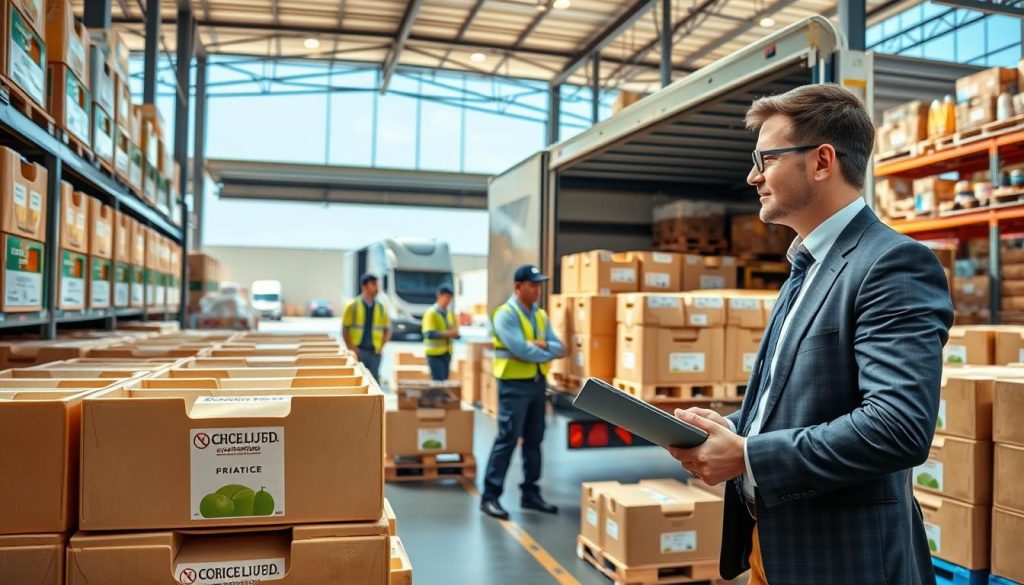
Juice producer partnership: rail-enabled facility advantage with direct rail access (including Mexico connections)
The juice producer partnership began in 2007 following an RFP tied to a new product launch. The aim was to integrate manufacturing support and storage with a third-party logistics provider. This provider had to meet global standards.
The STG unit involved was Dura Freight at the time, with six buildings in its portfolio. The site’s active rail spur provided direct rail access, including to Mexico. This met the customer’s need for a rail-enabled facility.
Customized warehouse design: pushback and flow racking built for deep lanes and efficient in/out flows
The warehouse design focused on pushback and flow racking to boost inbound and outbound speeds. It featured deep-lane storage up to 17 pallets per lane. This supported tighter slotting and cleaner pick paths for steady distribution.
Material handling routes were designed for predictable staging and quick turns. This layout reduced re-handling and supported clearer cycle counting for higher inventory accuracy.
Facility retrofit highlights: insulated metal panels, reinforced footings, and expanded rail door capacity
The retrofit included insulated metal panels and reinforced footings, along with rail door reconfiguration. Rail doors were expanded from six to eight, requiring wall removal, structure extension, and door alignment for operational fit.
Construction was done while the team implemented the WMS, recruited and trained staff, and procured equipment. This parallel work revealed the real constraints in warehousing: IT cutovers, staffing ramps, and infrastructure readiness happening simultaneously.
Dairy cooperative agility: rapid expansion after an Australia port strike rerouted freight to the U.S. West Coast
The dairy relationship started in 2016 with a New Zealand dairy cooperative, after the warehousing scope moved to a competitive bid. Six months into operations, an Australia port strike caused shipping uncertainty, rerouting freight to the U.S. West Coast.
STG secured additional space and added wireless infrastructure to bring the site online. Readiness was achieved in under three weeks to receive the first shipment and sustain distribution without extended delays.
Integrated third-party logistics support: drayage, local transportation, and delivery-issue problem solving
As the program grew, STG took on drayage, local transportation, and delivery-issue problem solving. This was previously challenging for the cooperative to manage internally. By 2025, the customer’s first full year using all STG services was supported by dedicated resources focused solely on account execution.
This scope shows how third-party logistics can reduce handoff friction across port pickup, short-haul moves, and final delivery exceptions. It links transportation control back to warehousing solutions that protect service levels under disruption.
| Program element | Juice producer (rail-enabled buildout) | Dairy cooperative (disruption-led expansion) | Operational impact on warehouse distribution |
|---|---|---|---|
| Start point and trigger | 2007 RFP after a new product acquisition; need to align storage with manufacturing support | 2016 bid process; expansion accelerated after an Australia port strike rerouted freight | Defines volume ramp, receiving cadence, and labor scheduling assumptions |
| Key facility differentiator | Active rail spur with direct rail access, including connections to Mexico | Additional space secured quickly and equipped for near-term activation | Improves inbound continuity and reduces dwell time at transfer points |
| Storage engineering | Pushback and flow racking with lanes up to 17 pallets deep | Flexible layout supported by wireless infrastructure for rapid onboarding | Supports faster putaway, cleaner staging, and fewer touches per pallet |
| Retrofit and build scope | Insulated metal panels; reinforced footings; rail doors expanded from 6 to 8 | Space expansion and wireless setup completed in under three weeks | Protects dock capacity and stabilizes appointment flow during peaks |
| Execution constraints managed | Construction while WMS implementation, hiring, training, and equipment procurement ran in parallel | Rapid readiness planning to receive the first shipment during routing changes | Maintains service consistency while systems and processes scale |
| Third-party logistics scope today | Integrated warehousing solutions tied to rail operations and WMS-controlled inventory | Drayage, local transportation, and delivery-issue problem solving; dedicated account resources in 2025 | Reduces handoff friction and improves exception response time |
Sustainability, Green Haul, and Resilience During Supply Chain Disruptions
Shippers now face stricter emissions reporting and supplier scorecards. Sustainability is no longer a side effort but a core part of procurement. STG Logistics offers programs that support daily transportation logistics without adding complexity.
Green Haul Solution as a practical transportation option
STG has introduced the Green Haul Solution as an eco-friendly and cost-effective option. It aims to reduce environmental impact while maintaining service levels. This solution helps buyers manage budgets and ESG reporting simultaneously.
Green Haul is ideal for lanes where efficient routing and equipment planning can cut waste. This is critical when capacity is limited and shipments must adhere to tight schedules.
Operational resilience during labor and weather disruptions
Risk planning often fails at the port gate. CEO Paul Svindland emphasizes adapting to port worker strikes and snowstorms. Scale and flexibility are key to keeping freight moving through global networks.
Resilience in logistics teams involves having alternate paths, rail options, and quick rebooking. These measures help manage detention and reduce inventory shocks.
Technology investments aimed at speed and service
STG plans to invest in emerging technology to streamline operations and enhance customer service. This includes tighter milestone tracking, improved exception management, and faster decision-making.
| Decision factor for shippers | What STG highlights | How it affects planning |
|---|---|---|
| Emissions and ESG reporting | Exploring ESG solutions tied to cost-effective execution | Supports supplier scorecards without forcing a separate process |
| Disruption readiness | Adaptation for strike risk and snowstorm impacts | Improves contingency routing and reduces schedule volatility |
| Operational efficiency | Emerging technology investments to streamline workflows | Faster exception response and clearer service accountability |
| Network coordination | Linking port, rail, and inland steps through integrated logistics services | Fewer handoff gaps across global logistics moves |
Conclusion
stg logistics has evolved significantly from its CFS warehousing roots in 1985 to a full-fledged port-to-door service. This transformation was fueled by strategic acquisitions, including Channel Distribution and Summit NW Corp. The company further expanded with XPO Intermodal in 2022 and Best Dedicated Solutions in 2023. Its partnerships with CSX and Union Pacific have enhanced its rail network, ensuring better lane consistency, reduced dwell times, and smoother handoffs.
For procurement teams, the choice hinges on several key factors. These include the strength of containerized freight, the quality of intermodal and drayage services, and the efficiency of its warehousing. The company excels in cross-dock operations, real-time inventory management, and maintaining food-grade standards. Its commitment to cold chain compliance is evident through Oregon Tilth organic certification and AIB facility certification, ensuring audit readiness and brand protection.
stg logistics has proven its worth beyond traditional freight forwarding. It has implemented a rail-enabled facility with connections to Mexico, built racking up to 17 pallets deep, and increased rail doors from 6 to 8. This has significantly boosted its throughput capacity. During a recent disruption, the company successfully rerouted to the U.S. West Coast in under three weeks, demonstrating its agility and preparedness.
stg logistics stands out in the NVOCC, CFS, and LCL sectors with its focus on speed and reliability. The company prioritizes dock-to-office alignment, tracks throughput, and monitors customer satisfaction daily. Its commitment to technology and sustainability, as seen in its Green Haul program, reflects its dedication to cost savings, emissions reduction, and resilience in modern supply chain management.
FAQ
What is STG Logistics’ core positioning in U.S. logistics services?
STG Logistics is a leading provider of containerized freight and integrated port-to-door logistics services in the U.S. It boasts a national footprint, with access to every major rail ramp and port. This supports end-to-end execution from the port/rail interface to final delivery.
How long has STG Logistics operated in supply chain management?
Founded in 1985 as St. George Logistics, STG Logistics has been in the logistics and supply chain business for over 40 years. A recent PRNewswire release highlights this milestone, underscoring its commitment to long-term transportation logistics and inventory management.
What service lines does STG Logistics report across transportation logistics and warehousing solutions?
STG Logistics offers a wide range of services, including asset-based intermodal transportation, marine and rail drayage, warehousing, transloading, contract logistics, and over-the-road FTL and LTL. These services are designed to support seamless execution from port to door, reducing handoff friction between modes.
What corporate ownership context is relevant for procurement and governance reviews?
STG Logistics is a portfolio company of Wind Point Partners, Duration Capital Partners, and Oaktree Capital Management. This ownership structure is important for enterprise decision-makers, influencing supplier due diligence, investment capacity, and continuity planning in third-party logistics relationships.
How did STG evolve from CFS warehousing into integrated port-to-door solutions?
STG grew from a CFS warehousing company to an integrated provider of port-to-door solutions. It expanded into intermodal, drayage, transloading, contract logistics, and over-the-road services through strategic acquisitions. These moves aimed to build a network of localized expertise and improve throughput at key nodes.
What acquisitions are cited as expanding capacity, asset scale, and nationwide coverage?
STG reports several milestones that have broadened its reach. In 2019, it launched the STG Logistics brand after acquiring Channel Distribution and Summit NW Corp. In 2022, the acquisition of XPO Intermodal added 15,000 intermodal containers across North America and Mexico. The acquisition of Best Dedicated Solutions in 2023 further expanded its over-the-road network, achieving true nationwide coverage.
How does STG support reliable intermodal and drayage execution for containerized freight?
STG has long-term partnerships with CSX and Union Pacific Railroads for intermodal services. These partnerships support consistent capacity planning and network reliability for containerized freight, ensuring smooth moves between ports, rail ramps, transloading sites, and customer distribution points.
What operational levers does STG emphasize to improve CFS/LCL performance for NVOCC and freight forwarding partners?
STG focuses on speed and reliability to differentiate its CFS/LCL operations for global logistics partners. It aims to keep trucks flowing, using metrics for throughput and customer satisfaction. The company also seeks to improve dock-to-office alignment to reduce dwell and stabilize handoffs.
What warehousing solutions and inventory management capabilities are stated in STG materials?
STG offers a range of warehousing solutions, including traditional storage, efficient cross-docking, and real-time inventory control. These capabilities support tighter inventory management, improved replenishment planning, and smoother transitions from inbound containers to outbound orders.
What cold chain logistics controls and certifications does STG cite for food-grade handling?
STG provides temperature-controlled warehouses and transportation solutions to safeguard product integrity. It uses technology tools and rigorous safety standards. The company also references quality control processes for temperature-sensitive goods, including Oregon Tilth Certification and AIB Certified Facility designations.
Where is a published STG cold food storage contact location listed for verification?
STG’s cold food storage overview lists: 951 Thorndale Avenue, Bensenville, IL 60106, 630.581.0519, and sales@stgusa.com. These details can support vendor validation and facility-level documentation requests for compliance teams.
What examples show STG applying warehouse technology and WMS discipline in operations?
STG adopted the Red Prairie WMS for a juice producer case. The implementation ran in parallel with recruiting and training a warehouse team and procuring equipment. This illustrates integrated change management across IT, staffing, and facility readiness for real-time visibility and throughput control.
What operational proof points are cited from customer solutions for port-to-door execution?
The juice producer case began in 2007 with STG operating as Dura Freight. The selected facility had an active rail spur with direct rail service connections, including Mexico. The warehouse featured pushback and flow racking with lanes up to 17 pallets deep, and a retrofit that expanded rail doors from six to eight.
How does STG describe resilience during disruptions such as port actions or severe weather?
CEO Paul Svindland emphasizes adapting to constant disruption, including port strikes and snowstorms. A dairy cooperative case notes that after an Australia port strike, STG quickly acquired additional warehouse space and equipped it with wireless infrastructure, ensuring continuity for inbound receipt and downstream distribution.
How does Mexico connectivity factor into STG’s coverage claims for U.S. shippers?
STG extends its shipping solutions to customers with logistics needs in Mexico. The juice producer case cites rail service connections including Mexico, and the 15,000 intermodal containers added through the XPO Intermodal acquisition span North America and Mexico. This footprint supports routing alternatives, reduces interline friction, and simplifies supplier governance for cross-border programs.
What is STG’s sustainability signal for shippers tracking emissions and ESG scorecards?
STG launched STG’s Green Haul Solution as an environmentally friendly and cost-effective transportation option. The company is also exploring additional ESG solutions to minimize environmental impact while maintaining cost-effectiveness, aligning with shipper reporting requirements and supplier sustainability evaluations.