
Online Degree in Logistics & Supply Chain Management
Today’s supply chains operate under tight deadlines, fluctuating freight costs, and strict regulations. For those already in the workforce, an online logistics degree can be a game-changer. It equips professionals to manage complex networks spanning suppliers, ports, warehouses, and delivery services.
U.S. universities have developed online programs tailored for working adults. Ball State University offers a 100% online bachelor’s degree. It’s designed for those who need flexibility, with asynchronous courses and weekly deadlines. This format is ideal for teams in procurement and logistics that cannot stop operations for fixed class times.
At the graduate level, The University of Southern Mississippi (Southern Miss) provides a Logistics and Supply Chain Management M.S. entirely online. No campus visits are required, though some online lectures might be necessary. The program consists of 30 credit hours, priced at $578.12 per credit hour. It can be completed in 1–3 years, depending on the number of hours enrolled, and does not require a GRE.
Cost and outcomes are key factors in evaluating an online logistics degree. Ball State encourages students to use a cost calculator and offers support from student success specialists. Oregon State University highlights its Career Success Center, which aids in networking, internships, and career planning. This support helps translate coursework into tangible job opportunities.
An online logistics degree is viewed as a strategic investment, like any other business decision. It involves assessing schedule risk, total cost, and the return on investment in new skills. The following sections will explore what students learn, how online delivery works, and how this degree meets employer needs.
Why an Online Degree in Logistics & Supply Chain Management Matters in Today’s Economy
Supply chains play a critical role in shaping inflation, product availability, and service levels in the United States. When lead times increase or quality controls fail, these issues directly impact household budgets and corporate earnings. A supply chain management online program equips individuals with the skills needed for planning, sourcing, logistics, and risk management.
For working adults, the value of such a program is evident. It aligns coursework with current performance metrics like on-time delivery, inventory turns, and total landed cost. Many top online supply chain management degrees also integrate with common employer tools, such as ERP workflows and data dashboards.
How global supply chains impact everyday products, from e-commerce to pharmaceuticals
Oregon State University views the global supply chain as essential for everyday items, including online shopping orders. A single late container or supplier shutdown can lead to stockouts and increased expedited freight costs. These disruptions often require trade-offs between speed, cost, and service.
The quality of pharmaceuticals from overseas is also affected. Regulatory compliance, chain-of-custody, and supplier audits are as critical as price. In a supply chain management online program, learners explore how lead-time variability and quality risks affect distribution networks.
Why employers value efficiency, resiliency, and sustainability skills
OSU highlights the importance of efficiency, resiliency, and sustainability in today’s business landscape. Companies seek experts with advanced skills, including cross-functional coordination and supplier negotiation. Employers measure success through metrics like cycle time, fill rate, and cost-to-serve.
Top online supply chain management degrees focus on analytics, process control, and scenario planning. These skills are vital for resilience planning, such as dual sourcing and safety stock policy. Sustainability efforts often involve packaging, network design, and emissions reporting.
Where logistics leaders work across manufacturing, services, and government
OSU notes that graduates are prepared for roles in operations and procurement management across various sectors. This includes factories, retailers, hospitals, public agencies, and third-party logistics providers. The primary tasks involve setting service targets, managing suppliers, and controlling operating risk.
Ball State reports that in-demand logistics roles nationally average over $100,000 a year. For experienced professionals, a supply chain management online program can serve as a compensation-aligned credential. Many top online supply chain management degrees are designed for managers who need to study while remaining on the job.
| Economic pressure point | What it changes in daily operations | Core capability reinforced in a supply chain management online program | Common employer metric |
|---|---|---|---|
| E-commerce demand spikes | Higher pick/pack volume, tighter delivery windows, more returns | Capacity planning, last-mile coordination, inventory positioning | On-time delivery rate |
| Overseas pharmaceutical sourcing risk | Stricter supplier qualification, more audits, tighter traceability | Supplier risk management, compliance controls, quality assurance | Defect rate per lot |
| Transportation volatility | Mode switching, carrier re-bids, expedited freight decisions | Freight strategy, cost modeling, contract terms | Total landed cost |
| Resilience and sustainability mandates | Network redesign, alternative suppliers, emissions reporting | Scenario analysis, sourcing strategy, sustainability accounting | Days of supply |
logistics and supply chain management degree online: What You’ll Learn and Why It’s Career-Relevant
In a logistics and supply chain management degree online, coursework focuses on skills employers value. Programs like Oregon State University’s emphasize service and logistics operations, project management, data analytics, and forecasting. These topics are directly linked to everyday business decisions.
Many top online logistics courses also focus on decision-making. Students learn to model supply chains, interpret results, and implement changes. They also learn to communicate solutions to teams across finance, operations, and procurement.
Service and logistics operations fundamentals
Operations coursework delves into how work flows through warehouses, transportation networks, and service systems. It covers cycle time, capacity, labor planning, and on-time delivery performance. Metrics like fill rate and order accuracy are used to measure success.
Students also develop project management skills by mapping scope, risks, and handoffs. This structure supports cross-functional execution in roles tied to distribution, customer fulfillment, and operations planning.
Demand planning, forecasting, and inventory strategy
Demand and inventory planning combines forecasting with real-world constraints like lead times and service-level targets. It’s a quantitative field, often focusing on time-series patterns and safety stock logic. Exception-based planning is also a key aspect.
In many top online logistics courses, analytics is seen as a practical skill, not just a theory. Students learn to translate forecast error into cost exposure and service risk. They also brief leaders on the tradeoffs involved.
Procurement, contract management, and supplier relationships
Procurement courses focus on sourcing strategy, total cost of ownership, and supplier performance management. The aim is to develop practical contract management skills. This includes learning terms that affect price, quality, delivery, and liability.
Industry-driven programs, such as Ball State University’s approach, view supplier relationships as part of an operating system. Interdisciplinary instruction connects logistics, technology, and management. This ensures buyers and planners share the same data and operating rules.
Process, quality management, and continuous improvement methods
Process and quality management cover root-cause analysis, control plans, and standard work. Continuous improvement is often applied through Lean Six Sigma tools. The focus is on measurable defect reduction and throughput gains.
Ball State’s capstone-style project themes illustrate how this work applies in practice. Topics include enterprise resource planning (ERP) adoption, green movement initiatives, and global manufacturing strategies. A logistics and supply chain management degree online views these as systems changes with costs, timelines, and change-management risks.
| Curriculum focus | Employer-recognized competency | Typical work output | Business metric influenced |
|---|---|---|---|
| Service and logistics operations |
service and logistics operations, project management |
Process map, labor plan, SOP updates |
On-time delivery, order accuracy, cost per shipment |
| Demand planning and forecasting |
forecasting, demand and inventory planning, data analytics |
Forecast model review, bias report, inventory policy |
Fill rate, stockouts, inventory turns, working capital |
| Procurement and supplier management |
contract management, supplier relationship management |
RFP evaluation, scorecard, negotiated terms summary |
Total landed cost, supplier OTIF, quality defects |
| Process and quality management |
process and quality management, continuous improvement |
Lean Six Sigma DMAIC storyboard, control plan |
Scrap rate, rework hours, cycle time, customer returns |
Across these topics, the strongest programs train students to provide analysis in supply chain modeling. They also teach them to communicate action plans to stakeholders. This blend of operational fluency and data-backed reporting is a hallmark of the best online logistics courses used by professionals.
Online Logistics Degree Format and Scheduling for Working Adults
For working adults, the delivery model is as critical as the course content. Online logistics degrees offer a structure that replaces traditional classroom hours. This format allows for virtual training without the need for commuting or fixed schedules.
Asynchronous courses with weekly deadlines and flexible pacing
Ball State University offers many courses asynchronously. Students navigate through readings, recorded lectures, quizzes, and discussions at their own pace. Weekly deadlines ensure the term stays on track.
This method accommodates professionals with variable schedules. It mirrors logistics teams’ work style, with deadlines and performance metrics. It’s a practical way for many to start virtual logistics training.
Balancing work, family, and coursework by taking one or two classes at a time
Ball State suggests taking one or two courses at a time. This approach helps avoid overload and protects time for work and family. It’s a common strategy for achieving a sustainable balance.
It also aids in managing time for detailed assignments. With an online logistics degree, a lighter course load supports consistent skill development. This is true across each term.
| Scheduling element | What it looks like in practice | Why it matters for working adults |
|---|---|---|
| Asynchronous coursework | Recorded content, assigned readings, discussion boards, and self-paced modules | Allows study blocks around shift work, travel, and family schedules |
| Weekly deadlines | Set due dates for posts, quizzes, case write-ups, and problem sets | Creates routine and supports on-time completion across a full term |
| One or two classes at a time | Reduced simultaneous courses until a steady workload is established | Lowers burnout risk while maintaining forward momentum |
| Online student support events | Live information sessions plus free on-demand webinars | Gives clear checkpoints for program fit, pacing, and expectations |
What “100% online” can look like, including occasional instructor-led online lectures
The University of Southern Mississippi offers a 100% online program. There’s no need to visit campus for lectures. Occasionally, an online lecture may be required, which could be a video session, live review, or presentation.
Before enrolling, decision support is key. Ball State provides live online sessions and free webinars. For example, a 7 p.m. Eastern webinar on Wednesday, June 3, 2026, focuses on online bachelor’s degrees. These resources help candidates assess the program’s fit within their demanding work week.
Curriculum Highlights in a Supply Chain Management Online Program
Coursework is a key differentiator between a general business program and a supply chain management online program. These programs focus on freight flow, distribution strategy, and analytics. They support the day-to-day operations of logistics.
At The University of Southern Mississippi (Southern Miss), the advanced logistics curriculum is designed for online study. The program states that not all University Bulletin choices are available online. Yet, there are enough online options to complete the degree.
Transportation systems and freight management concepts
Transportation content covers cost-to-serve, carrier selection, and service constraints across various modes. Southern Miss emphasizes transportation systems for efficient supply chain navigation and freight management. This includes planning, dispatch, and performance metrics.
Distribution systems and evolving distribution methods
Distribution courses focus on facility roles, labor planning, and network throughput. Southern Miss highlights new and evolving distribution methods. This reflects how e-commerce, parcel density, and customer lead-time targets reshape fulfillment design.
Supply chain design, modeling, and analysis for better decision-making
Design and analytics topics connect network trade-offs to governance, budgeting, and service targets. Oklahoma State University (OSU) offers training in supply chain modeling. It also teaches the ability to communicate solutions, positioning modeling as a management tool.
Global supply chain management and cross-border complexity
Global coursework addresses Incoterms, landed cost, compliance documentation, and disruption exposure. In top online supply chain management degrees, this content is paired with scenario planning. This allows managers to compare cycle time, duty impact, and resiliency options without slowing execution.
| Course example (Southern Miss) | Credit hours | Primary capability built | Operational decisions supported |
|---|---|---|---|
| Logistics Transportation Systems | 3 hrs. | Mode economics, capacity constraints, and freight management controls | Carrier strategy, routing trade-offs, on-time performance targets |
| Logistics Distribution Systems | 3 hrs. | Distribution design with new and evolving distribution methods | Facility roles, fulfillment flow, last-mile service levels |
| Supply Chain Design and Management | 3 hrs. | Network structure, sourcing footprint, and end-to-end coordination | Make-buy choices, node placement, service-to-cost alignment |
| Supply Chain Modeling and Analysis | 3 hrs. | Quantitative evaluation for planning and governance; decision communication | Scenario comparison, KPI dashboards, inventory and capacity policies |
| Global Supply Chain Management | 3 hrs. | Cross-border complexity, compliance factors, and landed-cost logic | Trade lane selection, lead-time buffers, supplier risk controls |
| Advanced Supply Chain Management | 3 hrs. | Integrated strategy across procurement, operations, and logistics performance | Cost-to-serve management, resiliency planning, continuous improvement |
Hands-On Learning Online: Internships, Experiential Projects, and Capstones
Online coursework can remain practical with applied work integrated into the schedule. In distance learning supply chain management, hands-on activities help students apply concepts like inventory control and freight planning. Employers value this applied output as much as academic transcripts.
Effective models support virtual logistics training through structured deliverables and peer collaboration. This approach ensures work can be reviewed and discussed professionally, even across different time zones.
Building an industry internship that fits work and location
Ball State’s applied-learning model serves as a template for online programs. Students can develop an internship at their current workplace or explore roles with other businesses or governmental organizations. This aligns with their professional goals, schedule, and location, reducing commuting barriers.
For distance learning supply chain management students, internships focus on KPIs and process discipline. Assignments include cycle count accuracy and supplier lead-time variability. Students document the baseline, test a change, and report the outcome.
Experiential options beyond internships
Ohio State University (OSU) requires an experiential learning opportunity for consistent outcomes. This can be a project, thesis, internship, or study abroad experience, coordinated with faculty and advisors. The work can be completed from wherever the student is located, supporting virtual logistics training for working adults.
These formats address various operating problems. A project might focus on network design, while a thesis tests forecasting bias. Study abroad alternatives can involve cross-border compliance and Incoterms.
| Applied format | Typical supply chain focus | What gets produced | Why it works online |
|---|---|---|---|
| Faculty-guided project | Demand planning, inventory policy, transportation spend | Data set, model outputs, and a decision memo with assumptions | Clear milestones and review points support distance learning supply chain management |
| Internship (current employer or new placement) | Process control, supplier performance, warehouse productivity | Baseline metrics, improvement plan, and results summary | Worksite access plus structured reporting strengthens virtual logistics training |
| Thesis option | Forecast error, risk exposure, sustainability reporting | Research design, analysis, and defensible findings | Faculty supervision and repeatable methods keep standards consistent |
| Study abroad experience or alternative | Global sourcing, customs, cross-border lead times | Operational briefings and a comparative process analysis | Remote coordination supports location flexibility without losing rigor |
Capstone work tied to real company challenges
Ball State’s senior capstone is a Supply Chain Integration Project with a top company on a critical initiative. Online teams plan, develop, and present viable alternatives, mirroring internal consulting. This structure ensures decision quality and operational constraints are met.
Capstones tackle global manufacturing strategies and sustainability. They focus on measurable targets like cost reduction and sustainability reporting. This process involves defining problems, testing options, and presenting trade-offs for leaders to act on.
Accreditation, Rankings, and How to Spot an Accredited Online Logistics Program
Finding the right online logistics program requires more than a simple search. Applicants aim to identify programs with strong academic standards, quality instruction, and career support. These factors distinguish top online supply chain management degrees from others.
Why AACSB accreditation matters for business-based supply chain programs
AACSB International is a key indicator for business schools. For supply chain programs, it shows structured faculty governance and ongoing quality checks.
Oregon State University’s program is a prime example. It’s offered by the Oregon State University College of Business, which holds AACSB accreditation. This accreditation is a clear, verifiable sign for those comparing programs.
How program rankings can reflect online academic quality
While rankings are not a substitute for accreditation, they offer a third-party view on quality. Oregon State University ranks No. 4 nationally in Best Online Bachelor’s in Business Programs by U.S. News & World Report. This ranking is based on academic standards.
For those looking at top online supply chain management degrees, rankings help focus on what matters most. This includes curriculum depth, faculty expertise, and student services.
What to verify before enrolling: college, program oversight, and outcomes support
Before applying, it’s essential to confirm the degree’s ownership and issuance. Oregon State University clearly states that its College of Business offers the degree. This clarifies academic oversight.
Ball State University emphasizes degree equivalence, stating that online and on-campus students earn the same Ball State degree. This clarity is important when comparing online and campus-based programs.
Outcomes support should also be specific. Oregon State University’s College of Business Career Success Center supports career development. It provides networking opportunities with employers, leading to internships and jobs.
Prospects can follow Ball State’s lead by asking for details on degree requirements, admissions, and rankings & accreditation. This due diligence ensures fair comparisons across different online supply chain management degrees.
| Verification focus | What to check | Why it matters for evaluation |
|---|---|---|
| Accreditation signal | AACSB International accreditation at the business-school level (example: Oregon State University College of Business) | Indicates a formal quality framework for business education and governance |
| Academic ownership | Degree offered by a named college (example: OSU states it is offered by its College of Business) | Clarifies who controls curriculum, faculty oversight, and program standards |
| Credential equivalence | School statement that online students earn the same degree as on-campus students (example: Ball State University) | Reduces risk of nonstandard credential language in transcripts and resumes |
| Outcomes infrastructure | Career services unit tied to the program (example: OSU College of Business Career Success Center) | Signals structured support for internships, recruiting access, and job search execution |
| Applicant due diligence | Ability to request degree requirements, admissions information, and rankings & accreditation details (example: Ball State process cues) | Helps validate program governance, entry standards, and support resources before enrollment |
Confirm the accreditor name and the accredited unit (college or school), not only the university brand.
Verify which college issues the degree and who manages curriculum decisions.
Ask how career services connects students to employers, internships, and recruiter networks.
Request written details on degree requirements, admissions, and rankings & accreditation for consistent comparison.
Degree Paths and Time to Completion: Bachelor’s vs. Master’s in Supply Chain
Choosing between a bachelor’s and a master’s degree often hinges on scope, depth, and employer needs. Professionals compare degree maps like they do the best online logistics courses. They look at credit load, required milestones, and schedule risk.
Typical bachelor’s structure, including core education and upper-division requirements
Oregon State University’s B.S. in Supply Chain and Logistics Management requires a minimum of 180 quarter credits. It includes OSU’s Core Education and major requirements. At least 60 upper-division credits focus on applied business and operations coursework.
For transfer planning, OSU notes that some requirements may transfer. Yet, the academic residency rule applies. A minimum of 45 of the last 75 credits must be completed at OSU, either online or on campus. Transfer credits are reviewed upon admittance for articulation.
Master’s program structure built around 30 credit hours and advanced coursework
The University of Southern Mississippi’s M.S. is a 30 total credit-hour, interdisciplinary program. It focuses on transportation management, freight management, distribution methods, supply chain design, and global supply chain management.
In many organizations, this program validates advanced planning and network decision skills. It supports roles in procurement analytics, carrier strategy, and cross-border operations.
Completion timelines that can fit full-time and part-time schedules
Southern Miss offers two clear pacing options. Full-time study can finish in one year by taking 12 hours in fall, 12 hours in spring, and 6 hours in summer.
Part-time study can finish in two years by taking 3–6 hours during fall, spring, and summer. This structure helps working adults keep steady progress while managing peak seasons and travel windows.
Oregon State University also offers an acceleration route through its Accelerated Master’s Platform. Current undergraduates can take graduate-level courses online that apply to the bachelor’s degree. Then, they can transfer into an MBA or M.S. in Business, with graduate tuition and fees charged for those graduate courses.
| Pathway | Credit requirement | Program design focus | Published completion pace | Planning constraint to flag |
|---|---|---|---|---|
| Oregon State University B.S. in Supply Chain and Logistics Management | Minimum 180 quarter credits; at least 60 upper-division credits | OSU Core Education plus major requirements in Supply Chain and Logistics Management | Varies by course load; structured for online or on-campus completion | Academic residency: 45 of the last 75 credits must be completed at OSU; transfer credits reviewed upon admittance |
| University of Southern Mississippi M.S. (Supply Chain) | 30 total credit hours | Interdisciplinary coverage of transportation management, freight management, distribution methods, supply chain design, and global supply chain management | Full-time: 1 year (12 fall, 12 spring, 6 summer); Part-time: 2 years (3–6 hours each term) | Term-by-term load drives the timeline and capacity for intensive projects |
Candidates often benchmark options by comparing degree structure to the best online logistics courses they’ve completed. A clear credit plan and a transparent calendar reduce rework, protect tuition spend, and keep a supply chain management online program aligned with promotion timelines.
Admissions and Application Requirements for Distance Learning Supply Chain Management
Admissions in distance learning supply chain management are based on measurable criteria and documentation. For the University of Southern Mississippi’s M.S. in Logistics and Supply Chain Management, applicants must have a minimum 2.75 GPA on a 4.0 scale. This GPA is calculated on the last 60 undergraduate credit hours, supported by an official transcript.
Southern Miss does not require the GRE, which can reduce application friction for working professionals. The online application also calls for a current resume or curriculum vitae (CV). This should summarize roles, operations exposure, and analytics tools used on the job.
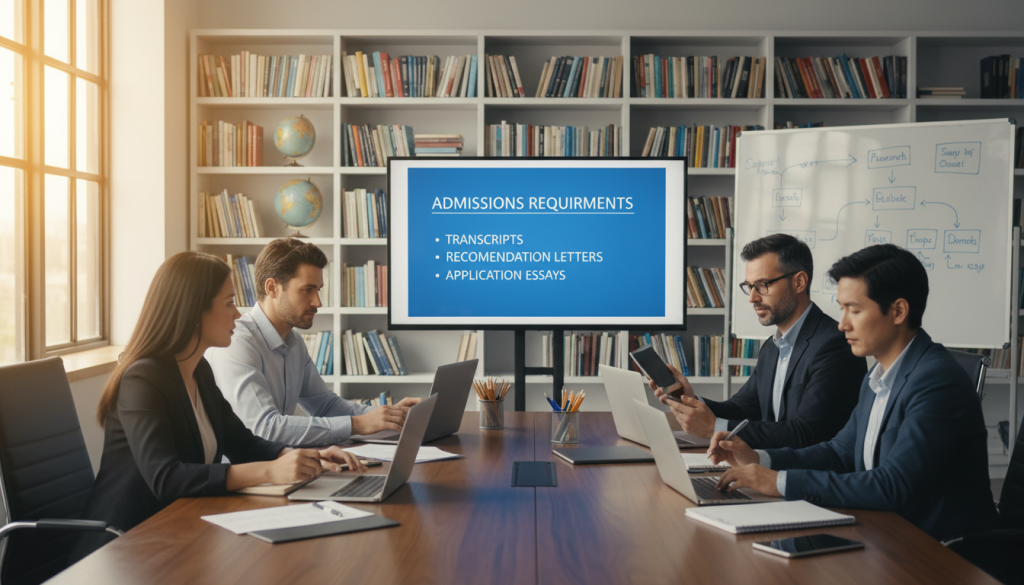
For applicants evaluating an accredited online logistics program, recommendations and writing samples carry real weight. Southern Miss requires three letters of recommendation from qualified evaluators. These are usually direct supervisors or academic faculty members, with specific feedback on readiness for graduate-level workload and professional judgment.
The same program also requires a Statement of Qualification (SOQ). It must be 2–3 pages, double-spaced. The SOQ should cover areas of interest, career goals, why the program is the right fit, and how prior education and experience connect. It should also explain how the degree is expected to improve career outcomes.
International applicants should plan for English proficiency review. Non-native English speakers must meet minimum TOEFL or IELTS scores based on university standards. This is a common screening step in distance learning supply chain management programs.
| Requirement or Policy | What the Applicant Submits or Completes | Operational Impact on Progress |
|---|---|---|
| Southern Miss GPA threshold | Minimum 2.75 GPA (4.0 scale) on the last 60 undergraduate hours, shown on an official transcript | Sets an explicit academic baseline used in admissions decisions |
| Southern Miss test policy | No GRE required | Shortens the timeline to apply and can lower total prep cost |
| Southern Miss professional record | Current resume or CV submitted through the online application | Supports evaluation of industry scope, leadership, and technical capability |
| Southern Miss recommendations | Three letters from direct supervisors or academic faculty members | Adds third-party evidence of performance and graduate readiness |
| Southern Miss SOQ | 2–3 pages, double-spaced; interests, goals, rationale, fit, and expected benefits | Measures writing clarity and alignment with program outcomes |
| Southern Miss progression gates | Degree plan approved by a faculty adviser and program coordinator before completing more than nine (9) graduate hours | Reduces course misalignment risk and improves time-to-degree control |
| Southern Miss academic standing and completion | Maintain a cumulative 3.0 graduate GPA; complete a comprehensiv eexamination and a mastery project (normally in the final semester) | Defines retention standards and verifies applied competence before graduation |
Credit transfer can also affect admissions planning for an accredited online logistics program. At Oklahoma State University, previously earned credits are reviewed upon admittance for articulation. The College of Business provides an unofficial transcript evaluation process alongside Transfer Credit Central guidance.
Application costs may shift based on how prospects engage with recruiting events. Ball State University ties one measurable incentive to participation: registering for a live online information session allows prospective students to apply for free. The waiver does not apply to on-demand webinars.
Across these examples, distance learning supply chain management applicants benefit from treating admissions as a documentation workflow. A well-organized transcript file, targeted recommendations, and a focused SOQ help reviewers compare candidates across an accredited online logistics program without relying on test scores alone.
Tuition, Fees, and Tools to Estimate Your Total Cost
Before diving into an online logistics degree, to know the costs is essential. Tuition per credit, course fees, and tools for analytics or collaboration are key factors. These elements significantly influence the total cost.
Using a tuition or cost calculator to plan ahead
Ball State suggests using a cost calculator for prospective students. This tool helps estimate education expenses. Student success specialists can further refine this estimate, considering pacing, credit load, and billing timing.
For an online logistics degree, this method distinguishes between fixed and variable costs. Fixed costs remain constant, while variable costs fluctuate based on course format or term schedule.
Examples of per-credit pricing and typical online course fees
Southern Miss provides a clear benchmark for an M.S. program: $578.12 per credit hour for a 30-credit-hour plan. This figure serves as a baseline tuition estimate, excluding institutional or course-level fees.
Southern Miss also notes that additional online course fees may apply, ranging from $20 to $60. Some courses may incur extra charges for items like books, meals during in-person components, or special technology, depending on the course design.
| Cost item | Southern Miss example | What it covers | How it changes the estimate |
|---|---|---|---|
| Tuition (per credit hour) | $578.12 | Instructional cost billed by enrolled credits | Sets the main baseline for a 30-credit plan |
| Program credit total | 30 credit hours (M.S.) | Degree requirement used for a starting forecast | Enables a straightforward tuition-only calculation |
| Typical online course fee range | $20 to $60 (when assessed) | Course-level charges tied to delivery or materials | Adds variable cost by course and term |
| Possible added course-specific costs | May include books, meals during in-person components, or special technology | Items required by course design or learning activities | Can shift term-by-term budgeting for an online logistics degree |
Resident vs. out-of-state tuition approaches for online learners
Residency rules can significantly impact total cost, affecting multi-state applicants. Southern Miss clarifies that online students pay resident tuition, avoiding out-of-state fees. This policy helps control costs.
For an online logistics degree, it’s vital to review residency pricing policies alongside fees and course requirements. This ensures a well-informed budget before enrollment.
Financial Aid, Grants, Scholarships, and Employer Support for Online Learners
Choosing a program can be influenced by financial decisions. For many working adults, the details of financial aid are as important as the course design. This is true when comparing an accredited online logistics program to campus options.
Well-structured awards play a significant role in evaluating top online supply chain management degrees. They can reduce first-term costs or cover high-fee graduate credits. This support is vital for professionals.
Adult learner grants and eligibility examples, including age and residency requirements
State grants often target adults returning to finish an undergraduate degree. Ball State University materials highlight the Indiana Commission for Higher Education Adult Student Grant. This is an example used by eligible learners in Indiana.
The Indiana Commission for Higher Education rules state that the Adult Student Grant awards up to $2,000. It is renewable and available to Indiana residents age 25 and older. They must be enrolled, or plan to enroll, in an undergraduate program. Additional requirements are listed by the state.
Online student scholarships and first-term awards that reduce upfront costs
Upfront discounts can lower the first tuition bill and reduce reliance on private borrowing. The University of Southern Mississippi offers an Online Student Scholarship. It provides $500 toward the first semester for first-time, fully online students. Additional scholarships are available through university processes.
For applicants screening top online supply chain management degrees, first-term awards can improve cash flow. They help budget for required costs like proctoring, course materials, and analytics tools.
Assistantships and tuition waivers in eligible graduate pathways
Graduate aid can shift the economics of a master’s track. At the University of Southern Mississippi, graduate assistantships are available for full-time students with regular admission. Assistantships can provide up to a full tuition waiver, including out-of-state tuition, plus a stipend.
Southern Miss also offers a tuition-free senior benefit with strict limits. Mississippi legal residents age 62 or older may enroll tuition-free in up to six (6) semester hours in fall or spring terms only. This is across Online, Hattiesburg, and Gulf Coast campuses, on a space-available, first-come, first-served basis.
Employer tuition assistance can complement these options. It is often aligned with workforce planning for procurement, transportation, and operations roles. When policies reimburse after a grade posts, learners in an accredited online logistics program may need short-term financing to bridge billing cycles.
| Support type | Provider | Benefit level | Who may qualify | Key constraints to plan for |
|---|---|---|---|---|
| Adult Student Grant | Indiana Commission for Higher Education (referenced in Ball State University materials) | Up to $2,000; renewable | Indiana residents age 25+ in an undergraduate program (enrolled or to be enrolled) | Subject to additional state requirements; award timing and documentation rules can affect disbursement |
| Online Student Scholarship | The University of Southern Mississippi | $500 toward the first semester | First-time, fully online students | Applies to the first semester; other scholarships follow separate university review steps |
| Graduate assistantship | The University of Southern Mississippi | Up to a full tuition waiver (including out-of-state tuition) plus a stipend | Eligible graduate students who are full-time with regular admission | Competitive placement; workload expectations can influence course load and scheduling |
| Senior tuition-free enrollment benefit | The University of Southern Mississippi | Tuition-free enrollment in up to six (6) semester hours | Mississippi legal residents age 62+ | Fall or spring only; space-available, first-come, first-served; available across Online, Hattiesburg, and Gulf Coast |
Across these options, program cost planning remains practical. Aid is matched to enrollment intensity, residency rules, and billing dates. This financial fit shapes how working professionals compare top online supply chain management degrees without focusing solely on price.
Career Outcomes and Job Market Value of Virtual Logistics Training
The labor market’s scale is a critical factor in career planning. The U.S. employs over five million logistics and supply chain professionals, with demand increasing. This supports long-term career mobility across various industries for those with top online supply chain management degrees.
Virtual logistics training focuses on practical skills like planning, sourcing, and execution under real-world constraints. Oklahoma State University highlights outcomes such as operations and procurement manager roles. These roles are relevant across manufacturing, service sectors, and government agencies. This aligns with employer needs for efficiency and resilience in daily operations.
Employer signals provide practical context to program outcomes. The University of Southern Mississippi reports alumni working at Huntington Ingalls, UPS, Chevron, and Coca-Cola Distribution. Their work spans the U.S. and overseas. Recognizable employers help benchmark job functions, required competencies, and typical promotion paths for professionals comparing degrees.
Outcomes claims must be clearly defined. Southern Miss reports that 100% of graduates find a job in their field within a year. Oklahoma State University notes that job-market tools and salary data are informational. They emphasize that completion does not guarantee employment or a specific salary, even with relevant work experience.
| Outcome signal | What programs commonly report | How employers may use it |
|---|---|---|
| Workforce scale | More than five million U.S. logistics and supply chain professionals (BTS figure cited by Southern Miss); demand described as rising | Supports hiring pipelines for transportation, distribution, procurement, and planning roles |
| Role alignment | Preparation for operations and procurement manager roles across manufacturing, services, and government agencies (OSU positioning) | Maps coursework to job families tied to cost, service levels, and supplier performance |
| Employer examples | Alumni employment reported with Huntington Ingalls, UPS, Chevron, and Coca-Cola Distribution (Southern Miss references) | Signals common hiring environments and compliance expectations, including safety and audit readiness |
| Time-to-job metric | Alumni survey claim: 100% employed in-discipline within one year (Southern Miss) | Used as one data point alongside experience, certifications, and interview performance |
| Compensation framing | In-demand logistics roles nationally average more than $100,000 a year (Ball State messaging) | Helps candidates evaluate total cost, opportunity cost, and likely ROI by career stage |
| Disclosure standard | Job-market tools and salary data are informational; no employment or salary guarantee (OSU note) | Sets realistic expectations for hiring timelines and market variability by region and sector |
Compensation is a key factor in ROI discussions for mid-career candidates. Ball State notes that in-demand logistics roles nationally average over $100,000 a year. This figure is often compared to tuition, time-to-completion, and internal promotion tracks. Top online supply chain management degrees are frequently evaluated alongside virtual logistics training quality, employer tuition support, and the candidate’s current scope of responsibility.
Conclusion
Evaluating a logistics and supply chain management degree online involves a framework: fit, practice, proof, and price. Fit means the program aligns with your schedule, allowing for flexible learning. Practice requires hands-on experience, like internships or industry projects. Proof comes from accreditation and rankings that show the program’s quality and outcomes.
In the U.S., the numbers highlight the trade-offs in distance learning. Oregon State University offers a bachelor’s degree requiring 180 quarter credits, with 60 upper-division credits and a 45-of-last-75 residency rule. The University of Southern Mississippi’s master’s degree is 30 credits at $578.12 per credit, with a 1–3 years completion time. Southern Miss also offers structured plans, including a 1-year full-time and a 2-year part-time option.
The job market for logistics and supply chain professionals is robust. The U.S. Bureau of Transportation Statistics reports more than five million jobs in this field. Employers invest in efficiency, resiliency, and sustainability. A degree in logistics and supply chain management can prepare you for these roles by teaching forecasting, procurement, transportation planning, and process control.
Before making a decision, conduct thorough research. Check for accreditation and the program owner. Review admissions and academic policies, including degree plan approvals and GPA requirements. Use cost calculators to estimate total costs. Also, check for scholarships, grants, and employer tuition benefits. This approach ensures your decision is based on verified data, not marketing promises.
FAQ
Why is a logistics and supply chain management degree online becoming a career lever for working professionals?
Today, multi-node supply chains are essential for business success and risk management. Oregon State University (OSU) emphasizes the role of supply chains in everyday life, from online shopping orders to the quality of pharmaceuticals. OSU notes that companies and governments are focusing on efficiency, resiliency, and sustainability. This demand for tech-savvy professionals with advanced people skills makes an online logistics degree a valuable asset for managers.
What does “fully online” mean in an online logistics degree or distance learning supply chain management program?
The term “fully online” can vary by institution. Ball State University offers a bachelor’s program that is 100% online with asynchronous courses and weekly deadlines, designed for working adults. The University of Southern Mississippi (Southern Miss) provides its Logistics and Supply Chain Management M.S. totally online with no campus visits required, though an online lecture may be required by the instructor.
How long does a supply chain management online program typically take, and what pacing works for working adults?
Southern Miss offers a 1–3 year completion window for its M.S., depending on hours enrolled. It provides clear schedules: one year full-time or two years part-time. For bachelor’s study, Ball State notes many online learners take one or two courses at a time to balance work, coursework, and personal responsibilities.
What will students learn in a top online supply chain management degree—and which skills do employers recognize?
Oregon State University (OSU) lists core competency areas employers value: service and logistics operations, project management, data analytics, forecasting, contract management, demand and inventory planning, and process and quality management. OSU states students learn to provide insights and analysis in supply chain modeling and to interpret, implement, and communicate innovative solutions. This positions the curriculum as applied management capability, not just technical training.
What do real course titles look like in an online master’s logistics curriculum?
Southern Miss provides course-level examples aligned to core logistics functions, including Logistics Transportation Systems (3 hrs.), Logistics Distribution Systems (3 hrs.), Supply Chain Design and Management (3 hrs.), Supply Chain Modeling and Analysis (3 hrs.), Global Supply Chain Management (3 hrs.), and Advanced Supply Chain Management (3 hrs.). Southern Miss describes the program as introducing new and evolving distribution methods, transportation systems, supply chain design, and global supply chain management, with attention to efficient navigation of supply chains and freight management. The university also cautions the list is a guide and that not all University Bulletin choices are available online, while stating there are sufficient online options to complete the degree.
How do internships, experiential learning, and capstones work in virtual logistics training?
Ball State frames applied learning as a core feature: students can develop an internship at their current workplace or pursue roles with other businesses or governmental organizations, shaped around professional goals, schedule, and location. Ball State’s senior capstone is a “Supply Chain Integration Project” where students work with a top company on a high-priority initiative, collaborating online to plan, develop, and present viable alternatives; example themes include Lean Six Sigma, enterprise resource planning (ERP), the green movement, and global manufacturing strategies. Oregon State University also requires an experiential learning opportunity—a project, thesis, internship, or study abroad experience—coordinated with faculty and an academic advisor and completed from wherever the student is located.
How can prospective students verify they are choosing an accredited online logistics program?
Verification should start with clear academic ownership and third-party benchmarks. Oregon State University (OSU) states its program is offered by the Oregon State University College of Business, which is accredited by AACSB International (The Association to Advance Collegiate Schools of Business). OSU also reports a No. 4 national ranking by U.S. News & World Report in Best Online Bachelor’s in Business Programs based on academic quality. Ball State emphasizes credential equivalence by stating students earn a Ball State degree whether courses are taken online or in a physical classroom, and it encourages prospects to request information on degree requirements, admissions information, and rankings & accreditation.
What are the key structure rules for an online bachelor’s pathway in supply chain and logistics?
Oregon State University publishes specific degree requirements for planning and transfer-risk control: the B.S. requires a minimum of 180 quarter credits, including at least 60 upper-division credits, combining OSU’s Core Education with major requirements in Supply Chain and Logistics Management. OSU also states an academic residency requirement: a minimum of 45 of the last 75 credits must be completed at OSU (online or on campus). Previously earned credits are reviewed upon admittance for articulation, and OSU supports planning with an unofficial transcript evaluation and Transfer Credit Central.
What admissions requirements and academic policies apply to Southern Miss’s online M.S. in Logistics and Supply Chain Management?
Southern Miss requires a minimum 2.75 GPA on the last 60 hours of undergraduate study (4.0 scale) and an official transcript, plus a current resume or CV, three letters of recommendation (such as direct supervisors or academic faculty), and a Statement of Qualification that is 2–3 pages, double-spaced, covering areas of interest and career goals. Southern Miss states no GRE required and notes English proficiency requirements for non-native speakers via TOEFL or IELTS per university standards. Policy gates include a degree plan approved by a faculty adviser and the program coordinator before completing more than nine (9) hours, maintaining a 3.0 cumulative GPA, and graduating with a comprehensive examination plus a mastery project, typically in the final semester.
What does the cost look like for a supply chain management online program, and which tools help estimate total expenses?
Southern Miss provides a clear baseline: the M.S. is 30 total credit hours at 8.12 per credit hour, enabling a straightforward tuition estimate before institutional or course-level fees. Southern Miss also reports that additional course fees may apply and typically range from to ; some courses may have additional fees for items such as books, meals during in-person components, or special technology, depending on course design. For planning support, Ball State encourages prospective students to use a cost calculator and notes student success specialists can assist with academic and cost planning.
How does resident vs. out-of-state pricing work for online students at Southern Miss?
Southern Miss states that online students pay resident tuition and do not pay out-of-state tuition. For multi-state applicants, this policy functions as a direct cost-control factor when comparing an online logistics degree across public universities.
What financial aid options are highlighted for online learners, including adult grants and scholarships?
Ball State references the Indiana Commission for Higher Education’s Adult Student Grant, which awards up to ,000, is renewable, and is available to Indiana residents age 25 and older enrolled (or to be enrolled) in an undergraduate program, subject to additional state requirements. Southern Miss lists an Online Student Scholarship that provides 0 toward the first semester for first-time, fully online students, with additional scholarships posted through the university. Southern Miss also states that graduate assistantships are available for eligible full-time students with regular admission and can provide up to a full tuition waiver plus a stipend.
Are there special tuition benefits for older learners at Southern Miss?
Southern Miss states that Mississippi legal residents age 62 or older may enroll tuition-free in up to six (6) semester hours for fall or spring terms only. The benefit applies across Online, Hattiesburg, and Gulf Coast campuses on a space-available, first-come, first-served basis.
What career outcomes and labor-market signals support the ROI case for the best online logistics courses and degree programs?
Southern Miss cites the Bureau of Transportation Statistics (BTS) figure that the U.S. employs more than five million logistics and supply chain professionals, with demand described as rising. Oregon State University reports that graduates are prepared for roles such as operations and procurement manager across manufacturing and service sectors and in government agencies. Ball State states that in-demand logistics roles nationally average more than 0,000 a year, positioning a logistics and supply chain management degree online as a compensation-aligned credential for experienced professionals. Southern Miss also notes alumni employer examples including Huntington Ingalls, UPS, Chevron, and Coca-Cola Distribution, and states that, based on its alumni survey, 100% of graduates land a job related to the discipline within a year of graduation; Oregon State University separately cautions that job-market tools and salary data are informational and that completion does not guarantee employment or a specific salary.
What support resources should professionals look for when comparing top online supply chain management degrees?
Support signals are often documented directly in program materials. Ball State promotes live online information sessions and free on-demand webinars, and provides a specific example: a 7 p.m. Eastern webinar on Wednesday, June 3, 2026 focused on online bachelor’s degrees; Ball State also states that registering for a live information session allows prospective students to apply for free, while the waiver does not apply to on-demand webinars. Oregon State University highlights the College of Business Career Success Center, which supports networking with employers and recruiters, internships and jobs, and career-path development.