
CLTD Certification Cost in the USA | Fees Guide
In the United States, the ASCM Certified in Logistics, Transportation and Distribution (CLTD) credential is a key indicator of skills in logistics and distribution roles. This guide provides a detailed look at the cltd certification cost, tailored for employers and individuals in the U.S. It offers a practical budget perspective.
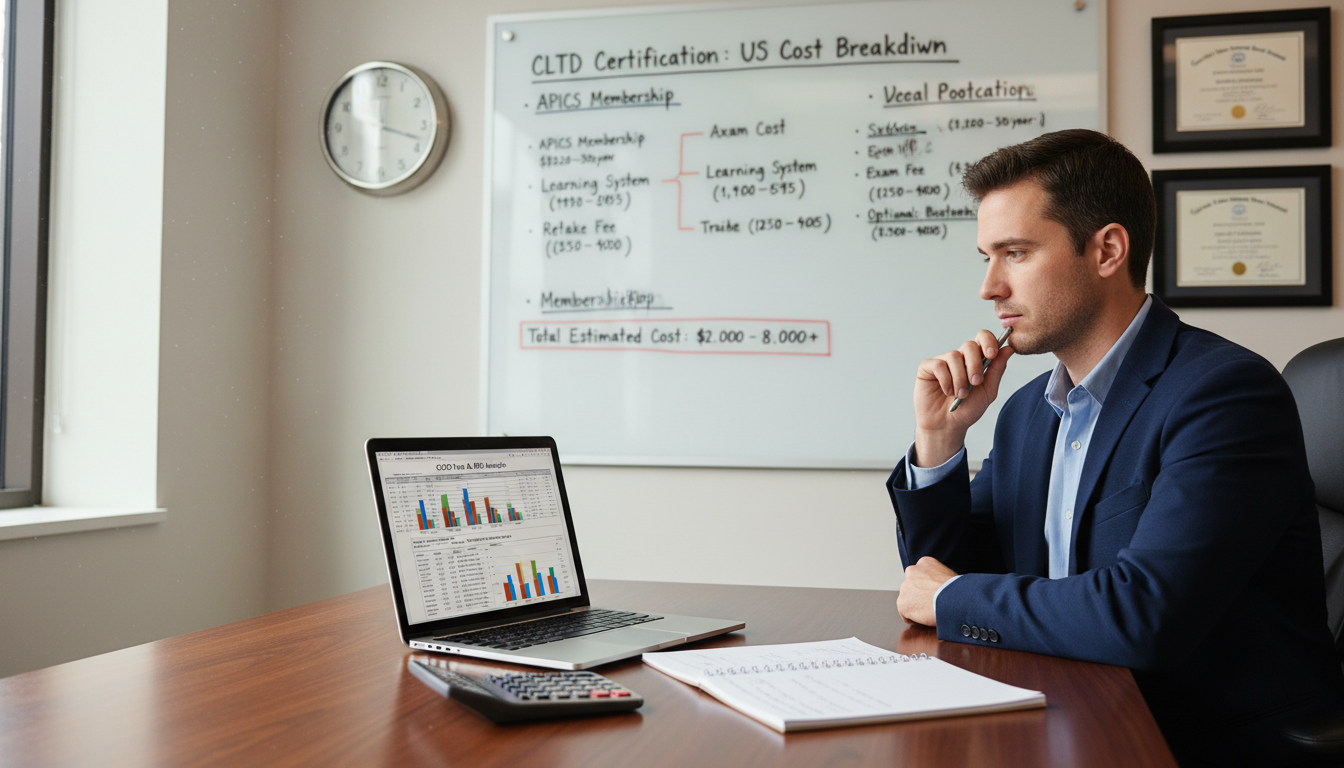
Typically, the total cost for obtaining the CLTD certification falls between $1,000 and $2,000, influenced by the study method, access to training, and the need for retakes. For those in procurement teams and management, breaking down the cost into fixed fees and variable preparation expenses makes it easier to assess the cltd certification pricing.
Understanding the CLTD cost involves more than just the exam fee. Candidates often incur additional costs for ASCM learning systems, practice tools, instructor-led courses, and time off from work. These expenses can significantly impact the overall investment.
Once certified, the CLTD certification investment doesn’t end. Maintenance activities, ranging from free webinars to seminars costing hundreds of dollars, can affect the long-term budget. These ongoing costs can be a surprise, even after the initial testing fee is covered.
CLTD Certification in the United States
In the U.S., the CLTD credential is viewed as both a professional signal and a budget item. The planning process begins with defining the program’s scope. It then considers the costs, including prep time, materials, and exam timing. This approach aids employers in comparing options before deciding on the CLTD certification price.
Certifying body: Association for Supply Chain Management (ASCM, formerly APICS)
The Association for Supply Chain Management, known as ASCM CLTD, issues the credential. Many U.S. candidates are familiar with APICS CLTD, as APICS was the legacy brand. CLTD was introduced in 2016, aiming to be a standard for logistics, transportation, and distribution excellence.
Given ASCM’s U.S. base, candidates often align their study schedules with domestic work cycles. The exam is delivered through global networks, affecting travel and scheduling. These practical considerations can impact the overall cost of CLTD certification beyond the exam fee.
What the CLTD credential covers: logistics, transportation, and distribution best practices
The CLTD focuses on end-to-end logistics capabilities. It covers logistics strategy, demand and capacity management, and customer and order management. It also includes warehouse operations and inventory management.
Transportation management across various modes is another key area. Global logistics topics include customs, documentation, and financial aspects like payment terms and taxes. Sustainability, reverse logistics, and performance metrics are also covered, supporting network design and improvement.
Why it’s valued: global recognition and career mobility for logistics professionals
The credential is seen as globally recognized, aiding in cross-region mobility. It supports roles in distribution center leadership, logistics management, and transportation management. Certified professionals may earn up to 23% more than their non-certified peers, according to APICS research.
For employers, the value lies in building capabilities in areas with persistent skills gaps. They focus on service levels, cost-to-serve, and operational reliability. The CLTD certification price is evaluated in the context of expected performance and readiness, not as a standalone training expense.
Typical CLTD Certification Price Range and What It Often Includes
In the U.S. market, the cost for a CLTD pathway is often estimated at $1,000–$2,000+ “all-in.” This range serves as a starting point for budgeting. The actual cost varies based on preparation and testing. A detailed cltd cost comparison requires distinguishing between essential items and optional extras.
Common all-in estimate: $1K–$2K+ depending on your chosen path and resources
Estimates often combine several costs into one figure, making the cltd certification cost seem simpler. Self-study tends to be closer to the lower end, using standard materials and minimizing retake risks. Instructor-led training and extended support can increase the total, with costs rising for structured cohorts and additional practice exams.
What may be bundled: exam registration, learning system access, and study tools
Many packages include the exam fee or credit along with the core learning system. Providers often bundle hardcopy books, web-based resources, and practice questions to match exam pacing. This bundling can make the cltd certification fee less apparent, even though it’s part of the overall cost.
The cltd cost breakdown typically falls into three categories: testing, content, and prep support. Testing includes the exam credit and scheduling. Content encompasses books and online modules. Prep support covers instruction, coaching, and mock exams.
Why pricing varies: membership discounts, training provider packages, and retake policies
Pricing differences often stem from ASCM membership discounts on exams and resources. Membership itself adds an annual cost. Provider packages vary, including live instruction, extended access, and post-class support. Retake policies can also impact the total, with some packages including a free retake under certain conditions, while others require repurchasing exam credit.
| Credential (ASCM/APICS) | Commonly cited market range (U.S.) | What “all-in” often includes | Budget signal for candidates |
|---|---|---|---|
| CLTD | $1,000–$2,000+ | Exam credit, learning system access, study tools (books + web resources), sometimes retake terms | Use a cltd cost comparison to test self-study vs. provider bundles and confirm retake rules |
| CSCP | $1,000–$2,500 | Exam fee plus study materials and learning resources in many registrations | Sets an upper reference point when weighing opportunity cost across credentials |
| CPIM | About $1,200 per module (registration + materials) | Module registration and study materials bundled for each module | Highlights how multi-module structures can change total spend and study time planning |
For procurement and logistics leaders reviewing reimbursement requests, the best way to assess value is to request a detailed breakdown. This clarifies essential costs, optional extras, and how timing, membership status, and retake policies affect the total.
CLTD Certification Cost
In the United States, the cost of cltd certification is viewed as a total investment, not just a one-time expense. It includes direct cash outlays and indirect costs like time away from work and reduced project capacity. This approach helps finance and HR teams manage costs consistently across roles and departments.
Core components that shape total cost in the USA
The cost analysis for cltd certification typically begins with the exam path and related resources. Costs often center around exam credit, test delivery, learning materials, and optional training. Authorized testing networks add to the budget with scheduling and test-day logistics.
The learning system layer encompasses printed or digital books, web-based reading, and practice tools. Training, the largest variable, can range from structured live online cohorts to self-paced programs. These elements form the core of cltd certification expenses seen on invoices and reimbursement requests.
| Cost component | What it covers in U.S. terms | Budget risk driver | Where it shows up |
|---|---|---|---|
| ASCM membership (optional) | Annual dues that may change exam and material pricing | Timing of enrollment vs. purchase date | Professional fees or employee development line |
| Exam credit and test delivery | Exam registration plus computer-based testing through an authorized network | Rescheduling, travel time, and retake exposure | Credentialing or compliance spend |
| Learning materials | Books, web-based resources, quizzes, and practice tools | Access windows and upgrade add-ons | Training materials or tuition assistance |
| Training program (optional) | Instructor-led online cohorts or self-paced prep with structured guidance | Package differences, coaching hours, and support level | Training services or vendor contracts |
Direct costs vs. indirect costs (like study time away from work)
Direct spending is straightforward, paid in dollars: membership, exam credit, learning system access, and training fees. Indirect costs, though harder to track, are significant. They include study hours that reduce overtime, cut billable hours, or delay work in analytics, procurement, or network design.
For many employers, the decision to invest in cltd certification hinges on these indirect costs. A realistic estimate assigns an hourly value to study time, including schedule constraints during peak seasons in transportation and distribution operations.
Planning tip: budget for both upfront fees and post-certification maintenance
Budgeting should also account for the long-term commitment after passing the exam. ASCM maintenance rules require ongoing professional development, which can range from free webinars to several hundred dollars per seminar. This creates ongoing spend and time commitments, not a one-time event.
Considering the entire lifecycle of cltd certification as an investment with initial costs and ongoing maintenance makes budgeting easier. This approach allows for a fair comparison with internal training options and other professional credentials during annual planning.
CLTD Certification Fee Components You’ll Likely Pay For
In the U.S., candidates face three main costs: the exam, the learning system, and training. It’s essential to track each expense to ensure a clear understanding of the total cost. This approach helps avoid double payments for overlapping services.
Given the variability in package offerings, it’s wise to verify what’s included versus what’s billed separately. This diligence is critical for making informed decisions on CLTD certification pricing. It ensures the final cost remains predictable.
Exam-related costs
The exam fee typically includes an exam credit or a direct fee. Additional costs may apply for scheduling and test-day arrangements, depending on the purchase structure.
Exams are often administered through Pearson VUE test centers, with some regions using additional authorized partners. In the U.S., candidates often compare whether the exam credit is sold separately or bundled with prep materials.
Learning system costs
Expenses for the learning system usually cover physical books and digital access. Providers often list various online tools such as pretests, mock tests, quizzes, flashcards, and an exam content manual.
The cost of the learning system can vary based on format, access duration, and the availability of practice tools. It’s important for buyers to confirm they are not duplicating purchases within a bundle, if they already possess current materials.
Training costs
Training costs are often separate from materials, but some packages combine them into a single price. Instructor-led live online cohorts are designed for working professionals, with set schedules and guided review.
Self-paced programs offer flexible study times and focused exam preparation. Marketing claims differ, with some packages including exam credit and one free retake, subject to certain conditions. Others emphasize extended support and scheduled coaching.
| Cost category | What is commonly billed | What “included” can mean in U.S. bundles | Double-pay risk to check |
|---|---|---|---|
| Exam | Exam credit/fee, scheduling, testing logistics | Exam credit included with prep, sometimes retake terms | Buying an exam credit twice across ASCM-aligned packages and training vendors |
| Learning system | Hardcopy books, digital platform access, pretests, mock tests, quizzes, flashcards, exam content manual | Single login with tools bundled for a fixed access period | Paying again for materials already owned or provided by an employer program |
| Training | Instructor-led live online cohort or self-paced course fee | Structured schedule, instructor support, guided practice, or flexible modules | Purchasing training that duplicates the same learning system features already included elsewhere |
ASCM Membership Costs and How Membership Affects CLTD Certification Pricing
For U.S.-based candidates, ASCM membership can alter the cost of obtaining the exam credit and study materials. This decision can influence the overall price of the CLTD certification, without changing the exam’s content or requirements.
Typical annual membership fee range: about $100–$300 (varies by level)
ASCM membership typically costs between $100–$300 annually, based on the level of membership. When considering the cost of CLTD certification, this fee should be viewed as a separate expense from training and testing costs.
Membership benefit: possible discounts on exams and learning resources
The financial advantage is clear: membership can lead to discounts on exam credits and study materials. These discounts can lower the overall cost of CLTD certification, making it more affordable when applied to planned purchases.
| Purchase scenario (U.S.) | What drives net cost | Budget signal |
|---|---|---|
| Exam credit + ASCM learning system purchased separately | Membership discount can lower combined checkout total across eligible items | May improve cltd certification investment efficiency when multiple ASCM items are in scope |
| Training provider bundle includes exam credit and broad materials | Membership value depends on any additional ASCM purchases during the same membership year | Membership may have limited impact on cltd certification pricing if no add-ons are planned |
| Employer reimbursement with defined caps | Reimbursement rules can shift which fees matter most (membership vs. exam vs. materials) | Run a cltd cost comparison against the policy to avoid uncovered items |
Decision point: when joining ASCM can reduce your overall CLTD certification investment
The decision hinges on timing and the mix of purchases. If a candidate plans to buy the exam credit and study materials separately, membership discounts can lower the total cost of CLTD certification.
On the other hand, if a bundled course already includes the exam credit and most materials, the value of membership depends on whether additional ASCM products will be purchased within the year. Membership discounts impact initial costs, while ongoing ASCM maintenance rules affect long-term validity and continuing education expenses.
CLTD Cost Breakdown of Learning Materials and Study Tools
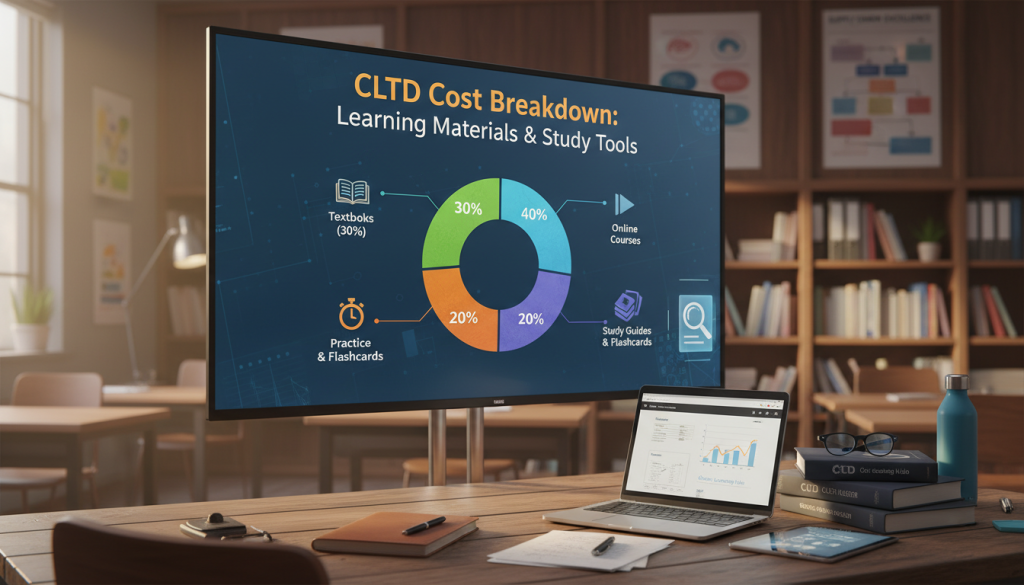
For many U.S. candidates, study materials drive the largest variable share of the cltd certification expenses. A clean cltd cost breakdown separates what comes in a learning system from what is added through a training provider or extra practice tools.
This cltd cost analysis also helps procurement teams compare like-for-like packages. It reduces the risk of paying twice for the same content in different formats.
Common inclusions referenced by training providers
Provider materials often list a learning system built around two hardcopy books, plus a student slide book in some cohorts. These print items support offline review, margin notes, and quick referencing during a commute or on-site downtime.
Web-based resources are commonly packaged alongside print. They typically include a pretest, mock test, quizzes, flashcards, and an exam content manual that maps topics to the exam domains.
- Two hardcopy books (learning system)
- Student slide book (provider-specific add-on)
- Pretest for baseline scoring and gap identification
- Quizzes and flashcards for rapid repetition
- Mock tests for readiness checks and pacing control
- Exam content manual for domain alignment and navigation
Why practice resources matter for exam alignment
The CLTD exam is commonly described as 150 multiple-choice questions in a 3.5-hour testing window, with no negative marking. That structure increases the value of timed mocks and question banks that match the on-screen rhythm.
In cltd cost analysis terms, practice tools are a performance hedge. They convert content review into decision speed, which affects how many items a candidate can attempt under time pressure.
Choosing formats for U.S.-based learners
Hardcopy books tend to work well for annotation and offline study blocks. Web-based tools tend to work well for spaced repetition, score tracking, and repeatable drills that fit a lunch break.
Material pricing can move. Some provider campaigns advertise an additional 10% discount on CLTD learning systems and bundles, which can shift the effective cltd certification price without changing the exam fee.
| Tool element | Typical format | Primary use in study workflow | Cost driver signal in a cltd cost breakdown |
|---|---|---|---|
| Two hardcopy books | Deep reading, annotation, and reference by domain | Shipping, edition updates, and replacement risk | |
| Student slide book | Print or PDF (provider-specific) | Lecture reinforcement and condensed review notes | Often bundled with cohorts; may be separate in self-study |
| Pretest | Web-based | Baseline score, weak-area identification, and study planning | Included in many bundles; standalone access can raise cltd certification expenses |
| Quizzes and flashcards | Web-based | Short drills, spaced repetition, and terminology accuracy | Value increases with retake limits and access duration |
| Mock tests and timed question banks | Web-based | Pacing practice for 150 questions in 3.5 hours; format matching | Higher cost when multiple full-length attempts are included |
| Exam content manual | Web-based | Topic mapping, targeted review, and scope control | Bundled access can lower perceived cltd certification price versus buying tools separately |
Training vs. Self-Study: CLTD Certification Expenses by Prep Method
Choosing how to prepare for the CLTD exam can significantly affect the overall cost. In the U.S., candidates often consider the time needed to prepare, the availability of instructors, and the number of practice cycles required. A thorough comparison of costs begins with distinguishing between what providers offer and what learners must pay for separately.
Live online training: structured schedules, instructor support, and guided revision
Live online training is priced based on its structured nature. Providers often schedule fixed calendars, such as from April 18 to June 21, 2026. This format includes weekly pacing, reducing the need for extensive planning. It can increase the cost of CLTD certification but may include additional benefits like guided revision plans and extended instructor access.
Costs are also influenced by group learning and instructor availability during and after training. Many programs offer “doubt-clearing” support, adding service costs. Some providers highlight a pass rate above 90% for trainees, justifying a higher investment in CLTD certification.
Self-paced prep: flexible timing with LMS access, recordings, and targeted practice
Self-paced options focus on flexibility and lower service costs. Providers often blend live sessions with self-study, using LMS access and recordings for professionals in the Americas. This approach can lower CLTD certification expenses for those with strong study habits.
Typical inclusions are 24×7 LMS access, recorded sessions, practice questions, and mock tests. Some plans also offer scheduled revision clinics. Pricing varies based on access duration and the number of test-like simulations included. For many U.S. buyers, the key is whether the practice coverage matches weak areas without excessive live instruction costs.
Value considerations: support, pass-readiness, and how quickly you plan to test
Speed-to-test significantly impacts the cost calculation. Candidates seeking a quicker path may pay more for instructor-led training to compress preparation time and reduce retake risks. This can protect the total CLTD certification investment. Budget-conscious candidates often opt for a learning system plus targeted mocks, accepting more self-management while keeping costs lower.
| Factor | Live online training | Self-paced prep | Cost impact focus |
|---|---|---|---|
| Schedule model | Fixed cohort dates (example: April 18–June 21, 2026) with a guided calendar | On-demand pacing with flexible batch timing | Fixed schedules can raise costs but reduce planning time |
| Instructor access | Instructor connectivity during and after training; group sessions and doubt-clearing | Limited direct instructor time; support varies by plan | More access typically increases cltd certification expenses |
| Content delivery | Live classes, structured revision, and guided checkpoints | Recorded sessions, LMS modules, and targeted drills | Recorded-first models often lower delivery costs |
| Practice depth | Often bundled quizzes and guided mock exam strategy | Practice questions and mock tests; revision clinics may be add-ons | More simulations can narrow skill gaps but raise total spend |
| Outcome signals used in marketing | Provider-reported pass rate above 90% for trainees | Emphasis on flexibility and repeat practice cycles | Outcome claims influence perceived value in a cltd cost comparison |
| Best-fit buyer profile | Needs structure, fast ramp-up, and accountability | Comfortable with self-direction and time management | Fit determines whether added support pays back |
CLTD Exam Structure and Requirements That Influence Your Cost Analysis
Exam mechanics play a significant role in budgeting, more than many candidates realize. Factors like timing, testing location, and eligibility impact scheduling speed and the risk of a paid retake. These elements can alter the cltd certification pricing and study resource planning.
In the U.S., the exam format is critical in a cltd cost analysis. It influences preparation time. A tight timeline may lead candidates to opt for paid instruction over self-study. This can increase the total cltd certification cost, even if the exam price remains the same.
Exam format facts
The CLTD exam is computer-based, delivered through Pearson VUE testing centers. Some areas also use authorized partners like Prometric. Online proctoring is available in many places, based on current policies.
About 150 multiple-choice questions are given within a 3.5-hour time limit. There’s no negative marking, which affects pacing and the type of practice tests that offer the best value for the cltd certification fee.
Scoring facts
Scoring is scaled, ranging from 200 to 350. A score of 300 is the passing threshold. This guides the number of full-length mocks and the depth of review needed.
This scoring setup can influence spending choices. Candidates needing more score margin often add practice exams or coaching. This shifts the cltd certification pricing, even if the exam registration itself is unchanged.
Eligibility pathways
Eligibility is based on several paths: a bachelor’s degree (or international equivalent), three or more years of related business experience, or approved credentials like CPIM, CPIM-F, CSCP, SCOR-P, CIRM, CPM, CPSM, or CTL.
These pathways affect how soon a candidate can test and how much prep time is realistic. When the timeline is tight, candidates may opt for structured training to reduce retake risk. This can increase the cltd certification cost beyond the base fee.
| Cost driver tied to exam rules | Operational detail | Budget impact in cltd certification pricing |
|---|---|---|
| Testing delivery model | Computer-based exam; typically at Pearson VUE centers; online proctoring may be available by policy | Travel time, scheduling windows, and rescheduling constraints can add indirect cost |
| Exam length and item volume | About 150 multiple-choice questions in 3.5 hours; no negative marking | Often drives investment in timed practice sets and full-length simulations |
| Scaled scoring threshold | Scaled range 200–350 with 300 typically required to pass | Higher score buffer targets can increase spend on tutoring, analytics tools, or extra mock exams |
| Eligibility readiness | Bachelor’s degree, or 3+ years related experience, or approved credentials (CPIM, CSCP, CPSM, CPM, CTL, and others cited) | Eligibility speed affects test date choices and can shift the balance between self-study and paid training |
Retake and Timing Costs: How Failed Attempts Can Change CLTD Certification Pricing
In the United States, retakes pose a significant budget risk due to the exam’s high-stakes nature. If an attempt fails, the cost of obtaining a CLTD certification can escalate quickly. This is because candidates must repurchase exam credits and invest additional time in preparation.
These extra weeks also incur indirect costs. For many employers, prolonged preparation periods can lead to lost productivity. This includes time away from projects, overtime, or reduced output. Such indirect costs can significantly increase the total expenses associated with obtaining a CLTD certification, even if the direct fees remain unchanged.
Retake risk planning
Planning for a second attempt can significantly alter the cost structure of obtaining a CLTD certification. Candidates often need to repurchase exam credits. They may also require extended access to learning systems or additional instructor support if their initial access windows expire.
| Cost lever | What changes after a failed attempt | Budget impact on cltd certification fee exposure |
|---|---|---|
| Exam purchase | Exam credit is typically repurchased for another scheduled sitting | Raises direct cash outlay and shifts cltd certification pricing above the initial plan |
| Learning access window | Extra months may be needed for practice tests, quizzes, and review | Can add renewal or extension charges to total cltd certification expenses |
| Work time and productivity | More study hours can crowd out work tasks or require schedule adjustments | Increases indirect cost and widens the overall cltd cost breakdown |
Provider variations
The market offers varying approaches to handling retake risks. Some training packages include a “1 Free Retake Exam” offer. This is contingent on passing the first exam and subject to specific terms and conditions set by the provider.
While such offers can reduce uncertainty, they do not eliminate all costs. Candidates may incur additional expenses for extended preparation time, platform access, or extra coaching if they fail to meet their initial timelines.
Scheduling strategy
Effective planning is a key cost control strategy. It focuses on minimizing the need for retesting. Providers often emphasize the importance of mock exams, quizzes, and structured study plans. These are designed to prepare candidates for the 150-question, 3.5-hour format and reduce errors under timed conditions.
- Set a test date only after timed practice scores stabilize, not after content is merely “covered.”
- Protect study blocks on the calendar to limit drawn-out prep that inflates cltd certification expenses.
- Use full-length mock exams to confirm pacing, then refine weak domains to control cltd certification pricing risk.
Ongoing Costs After You Pass: Maintenance, Recertification, and Continuing Education
Passing a certification exam is just the beginning. In the U.S., the costs don’t end there. They become part of the ongoing investment for teams, often linked to pay bands or role matrices.
From a financial perspective, the costs extend beyond the initial test day. A thorough cost analysis is essential. It tracks renewal timelines, point rules, and the balance between free and paid education options.
Certification validity: typically 5 years under ASCM maintenance rules
ASCM maintenance rules generally treat APICS/ASCM certifications as valid for five years. This cycle supports governance and auditability. It allows activities to be logged and verified against ASCM certification maintenance policies.
For employers, this fixed window aids in forecasting recurring costs. It helps in planning the workforce when credentials are part of job qualification matrices.
Maintenance requirement: earn and submit 75 points within the 5-year cycle
Renewal is tied to earning and submitting 75 points within five years. Points can come from structured learning, events, and other approved professional development activities.
This requirement shifts the cost from a one-time fee to a managed spend profile. Many U.S. organizations treat it like continuing education, with manager approval and annual caps.
Cost range for maintenance activities: from free webinars to paid seminars costing several hundred dollars
Maintenance points can be earned through free webinars offered by ASCM. This keeps cash outlay low when time is available. Other options include paid seminars that can cost several hundred dollars, depending on format and duration.
This range impacts the investment by organization type. Firms with tight travel controls may prefer virtual options. Larger networks may budget for in-person sessions to standardize practices.
| Maintenance activity type | Typical price range (USD) | Primary cost driver | Budget signal for U.S. employers |
|---|---|---|---|
| ASCM webinars (virtual) | $0 | Staff time and scheduling | Low cash spend; fits annual development plans with minimal approvals |
| Online short courses (self-paced) | $50–$300 | License access and course length | Predictable reimbursement; scalable across distributed teams |
| Instructor-led workshops (virtual or onsite) | $300–$900 | Instructor fees and seat limits | Useful for targeted capability building; often requires manager sign-off |
| Seminars and conferences | $400–$1,200+ | Registration plus travel exposure | Higher variance; best handled with pre-approved spend thresholds |
Conclusion
In the United States, candidates should budget $1,000–$2,000+ for cltd certification. This includes exam fees, learning resources, and prep choices. The total cost varies with ASCM membership, paid instruction levels, and the risk of a second exam attempt. Ultimately, the path chosen influences the final cost.
Viewing the cltd certification cost as a multi-stage investment is wise. Initial expenses cover exam registration and prep. Ongoing costs follow over a 5-year credential cycle. ASCM’s maintenance rules require 75 professional development points, achievable through both free and paid options.
Comparing costs is key. ASCM membership can lower the net price with discounts but adds an annual fee, typically $100–$300. Training bundles offer exam credit, official materials, and practice tools. Some include retake terms that cap costs.
For employers and professionals, the best pricing outcome hinges on execution. Effective practice, exam-format drills, and disciplined scheduling can reduce retake risks and protect budgets. The optimal route balances instructor-led training and bundle protections with a lean self-study plan using official learning systems.
FAQ
What is the typical CLTD certification cost in the USA, all-in?
In the U.S., the cost for a CLTD certification can range from $1,000–$2,000+. This amount typically covers more than just the exam. It may include exam credit, the CLTD Learning System, and prep support. The final cost depends on the prep model, ASCM membership, and retake needs.
What does the CLTD certification fee usually include—and what is often extra?
The CLTD certification fee often includes exam credit, learning materials, and online study tools. Yet, candidates may also pay for ASCM membership, instructor-led training, extended access to learning systems, and retake exam credits. It’s important to understand what’s included and what’s extra to avoid double payments.
Who issues the CLTD credential, and why does that matter for cost planning?
The Association for Supply Chain Management (ASCM), formerly APICS, issues the CLTD credential. Being U.S.-based, ASCM influences how U.S. candidates plan their membership, purchase exam credit, and choose official learning resources. Exam delivery is through authorized networks like Pearson VUE test centers, affecting scheduling and sometimes travel.
How do ASCM membership costs affect CLTD certification pricing?
ASCM membership costs around $100–$300 per year, depending on the level. Membership can lower the net cost of CLTD certification by providing discounts on exams and learning resources. For many, the best value is buying exam credit and the Learning System directly from ASCM. If a third-party bundle already includes these, the membership ROI depends on additional ASCM purchases planned for the year.
What are the biggest line items in a CLTD cost analysis beyond the exam?
Beyond the exam, CLTD certification costs in the U.S. fall into three main categories: exam-related costs, learning system costs, and training costs. Indirect costs, such as study time away from work, also play a significant role. A thorough cost analysis should consider both direct expenses and the value of time.
What study tools are commonly included in CLTD learning systems and provider packages?
CLTD learning systems often include hardcopy books and web-based tools like pretests, mock tests, quizzes, flashcards, and an exam content manual. Some packages also offer additional materials, such as two hardcopy books and a student slide book. These tools aim to support repetition, readiness benchmarking, and timed practice.
How does the CLTD exam format influence prep spending and total CLTD certification price?
The CLTD exam is computer-based with about 150 multiple-choice questions in a 3.5-hour window, with no negative marking. Scoring ranges from 200–350, with 300 being the pass mark. Pacing and format familiarity are key, so many candidates focus on timed mock exams and question-bank practice, which can affect the total cost.
How much can a retake change the CLTD certification cost, and do any bundles include retake protection?
Retakes can significantly increase the cost of CLTD certification if exam credit or learning resource access must be repurchased. Some bundles offer one free retake under specific terms and conditions. It’s critical to confirm if the retake is included, what triggers eligibility, and whether timelines require additional study-system or training spend.
What ongoing costs should be budgeted after passing CLTD?
CLTD certification is maintained for 5 years under ASCM rules, requiring 75 points to be earned and submitted. Maintenance costs can range from $0 (for free ASCM webinars) to several hundred dollars for paid seminars. This creates recurring budget lines for employers, making CLTD a multi-year investment.
How does CLTD compare to other ASCM/APICS credentials in budget expectations?
CLTD is often compared to other ASCM/APICS credentials like CSCP in a $1,000–$2,500 range and CPIM at about $1,200 per module. These comparisons help finance and HR stakeholders understand the CLTD certification price within a broader credential portfolio. They also evaluate opportunity cost across various roles in logistics, transportation, distribution, and end-to-end supply chain functions.
,000–,000+. This amount typically covers more than just the exam. It may include exam credit, the CLTD Learning System, and prep support. The final cost depends on the prep model, ASCM membership, and retake needs.