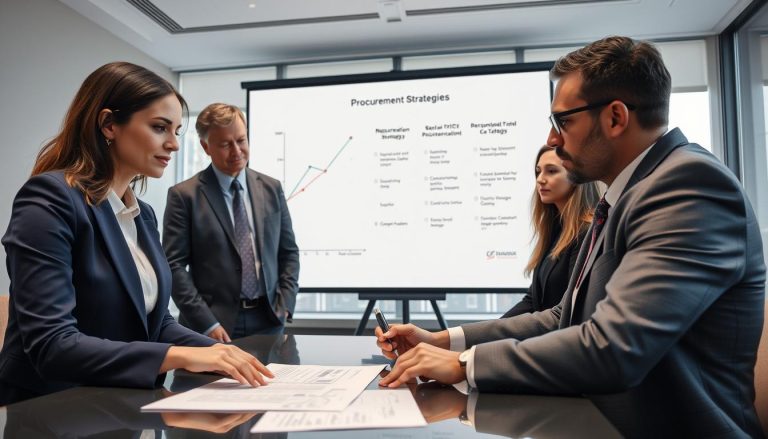
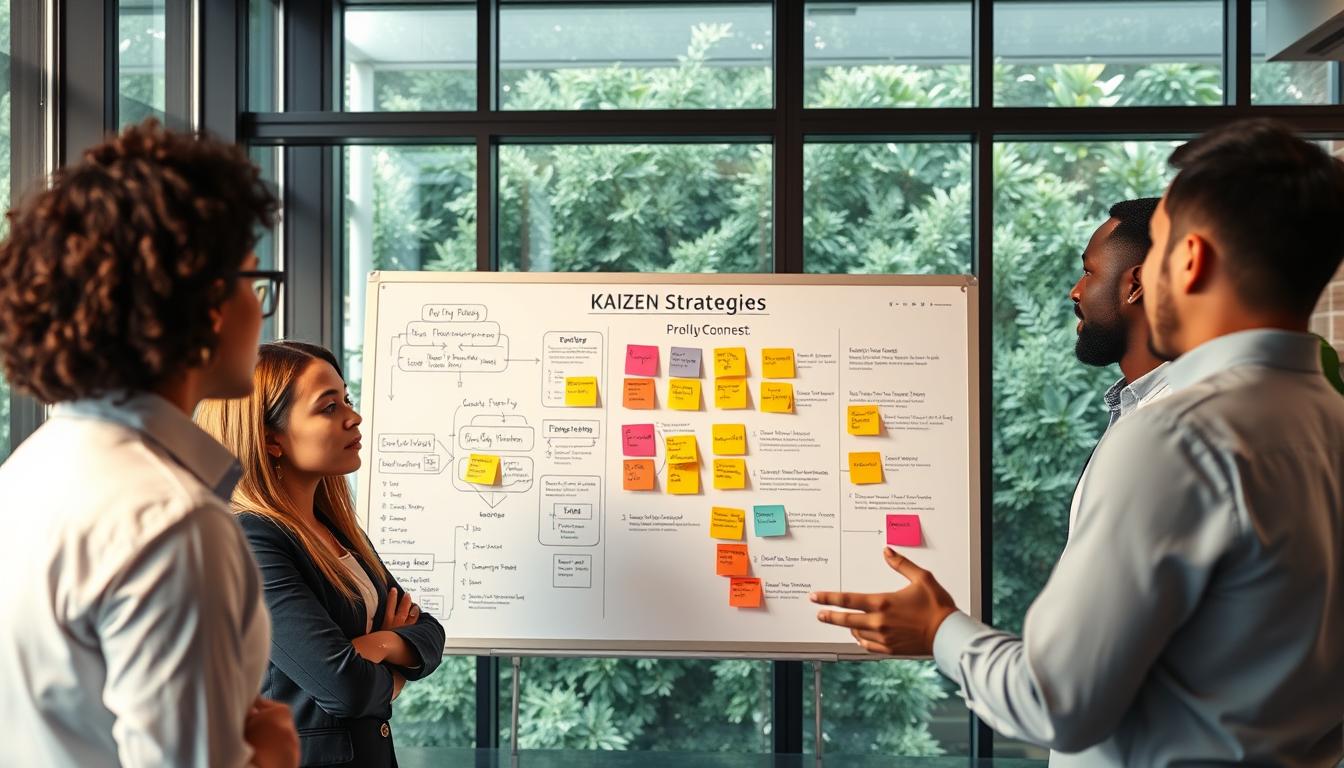
Kaizen Strategies for Efficient Operations
Kaizen Continuous Improvement in Operations offers a structured approach to achieving better outcomes with less risk. This piece delves into how daily, incremental changes lead to consistent performance in various sectors. It focuses on linking continuous improvement strategies to tangible results in the United States. This is achieved through the application of expert methods and thorough economic analysis.
Operational excellence is about executing strategy more reliably and consistently than competitors. Harvard Business Review research shows that leading practices can lead to about 25% higher growth and roughly 75% higher productivity compared to laggards. Companies like Toyota, Philips Lighting, General Electric, Nestlé, Danaher Corporation, Johnson & Johnson, and Amazon exemplify how operational efficiency techniques enhance GQCDM results—growth, quality, cost, delivery, and motivation. They also reduce variability and risk.
Kaizen is in line with Lean and Six Sigma, forming a unified system. Lean tools like Value Stream Mapping, 5S, and Just-In-Time eliminate waste and enhance flow. Six Sigma’s DMAIC method reduces defects and variation. Together, these disciplines provide a coherent playbook for operations in the United States. They enable fact-based control, faster cycle times, and stable cost structures backed by professional economic analysis.
Kaizen, meaning “change for the better,” relies on employee engagement, evolving standards, and data-driven evaluations. These strengthen ISO 9001 systems. The U.S. Environmental Protection Agency views Kaizen as a Lean method for quick, incremental improvements in both public and private sectors. The goal is clear: to build capability for steady gains that compound into lasting advantages.
Kaizen Philosophy in Operations
Kaizen philosophy in operations views improvement as a daily routine. Teams aim for ongoing process enhancement through small, testable changes. These changes aim to reduce waste, enhance quality, and maintain flow. The philosophy seeks sustainable growth over one-time fixes, fostering a continuous improvement culture that aligns with business objectives.
Leaders and frontline employees have distinct roles in solving problems. Standard work, visual cues, and rapid feedback loops link actions to outcomes. These practices turn observations into measurable results, ensuring rigor and accountability.
From “change for the better” to daily operational gains
Kaizen, meaning “change for the better,” involves frequent, small adjustments across all levels of the organization. Staff refine processes, balance workloads, and eliminate handoff inefficiencies. This approach builds expertise and embeds lean management principles into daily tasks.
Results include shorter cycle times, fewer defects, and lower costs. These improvements grow as teams document their learnings, standardize successful practices, and continually seek new enhancements.
How Toyota Production System and Lean shaped modern Kaizen
Taiichi Ohno and Shigeo Shingo made Kaizen central to the Toyota Production System. They focused on eliminating seven wastes—overproduction, waiting, transportation, excess inventory, unnecessary movement, defects, and overprocessing. W. Edwards Deming’s emphasis on process and statistical thinking further solidified the use of data at the Gemba.
Lean Thinking by James P. Womack and Daniel T. Jones later formalized these principles into lean management. It stresses value, flow, and pull. Today, firms apply Kaizen to eliminate waste, stabilize processes, and ensure reliable delivery.
Differentiating continuous improvement from operational excellence
Continuous improvement focuses on making work better incrementally, day by day. Operational excellence, on the other hand, defines the system that sustains it. It encompasses leadership, strategy alignment, standardization, and transparent metrics. One drives action, while the other ensures consistency and durability.
When continuous improvement is embedded in a strong management system, teams focus on value, verify changes with data, and scale successful practices. This integration keeps improvement focused, repeatable, and resilient across various functions.
Operational Excellence Methodology and Its Connection to Kaizen
Operational excellence methodology connects strategy, people, and processes to deliver value efficiently. It aims for optimized resource use, not mere cuts. Companies like Toyota, Danaher, Johnson & Johnson, and Amazon have seen significant improvements in growth, quality, cost, delivery, and motivation.
Kaizen Continuous Improvement in Operations drives daily, team-based changes. These small, frequent improvements lead to lasting gains. Lean practices, such as Value Stream Mapping and Just-In-Time, reduce waste. Six Sigma’s DMAIC method uses statistical discipline to lower variability. These efforts enhance process excellence and ensure stable flow.
Daily improvement and focused Kaizen events are key to sustaining momentum. Strategy deployment ensures both modes align with vital initiatives. Leaders translate goals into actionable targets and routines. Teams then focus on rapid cycles to remove obstacles and standardize better practices.
This approach turns continuous improvement strategies into consistent results. Breakthrough projects tackle significant constraints. Daily suggestions address smaller gaps in safety, quality, and throughput. The portfolio remains visible, prioritized, and resourced, ensuring execution aligns with customer needs.
Governance supports process excellence with fact-based reviews and transparent metrics. Roles are clearly defined, handoffs are smooth, and escalation paths are brief. As capabilities grow, lessons are shared across the value stream, strengthening culture and protecting gains.
Effective strategy deployment relies on a consistent rhythm. Leaders set quarterly objectives, cascade targets, and audit standards at the Gemba. Teams apply PDCA and DMAIC to verify causes, test countermeasures, and solidify wins. This rhythm reduces noise, accelerates learning, and keeps Kaizen Continuous Improvement in Operations aligned with enterprise goals.
The outcome is a cohesive system where continuous improvement guides investment and operational excellence sustains performance at scale. When Lean, Kaizen, and Six Sigma operate in sync, waste decreases, flow improves, and employees understand how their work supports the mission.
Core Principles That Power Operational Excellence
These principles turn operational excellence into daily practice. They apply across various sectors, including supply chains, shared services, plants, and digital teams. They align lean management principles with measurable gains in delivery, quality, and cost, all while keeping customer value in focus.
Create customer value across every operation
Define value by what the customer will pay for and what reduces risk or delay. Treat each handoff as the next operation is the customer. This reframes planning, procurement, and finance as value streams that prevent rework and shorten lead time.
Teams map demand to capability using takt time, service-level targets, and first-pass yield. Applying lean management principles here directs investment toward steps that protect flow and raise customer value.
Let it flow: removing blockers to value delivery
Flow efficiency improves when non-value-added work is removed. Taiichi Ohno’s guidance—compress order-to-cash—remains a practical test. Eliminate waiting, overproduction, extra transport, excess inventory, defects, overprocessing, and unused talent.
Use small batch sizes, leveled scheduling, and clear pull signals. The operational excellence methodology favors cycle-time control and queue reduction over local labor utilization.
Go to Gemba for fact-based decisions
Decisions gain accuracy when leaders observe work at Gemba. Standardized Gemba Walks replace ad hoc tours. Structured questions, time-stamped metrics, and process confirmation prevent bias and support repeatable diagnosis.
Deming warned against casual “walking around.” Evidence from the place where work happens anchors corrective action, stabilizes flow, and makes variance visible.
Empower people with a no-blame culture
Replace inspection and fault-finding with coaching and skill-building. Leaders develop capability through targeted training, cross-functional problem-solving, and daily management routines.
Psychological safety enables rapid escalation of issues before they become defects. This approach sustains gains and aligns with lean management principles focused on respect for people.
Be transparent with visual management
Visual management displays both wins and gaps in real time. Cells, warehouses, and offices post leading indicators, alarms, and standard work so everyone sees status at a glance.
Clear visuals speed handoffs and aid root-cause analysis. By exposing bottlenecks early, teams protect customer value and maintain predictable delivery.
| Principle | Primary Mechanism | Key Metric | Practice Example | Business Effect |
|---|---|---|---|---|
| Create customer value | Define value from end user and next-operation perspectives | First-Pass Yield, Net Promoter Score | Value Stream Mapping linking order intake to fulfillment | Higher conversion, reduced rework |
| Let it flow | Remove non-value-added steps and shrink batches | Lead Time, Flow Efficiency | Pull systems with leveled scheduling (Heijunka) | Shorter order-to-cash, lower WIP |
| Go to Gemba | Direct observation and process confirmation | Adherence to Standard Work, Defect Rate | Structured Gemba Walks with time-stamped checks | Faster problem detection, stable processes |
| Empower people | No-blame coaching and capability development | Corrective Action Lead Time, Training Completion | Team huddles with skill matrices and coaching kata | Higher engagement, sustained improvement |
| Visual management | Transparent metrics and status-at-a-glance | On-Time Delivery, Andon Calls Resolved | Obeya rooms, tiered daily management boards | Quicker decisions, aligned priorities |
Kaizen Continuous Improvement in Operations
Scaling Kaizen Continuous Improvement in Operations requires disciplined routines, clear metrics, and visible leadership. Daily problem-solving, brief stand-ups, and rapid feedback loops fuel ongoing process improvement. Standards are flexible, recorded, and updated as teams learn from real conditions.
Embedding a continuous improvement culture company-wide
A continuous improvement culture engages all levels of the organization in shared efforts. Leaders dedicate time to operational Kaizen practices, train for capability, and verify processes at the Gemba. This approach links learning to action, making small wins visible across functions.
Enterprise programs employ structured onboarding, role-based coaching, and visual management to maintain behaviors. Standards evolve as living documents: teams document best practices, monitor results, and adjust with changes in demand, technology, or regulation.
Incremental changes that compound into breakthrough results
Daily kaizen ideas, when tracked and closed, accumulate. Small improvements in cycle time, defect checks, and layout tweaks lead to significant gains in throughput and cost. Firms often combine these efforts with focused Kaizen Events to remove major constraints and accelerate learning.
Results manifest in GQCDM indicators. Quality improves as error traps tighten. Delivery stabilizes as flow balances. Motivation increases as teams see their solutions adopted and scaled.
Aligning strategy, leadership, and team management
Effective strategy alignment connects enterprise goals to tiered metrics and routine reviews. Leaders model operational Kaizen practices by asking fact-based questions, recognizing experiments, and clearing blockers. Cross-functional governance ensures priorities cascade to daily work.
Hoshin-style planning links targets to initiatives, owners, and checkpoints. This structure keeps ongoing process improvement aligned with budget, capability, and risk. The outcome is a coherent system where objectives guide resources and the continuous improvement culture sustains execution quality.
Lean Management Principles and Waste Elimination
Lean management principles focus on flow, customer value, and disciplined problem-solving. Teams map work from order to cash, remove delays, and stabilize cycle times. This approach narrows variation and improves delivery performance.
Value stream mapping clarifies current and future states across procurement, production, and logistics. It identifies bottlenecks, rework loops, and handoff friction. This analysis guides operational efficiency techniques to cut lead time and cost.
Waste elimination targets seven recurring losses defined by Taiichi Ohno: overproduction, waiting, transportation, excess inventory, unnecessary motion, defects, and overprocessing. Removing these losses increases throughput while preserving quality.
Just-In-Time aligns supply with actual demand to reduce inventory and cash tied up in stock. Pull signals and small lot sizes shrink queues and transport. Stable takt time and standard work protect flow and limit variability.
Daily Kaizen routines capture local issues while focused events address structural constraints. Teams document new best practices so gains hold under normal variation. Leaders verify results at the gemba with objective metrics.
| Lean Focus Area | Primary Objective | Operational Mechanism | Typical Metric | Business Effect |
|---|---|---|---|---|
| Value Stream Mapping | Reveal end-to-end flow gaps | Current/future state diagrams and timing | Order-to-cash lead time | Faster throughput and clearer priorities |
| Waste Elimination | Remove non-value steps | Root-cause analysis and standard work | Non-value-added time share | Lower unit cost and fewer defects |
| Just-In-Time | Match supply to demand | Pull systems, small batches, takt alignment | Days of inventory on hand | Reduced working capital and smoother flow |
| Operational Efficiency Techniques | Stabilize and simplify processes | Line balancing, changeover reduction, visual control | Throughput and schedule adherence | Higher reliability and on-time delivery |
Operational Kaizen Practices for Daily Improvement
Daily discipline is key to turning ideas into reality. Companies like Toyota, Danaher, and Boeing use operational Kaizen to keep improving every day. Leaders make sure these efforts are consistent by setting routines, coaching, and reviewing facts. This approach helps teams and shifts work together towards continuous improvement.
Quality circles to tap frontline problem-solving
Quality circles are small groups that meet regularly to tackle problems. They study issues, test solutions, and present data-driven ideas. This method brings problems to the surface, speeds up solution adoption, and increases ownership.
Good circles use simple tools like cause-and-effect charts and Pareto analysis. Leaders do Gemba Walks, ask open-ended questions, and remove obstacles. This lets teams work efficiently and document their learning.
Standard work and flexible, evolving standards
Standard work makes processes consistent, reduces variation, and allows for cross-training. Teams document steps, time, and safety measures. They then check performance using simple job aids.
Standards must change over time. New best practices are documented, employees are trained, and materials are updated. This cycle drives ongoing improvement and supports continuous enhancement at a large scale.
Visual management to expose gaps and accelerate learning
Visual management makes it clear how things are going. Boards show plans versus actual results, defect trends, and andon events. This includes negative results to encourage accountability and quick action.
Clear visuals quickly show problems, guide priorities, and ensure smooth handoffs. Combined with standard work and quality circles, they form a strong system. This system finds issues early and keeps the momentum going.
PDCA, DMAIC, and Data-Driven Decisions
PDCA offers a rapid learning cycle for the shop floor. It begins with a clear problem statement and measurable goals. The ‘Do’ phase involves a small pilot to manage risk. The ‘Check’ phase compares results against targets using critical metrics. The ‘Act’ phase standardizes successful changes or refines the plan for future iterations, promoting continuous improvement without major disruptions.
DMAIC, a cornerstone of the Six Sigma methodology, addresses complex, persistent issues. It starts with defining the problem and understanding customer needs. The ‘Measure’ phase captures the baseline capability. ‘Analyze’ identifies root causes through statistical analysis. ‘Improve’ reduces variation with designed solutions. ‘Control’ maintains improvements with control plans and standard work. This framework supports data-driven decisions, aiming to reduce defects and stabilize processes.
The Six Sigma methodology is grounded in statistical principles, linking sigma ratings to process capability. Lower variability enhances repeatability and shortens cycle times. By combining PDCA for quick experiments with DMAIC for in-depth analysis, teams foster disciplined, evidence-based improvements in production, service, and supply chain operations.
Decision-making quality hinges on verified facts gathered at the Gemba. Accurate measures, such as defect per million opportunities and first-pass yield, guide decision-making. Clear indicators, control charts, and capability indices confirm the effectiveness of changes and prevent backsliding. Organizations that integrate PDCA with DMAIC embed continuous improvement into their daily operations and strategic problem-solving.
5S as a Foundation for Operational Efficiency Techniques
In high-velocity operations, 5S acts as a practical base for flow. It aligns with lean management principles, boosting workplace organization. This leads to quicker changeovers, reduced motion losses, and consistent safety and quality.
Sort, Set in order, Shine: clearing space and risk
Sort eliminates nonessential items, reducing clutter and risk. It minimizes trip hazards and search times, aiding operational efficiency. Set in order organizes tools by use, seen in Toyota plants and GE Aviation cells, reducing reach and motion.
Shine introduces routine cleaning, revealing leaks, loose fasteners, and wear. Clean lines increase first-pass yield, ensuring safety and quality by preventing contamination. Visual cues, like shadow boards and floor markings, make standards clear.
Standardize and Sustain: locking in gains
Standardize documents the best methods for every shift to follow the same process. This step solidifies workplace organization with checklists, color codes, and layouts aligned with takt time. It stabilizes cycle times and ensures predictable handoffs.
Sustain builds discipline through training, process confirmation, and leader standard work. Audits during Gemba reinforce habits, keeping practices consistent. When sustained, 5S evolves into a daily system, not just a one-time cleanup.
Linking 5S to safety, quality, and flow
Clear aisles and labeled zones cut down on transport and motion waste, boosting flow. Clean equipment lowers unplanned downtime and defects, improving safety and quality. These outcomes align with operational efficiency techniques and core lean management principles.
By reducing search time and making abnormalities visible, teams respond quicker to root causes. This discipline enhances scheduling stability and improves throughput without additional capital.
Building a Continuous Improvement Culture
Creating a continuous improvement culture begins with clear leader actions. Executives and supervisors must commit to coaching during Gemba walks, confirm processes, and dedicate time for Kaizen activities. Adopting a “no blame, no judge” approach fosters a safe environment for fact-based problem-solving, aligning with the Kaizen philosophy in operations.
The scope of improvement is vast, encompassing all aspects of an enterprise. Operational excellence spans production, logistics, procurement, maintenance, quality, sales, R&D, and finance. By fostering end-to-end dialogue, teams align on goals and identify common challenges. Visual management aids in setting priorities, revealing bottlenecks, and maintaining consistency across shifts and locations.
Strategy deployment is key to focusing efforts on critical initiatives. Leaders must translate goals into actionable steps, standard work, and measurable milestones. Daily Kaizen activities facilitate incremental improvements, while Kaizen Events aim for significant breakthroughs. Training programs enhance skills, ensuring improvements are repeatable, verifiable, and stable.

Effective leadership and team management are essential. They link incentives, skills, and time effectively. Clear roles and streamlined governance facilitate quick decision-making without adding unnecessary bureaucracy. Regular updates to standards keep practices relevant, fostering adaptability and strong supplier relationships while maintaining quality.
Lean success stories from Toyota, Danaher, and Intel demonstrate the power of cultural transformation and the Kaizen philosophy in operations. These companies have seen significant improvements in customer satisfaction, efficiency, and cost reduction. Embedding operational excellence methodology boosts workforce engagement, unifies management, and strengthens shareholder value.
- Mechanisms that reinforce the system: strategy deployment, daily Kaizen and Kaizen Events, visual management, and capability-building programs.
- Behaviors that sustain it: coaching at Gemba, process confirmation, and the “no blame, no judge” norm.
- Enterprise outcomes: stable operations, faster response, aligned objectives, and resilient supply chains.
Measuring Impact: GQCDM Results and Business Outcomes
Organizations use GQCDM to track progress and turn improvement work into measurable business outcomes. This approach combines customer value, process stability, and people engagement. It also incorporates operational efficiency techniques from Kaizen Continuous Improvement in Operations. Leaders rely on disciplined reviews and verified data to make objective decisions.
Growth, quality, cost, delivery, motivation as north stars
Growth increases with reliable flow and strong service, attracting repeat demand. Companies like Toyota and Amazon have seen revenue boost through better availability and faster lead times. Quality improves as defects decrease through waste removal and standard work, stabilizing outputs with Six Sigma performance.
Costs drop as rework, overtime, and inventory shrink. Delivery gets better with Just-In-Time and pull signals, shortening cycle time. Motivation grows as teams see clear goals and visual results at Gemba. Transparent metrics make progress tangible, supporting daily focus.
Reducing variability and defects with Six Sigma
DMAIC reduces variation, increases capability, and raises sigma levels. This improves quality and delivery reliability, cutting scrap and service credits. Companies like Danaher and General Electric have hardened processes using these methods, pairing statistical control with lean flow to maintain gains.
Six Sigma performance aligns with operational efficiency techniques by targeting root causes, not symptoms. When combined with Kaizen Continuous Improvement in Operations, it prevents drift, sustains standard work, and preserves customer promise.
Proving value: higher productivity and top-line growth
Harvard Business Review reports that operational excellence leaders achieve about 25% higher growth and 75% higher productivity than laggards. Examples from Toyota, Johnson & Johnson, Philips Lighting, Nestlé, and Amazon show durable gains in throughput, first-pass yield, and unit cost.
Verification relies on visual management for both wins and misses, standardized Gemba checks to validate source data, and PDCA or DMAIC scorecards to confirm cause-and-effect. This discipline links GQCDM measures to clear business outcomes without guesswork.
Conclusion
Kaizen philosophy in operations is the daily engine driving operational excellence. Lean management eliminates waste and enhances flow. Six Sigma, on the other hand, minimizes variability and defects. PDCA and DMAIC bring disciplined, data-driven control to ongoing improvement, turning strategy into action through 5S, standard work, and visual management.
Enterprises that commit to continuous enhancement strategies see stronger GQCDM results and lower risk. Independent benchmarks show top performers achieve 25% higher growth and up to 75% higher productivity. These practices turn policy into scalable routines across plants and shared services.
In the United States, a continuous improvement culture across procurement, production, logistics, and customer operations boosts resilience and cost control. ISO-aligned quality systems benefit from clear roles, visual cues, and rapid feedback loops. This leads to consistent delivery, higher first-pass yield, and stable cash conversion cycles, supporting long-term competitiveness.
Looking ahead, organizations that align continuous enhancement strategies with mature operational excellence will maintain an advantage. By keeping PDCA and DMAIC cadence, reinforcing standard work at Gemba, and investing in skills, teams ensure ongoing improvement. This positions U.S. enterprises for durable efficiency, quality, and growth.
FAQ
How does Kaizen Continuous Improvement in Operations differ from operational excellence methodology?
Kaizen focuses on daily, incremental changes led by employees using PDCA and quality circles. Operational excellence is the enterprise system that aligns strategy, leadership, standards, and visual management. It scales across various areas, enabling ongoing process improvement with low risk and repeatable results.
What proof shows operational excellence delivers growth and productivity?
Research by Harvard Business Review shows leaders in operational excellence achieve about 25% higher revenue growth and 75% higher productivity than laggards. Companies like Toyota, Danaher, and Johnson & Johnson have documented gains in growth, quality, cost, delivery, and motivation.
How do Lean management principles, Kaizen, and Six Sigma work together?
Lean removes waste and improves flow using Value Stream Mapping, 5S, and Just-In-Time. Kaizen embeds small daily improvements and a continuous improvement culture. Six Sigma applies DMAIC to cut defects and variability. Together, they deliver operational efficiency techniques that raise quality and shorten lead time.
What are the core Kaizen philosophy practices used in operations?
Practices include Gemba-based decisions, standard work, evolving standards, 5S discipline, and visual management. Teams run daily Kaizen plus periodic Kaizen Events for breakthrough change. These practices build capability and sustain results.
Why is “Go to Gemba” critical for decision quality?
Decisions made at the place of work draw on direct observation and accurate data. Standardized Gemba Walks verify facts, expose Muda, and ensure PDCA and DMAIC use reliable inputs. This approach aligns with Deming’s view that structured, data-driven cycles outperform casual observation.
How does 5S support safety, flow, and quality outcomes?
5S—Sort, Set in order, Shine, Standardize, Sustain—reduces motion and search waste, prevents contamination, and improves equipment uptime. The result is safer work, fewer defects, and faster order-to-cash flow. Visual management complements 5S by making standards and abnormalities visible.
What operational efficiency techniques cut lead time without adding risk?
Flow redesign using Value Stream Mapping, pull systems and Just-In-Time, setup reduction, error-proofing (Poka‑Yoke), and standard work. Piloting changes via PDCA limits risk, while DMAIC controls stabilize gains. These strategies improve delivery reliability and cost positions.
How do quality circles contribute to ongoing process improvement?
Small, area-based teams meet regularly to identify problems, analyze root causes, and propose countermeasures. Solutions are practical and adopted faster. This reinforces a Kaizen philosophy in operations and strengthens engagement.
What metrics should leaders track to measure Kaizen’s impact?
Track GQCDM: revenue growth, first-pass yield and defects per million opportunities, unit cost and working capital, on-time-in-full and lead time, and motivation indicators. Visual management should display both positive and negative results for accountability.
When should teams use PDCA versus Six Sigma’s DMAIC?
Use PDCA for rapid, incremental tests and daily learning cycles. Use DMAIC for complex, chronic issues that need statistical analysis and controls. Both reinforce fact-based management and support an operational excellence methodology.
How can leadership build and sustain a continuous improvement culture?
Allocate time for Kaizen, model no-blame coaching, run standardized Gemba routines, and align incentives to value, flow, and problem-solving. Maintain standards as living documents and use visual management to keep targets and gaps clear. This embeds Kaizen Continuous Improvement in Operations at scale.
Is Kaizen compatible with ISO 9001 and public-sector operations?
Yes. Kaizen’s emphasis on standardized processes, corrective action, and continual improvement aligns with ISO 9001 requirements. U.S. public-sector guidance from the EPA recognizes Kaizen as a Lean method for rapid, incremental improvement, confirming cross-industry applicability.
What is the role of Kaizen Events in an operational excellence program?
Kaizen Events are short, focused projects that target bottlenecks for breakthrough results. They run alongside daily Kaizen to combine fast wins with steady gains. Strategy deployment selects the vital few priorities, ensuring resources are applied where they create the most value.