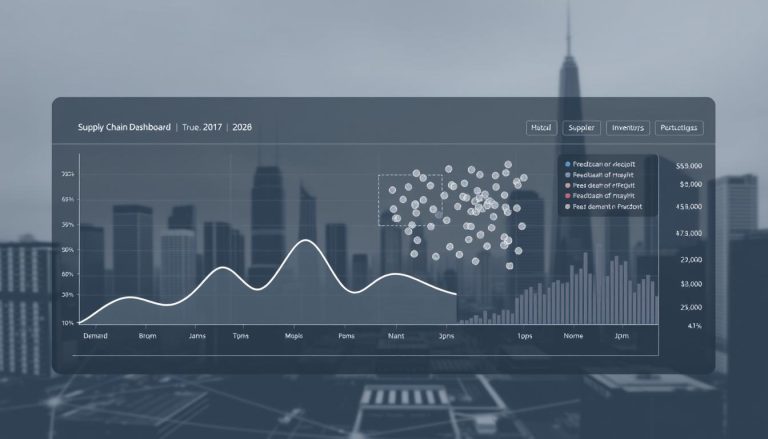

Essential Supply Chain Applications for Efficiency
In the U.S., supply chain efficiency is gauged by the effective use of labor, capacity, and capital to fulfill demand. The goal is straightforward: deliver products from origin to customer swiftly and at the lowest total cost. This must be done without compromising service quality.
Today, efficiency goes beyond mere speed and cost. Leaders now focus on visibility, sustainability, and resilience. Disruptions can quickly turn small delays into lost sales and increased expediting costs. This broader perspective has elevated supply chain applications to a critical role in managing execution and risk.
Technology integration is the backbone that ties together procurement, production, transportation, warehousing, and distribution. It streamlines data flows, reducing manual errors and cycle times. This enables faster decision-making through shared dashboards and alerts. It’s here that supply chain optimization becomes tangible, not just a concept.
This analysis delves into the areas where digital tools yield the most significant benefits and the metrics that demonstrate their impact. It covers perfect order performance, inventory turnover, lead time, and end-to-end cycle time. It also highlights the importance of ERP systems like SAP and Oracle, as well as WMS, TMS, IoT tracking, analytics, and automation in boosting throughput and controlling costs.
Supply Chain Efficiency in 2026: What It Means for Modern Operations
In 2026, supply chain efficiency is about maintaining a seamless flow under pressure. Modern operations integrate planning, sourcing, production, and logistics into a unified system. This integration includes risk management, not just cost reduction.
Efficiency as speed and cost control, plus visibility, sustainability, and resilience
Speed and cost control are essential, but they’re no longer the only measures. Visibility is critical for real-time data on supplier capacity and inventory status. Sustainability has become a key operational constraint, with strict rules and audits influencing purchasing decisions.
Early 2025 policy papers highlight the need for high-quality data to enhance supply chain resilience. Without current data, response times slow, and risks increase. Supply chain applications are now critical for governance and decision-making.
Why “efficient but fragile” breaks during disruptions like pandemics, trade volatility, and regulatory pressure
Disruptions are real, not just hypothetical. Pandemics, trade issues, and strict regulations can drastically change costs and availability. Procurement teams must balance service levels with budget discipline and responsible purchasing.
The “efficient but fragile” model often fails due to lean inventory strategies. Lean targets may reduce costs but can halt production with missing shipments. Supply chain optimization now includes redundancy planning and trigger-based replenishment.
Responsiveness vs. efficiency and why high-performing supply chains balance both
Efficiency focuses on cost minimization and resource optimization. Responsiveness prioritizes speed and flexibility in response to demand or supply changes. The balance between these is operational, affecting KPIs, staffing, and network design.
| Operating trait | Efficiency-led model | Responsiveness-led model |
|---|---|---|
| Primary goal | Lowest total cost to serve within targets | Fast recovery and rapid service adjustments |
| Inventory posture | Lean stock, tight reorder points | Strategic buffers for critical SKUs and components |
| Sourcing approach | Concentrated volumes for price leverage | Diversified sourcing with qualified alternates |
| Planning cadence | Fixed cycles with stable parameters | Frequent re-plans using scenario analysis |
| Data requirement | Accurate cost and utilization data | Near-real-time status data across partners |
High-performing supply chains aim for a balanced model. They maintain cost discipline while building agility through diversified sourcing and redundancy. Data-driven monitoring and scenario planning support this structure, ensuring supply chain optimization through standardized workflows and consistent decision logic.
Core Supply Chain Functions Where Applications Create the Biggest Gains
In today’s fast-paced world, efficiency is key. It’s about getting the most out of what you have, with minimal waste. This means a smooth flow from suppliers to customers, with fewer steps in between. Supply chain applications serve as the backbone, ensuring everything runs smoothly across different areas.
Procurement, production, transportation, warehousing, and distribution as an integrated system
Procurement starts by improving how we choose vendors, negotiate prices, and schedule purchases. Production then focuses on maintaining profit margins through consistent work, stable schedules, and efficient use of assets. Next, transportation and warehousing turn these plans into action, ensuring goods move and are stored reliably. Distribution uses data to optimize routes and schedules, protecting delivery promises and controlling costs.
When these areas work together as one, the benefits become clear. For instance, buying cheaper can sometimes increase storage costs. Faster shipping methods might hide delays in picking. Logistics software and supply chain apps help us understand these trade-offs by providing consistent data on lead times, service levels, and total costs.
| Function | Primary efficiency lever | Typical measurable KPI | Where applications reduce waste |
|---|---|---|---|
| Procurement | Competitive sourcing and compliant buying channels | Spend under management; purchase order cycle time | Automated approvals, fewer off-contract buys, cleaner supplier master data |
| Production | Stable plans and standardized execution | Overall equipment effectiveness (OEE); schedule adherence | Digitized work instructions, constraint alerts, faster changeovers |
| Transportation | Consolidation and optimized routing | Cost per shipment; on-time delivery | Carrier selection logic, appointment coordination, exception management |
| Warehousing | Space utilization and labor productivity | Lines per hour; inventory accuracy | Slotting rules, directed putaway, reduced travel time and rework |
| Distribution | Service reliability with controlled fulfillment cost | Perfect order rate; order cycle time | Dynamic allocation, better cutoff management, fewer split shipments |
Technology integration as the “glue” for real-time visibility and better decision-making
Integration is the key that turns activity into useful data. ERP systems link finance, orders, and inventory, while WMS and TMS handle the physical tasks of storage and shipping. When these systems share data, planners can make decisions based on a single, accurate view of inventory, capacity, and demand.
IoT devices extend visibility to location, temperature, and dwell time, reducing uncertainty in transit and storage. Digital transformation replaces manual coordination with automated workflows, audit trails, and alerts. In this environment, logistics software and supply chain apps provide actionable insights, not just reports.
Partner ecosystem management through shared metrics and collaborative platforms
Effective partner management relies on measurable goals. Shared metrics like on-time delivery, lead time variability, and defect rates create a common scorecard for suppliers, carriers, and warehouses. Real-time data exchange minimizes errors and shortens lead times through coordinated planning.
Collaboration with suppliers involves regular communication, joint planning, and shared forecasts. Collaborative platforms support these efforts by standardizing updates, tracking commitments, and alerting to exceptions early. With the right software, partners can align on capacity, timelines, and service goals using the same data.
Common Barriers That Reduce Efficiency and How Software Helps Remove Them
Efficiency losses often stem from disconnected data and inconsistent workflows. Teams using email threads, spreadsheets, and local systems face challenges. Procurement software and supply chain applications address these issues by standardizing data capture and making exceptions clear.
Software’s value peaks when it supports both policy and daily operations. It aids in supplier rationalization, clean purchasing controls, and shared reporting. The aim is to cut down on rework and prevent delays caused by missing or conflicting records.
Fragmented supplier networks that create siloed supplier and warehouse data
A wide supplier base leads to uneven item data, shifting lead times, and inconsistent labeling. Warehouse records often diverge from supplier master data, hindering traceability and slowing down receiving. This weakens monitoring of supplier performance, reliability, and disruption risk.
Two common solutions in mature programs are vendor consolidation and category-based sourcing. Vendor consolidation streamlines data, contracts, and service levels. Category-based sourcing groups related goods and services under a single supplier, simplifying ordering and reducing total risk.
Poor spend visibility caused by manual purchasing and document errors
Spend visibility tracks where each procurement dollar is allocated. Manual purchasing hampers this through misplaced documents, duplicate orders, and invoice mismatches. These errors lead to delays and increase the risk of policy violations.
Procurement software automates approvals and enforces catalog or contract buying. Supply chain applications enhance value by providing unified analytics dashboards. These dashboards centralize spend data, flag variances, and highlight delay points, enabling teams to streamline workflows.
Lack of alignment across procurement, finance, and operations without a governance model
Misalignment across procurement, finance, and operations causes bottlenecks, data inaccuracies, late payments, and compliance risks. Different rules for supplier setup, buying thresholds, and coding lead to avoidable handoffs and rework.
A procurement governance model establishes standardized processes and policies. Many organizations centralize buying for high-risk categories while maintaining local flexibility for low-risk needs. A hybrid model is often used, allowing buyers to purchase from pre-approved vendors within standardized workflows.
| Barrier | Operational impact | Software-supported control | What teams track |
|---|---|---|---|
| Fragmented supplier network | Siloed supplier and warehouse data, slower receiving, limited disruption monitoring | Supplier master data governance, vendor consolidation workflows, category-based sourcing support | Supplier on-time delivery, lead-time variance, fill rate, defect rate |
| Manual purchasing and document errors | Invoice mismatch, duplicate orders, delays, and policy leakage | Automated approvals, three-way match, centralized spend analytics dashboards | Spend under management, exception rate, cycle time, off-contract spend |
| Cross-functional misalignment | Conflicting codes and thresholds, rework between teams, compliance gaps | Standardized policies, role-based controls, integrated workflows across finance and operations | Approval compliance, PO accuracy, payment timing, audit findings |
supply chain applications
In 2026, supply chain applications will be evaluated based on data quality, control, and speed. Optimization requires clean data from procurement to delivery. Clear ownership of workflows and exceptions is also essential. Early 2025 U.S. policy changes raised the bar for high-quality trade and sourcing data.
What to prioritize: end-to-end visibility, workflow automation, and integrated data
Teams prioritize end-to-end visibility first to reduce blind spots. This includes suppliers, inventory, and transport. Integrated data across ERP, SCM planning, and execution tools is the baseline for optimization. When data matches, planners can trust lead times and service levels.
Workflow automation is key for repeatable tasks that cause delays. Common areas include purchase order routing and shipment status updates. Many use robotic process automation for admin tasks and predictive analytics for demand swings.
| Selection criterion | What it controls in daily operations | Operational metric it supports |
|---|---|---|
| End-to-end transparency | Single view of orders, inventory positions, and shipment events across nodes | Order cycle time, fill rate, on-time delivery |
| Integrated master data | Consistent item, supplier, and location records across ERP and execution tools | Forecast bias, inventory accuracy, invoice error rate |
| Automation for routine work | Fewer manual handoffs in buying, billing, and logistics coordination | Procurement cycle time, touchless invoice rate, exception volume |
| Embedded compliance controls | Guided buying, spend limits, and preferred or restricted vendor rules | Spend under management, policy adherence, audit readiness |
| Analytics for risk and allocation | Early warnings for supplier disruption and constrained capacity decisions | Time-to-recover, backlog days, service level variance |
Choosing platforms that support agility and scalability as complexity grows
As networks expand, platforms must scale without adding friction. Agility is key for strategies that include redundancy and alternate sourcing. Supply chain applications should support configurable rules and stable integrations.
Integration benchmarks help separate marketing claims from reality. Amazon Business reports integrations with over 300 systems, reducing manual data entry. This supports optimization by improving data consistency.
Building a unified system strategy to reduce silos and improve control
A unified strategy starts with mapping decision-making, data creation, and exception handling. Procurement, finance, and operations often track the same transactions differently. Standard data definitions and shared workflow ownership keep controls consistent.
Application-level controls are important for usability and compliance. Guided buying policies and spend thresholds reduce maverick spend. These controls feed shared dashboards, supporting optimization daily.
Logistics Software Solutions for Transparency, Tracking, and Faster Decisions
Transparency is not just a reporting feature; it’s a must-have for operations. When data is delayed or scattered across systems, teams waste time and miss critical signals. Effective logistics software connects procurement, production, and distribution. This ensures decisions are based on the same, accurate information.
Today, many supply chain applications operate in the cloud. They draw data from ERP, WMS, and TMS workflows. This shared data enables real-time dashboards, tighter exception management, and quicker approval cycles across different functions.
Cloud dashboards that maintain end-to-end transparency
Cloud platforms consolidate data on orders, inventory, and shipment status into one view. Stakeholders can filter by SKU, lane, customer, or facility. They see the same timestamps and status codes, reducing errors from duplicate spreadsheets and mismatched emails.
This visibility also boosts resilience. Digital monitoring tracks supplier performance metrics like delivery lead time and defect rates. Many applications use alerts to signal early slippage, preventing service level drops.
IoT sensors for inventory, movement, and condition tracking
IoT devices fill gaps where scans and manual updates fall short. They monitor inventory levels, track trailer dwell time, and confirm product movement. Sensors also track conditions like temperature and humidity, protecting sensitive goods.
With logistics software, these signals enhance lead-time visibility and on-time delivery performance. Early exception detection can cut order cycle time by prompting necessary changes.
Digital twins and 3D modeling for safer network changes
Digital twins create a virtual replica of the logistics network. Teams can model changes like new DC locations or carrier mix shifts. 3D modeling simulates warehouse layout changes and pick paths.
These simulations support detailed analyses tied to operational KPIs. Planners can test trade-offs in warehouse utilization and labor hours without disrupting operations. Many applications use these models for standardized scenario planning.
| Capability | Operational data used | Decision cadence | KPI impact areas |
|---|---|---|---|
| Shared cloud dashboards | Order status, inventory positions, ASN and carrier milestones, supplier OTIF | Hourly to daily reviews | Lead-time visibility, order cycle-time compression, on-time delivery rate |
| IoT sensing and telematics | Location pings, dwell time, temperature, humidity, shock, bin-level counts | Real time to intraday alerts | Exception detection speed, spoilage and damage reduction, service reliability |
| Digital twins and 3D models | Network constraints, capacity, labor standards, slotting rules, historical demand | Weekly to quarterly scenario cycles | Warehouse utilization tracking, throughput stability, cost-to-serve control |
| Supplier performance monitoring | Delivery variance, quality compliance, payment terms behavior, disruption signals | Daily to weekly risk reviews | Resilience readiness, inbound predictability, fewer expediting events |
Inventory Management Tools That Improve Turnover and Reduce Stock Risk
Inventory optimization is a key to unlocking capital efficiency. When inventory sits idle for too long, it ties up cash, increases storage costs, and raises the risk of write-offs. Inventory management tools help manage stock levels to meet service targets. This way, teams can avoid overbuying without missing shipments.
The inventory turnover ratio (ITR) is a direct measure of inventory efficiency. It shows how often goods are sold and replaced within a given time frame. A higher ITR indicates faster sales and tighter inventory control, which reduces carrying costs and protects order fulfillment rates.
ITR also guides planning discipline. It informs demand forecasting, just-in-time ordering, and supplier collaboration on lead times and minimum order quantities. With accurate signals, inventory management tools can align replenishment with real consumption. This reduces working-capital friction and enhances supply chain optimization across purchasing and fulfillment.
Segmentation and analytics enhance decision-making when SKUs have different behaviors. Advanced models separate fast-moving, high-margin items from slow movers. They set distinct service levels and safety stock policies. This demand-driven approach reduces excess inventory while maintaining availability, a critical goal for inventory management tools in complex networks.
| Inventory policy focus | Primary goal | Typical ITR pattern | Stock risk profile | How inventory management tools support supply chain optimization |
|---|---|---|---|---|
| Minimal holdings | Lower carrying cost and free cash | Higher, if supply is stable | Higher stockout exposure during delays | Automated reorder points, lead-time monitoring, and exception alerts to keep flow tight |
| Strategic buffers | Protect service levels for critical items | Moderate, by design | Lower stockout risk for constrained supply | SKU segmentation, risk-based safety stock, and scenario testing to size buffers by item and lane |
| Targeted de-stocking | Reduce aging inventory and obsolescence | Improves after cleanup | Lower write-off risk, short-term service risk if misapplied | Aging dashboards, slow-mover flags, and policy controls to prevent repeat overbuying |
Lean inventory can cut costs but increases vulnerability to supplier delays or transport capacity issues. For this reason, supply chain optimization often requires strategic redundancy. Inventory management tools help identify items that can be kept lean and those that need buffers. They consider demand variability, lead-time risk, and customer service impact.
Warehouse Management Systems for Space, Labor, and Picking Efficiency
Warehouse management systems are at the heart of fulfillment, controlling work in real time. They enable teams to handle products with fewer touches and exceptions. When combined with inventory management tools, they ensure stock records match physical movements.
Warehouse execution essentials
Warehouse management systems oversee key steps: receiving, putaway, slotting, picking, packing, and cycle counting. They ensure accurate task assignment, scan validation, and location logic. This reduces mis-picks and short-ships, lowering rework and claims.
Inventory management tools enhance value by sharing item masters, lot attributes, and reorder rules with the warehouse. This data supports cycle counting discipline and quick root-cause checks. It also shortens the time to correct exceptions.
Automation options that fit the workflow
Automation excels in reducing travel time and repeat handling. Goods-to-person systems like AutoStore cut walking by bringing bins to operators. This stabilizes pick rates during labor swings. AS/RS increases vertical utilization, while AMRs and AGVs support replenishment and tote moves without using lift capacity.
Barcode and RFID workflows are common in U.S. facilities for their low cost and traceability. Warehouse management systems enforce scan points, confirming the right item, location, and quantity before shipment. Inventory management tools reflect these movements for planning and allocation.
Maveneer’s work for a leading Canadian big box retailer is a documented example. AutoStore goods-to-person systems were integrated across multiple distribution centers. Very Narrow Aisle racking was used to raise storage density, and a phased cutover was designed to limit disruption with a third-party logistics operator.
| Change implemented | Operational intent | Reported outcome |
|---|---|---|
| AutoStore goods-to-person across multiple DCs | Eliminate walking during order fulfillment and lower variable labor | $2 million labor cost savings; 36% increase in outbound volume |
| Very Narrow Aisle (VNA) racking | Increase storage density within the same footprint | 50% increase in SKU capacity |
| Phased implementation with a 3PL in live operations | Maintain service levels while systems and processes change | $50 million in annual transportation cost savings |
Warehouse utilization as a speed-and-cost metric
Warehouse utilization measures space and location usage versus capacity. Low utilization can hide empty slots or slow replenishment, delaying picks. Overutilization can cause congestion, increasing cycle time and safety risks.
Warehouse management systems help control utilization with heat maps, location history, and work queues tied to volume. This visibility aids in adjusting slotting and labor plans without degrading service. Inventory management tools complement this by showing which SKUs drive peaks, ensuring space and replenishment align with demand.
Transportation Management Systems to Cut Freight Cost While Maintaining Service Levels
Freight costs are a significant variable in supply chain budgets. Transportation management systems help manage these costs while ensuring delivery promises are kept. Logistics software solutions enforce consistent rules for mode selection, tendering, and handling exceptions.
U.S. networks aim for lower costs per shipment, fewer empty miles, and fewer service failures. Achieving these goals requires clean order data, accurate transit times, and tracking carrier performance.

Route optimization, dynamic scheduling, and load consolidation
Route optimization reduces miles and driver hours by choosing efficient sequences and realistic time windows. Dynamic scheduling allows planners to adapt to late orders, weather, and other disruptions. Load consolidation improves trailer utilization by combining orders across lanes and dates.
Mode selection is also critical. For urgent freight, the system may choose air or expedited ground based on distance and customer priority. For routine replenishment, it can shift volume to lower-cost modes without compromising service levels.
Multi-carrier strategies to protect capacity
Dependence on a single carrier increases risk when capacity tightens or lanes become unprofitable. Multi-carrier strategies spread volume across contract carriers, regional providers, and spot coverage when needed. Shippers use logistics software to compare rates, acceptance, and historical on-time performance in one workflow.
Disruption plans are easier to execute with routing guides, backup carriers, and escalation rules already set. Transportation management systems also apply the same controls across plants, distribution centers, and third-party logistics partners.
On-time delivery and lead time visibility
Service levels depend on two metrics that executives can audit. On-time delivery rate measures the share of shipments that arrive within the promised window. Lead time tracks duration from manufacturing start to finished-goods availability, helping locate delays.
When those metrics trend off target, visibility features highlight root causes like missed pickups, dwell time at docks, or repeated accessorial charges. In a constrained distribution environment, the Maveneer case reported $50 million in annual transportation savings from network changes, showing the financial impact of disciplined execution.
| Operational lever | What it controls | Primary cost impact | Primary service impact | Metric to monitor |
|---|---|---|---|---|
| Route optimization | Stop sequence, mileage, time windows, driver hours | Lower miles and overtime; fewer reroutes | More predictable ETAs on planned routes | Cost per mile; on-time delivery rate |
| Dynamic scheduling | Pickup and delivery appointments as conditions change | Reduced detention and missed appointment fees | Faster recovery from late orders and delays | Dwell time; tender acceptance time |
| Load consolidation | Order grouping by lane, date, cube, and compatibility | Lower cost per unit shipped; fewer partial loads | Stable service when cutoff times are enforced | Trailer utilization; cost per shipment |
| Multi-carrier routing guide | Carrier mix, backup capacity, lane-level rules | Rate leverage and reduced premium spot buys | Higher resiliency during capacity disruptions | Primary carrier acceptance rate; spot share |
| Lead time and exception visibility | Milestones from production start to availability | Fewer expedite moves caused by late detection | Earlier intervention on bottlenecks | Lead time variance; exception rate |
Demand Planning Software for Forecast Accuracy and Operational Responsiveness
In today’s fast-paced world, demand planning is key to balancing speed and efficiency. It’s about how quickly a business responds to changes in orders, promotions, or supply issues. At the same time, it aims to control costs, maintain stable production, and ensure high service levels. Demand planning software bridges this gap by transforming demand signals into actionable plans for teams.
Many platforms leverage AI and machine learning to uncover patterns missed by manual methods. Predictive analytics enhance forecast accuracy by considering factors like price changes, lead-time adjustments, and channel shifts. Then, prescriptive analytics evaluates different scenarios, such as rerouting shipments or adjusting replenishment schedules. Dashboards and reports turn these insights into daily actions across sales, operations, and finance, driving supply chain optimization.
Effective planning only adds value when it aligns inventory and production. When forecasts match production plans, plants reduce unnecessary changes, scrap, and expedited shipping. Demand-driven replenishment also minimizes stockout risks while preventing excess inventory. These strategies directly boost customer satisfaction and working-capital management, essential for supply chain optimization.
Categories like consumer goods and apparel face significant demand fluctuations and short selling seasons. Seasonal peaks and regional events can drastically alter volume, increasing costs if inventory is placed incorrectly. Demand planning software aids in modeling these scenarios, including “what-if” analyses based on constraints like capacity, supplier lead times, and transportation limits.
Building resilience involves testing assumptions before disruptions occur. Scenario modeling allows planners to compare outcomes under different supplier scenarios, production plans, or safety-stock policies. Forecast updates also enable quick production adjustments when demand unexpectedly changes. With shared views and clear alerts, supply chain optimization becomes a continuous process, not just a one-time effort.
| Capability in demand planning software | Planning output | Operational lever for supply chain optimization | Primary KPI affected |
|---|---|---|---|
| AI and machine learning pattern detection | Refined baseline forecast and cleaner demand signals | Reduced manual overrides and faster consensus planning | Forecast accuracy, planner cycle time |
| Predictive analytics with causal factors | Short- and mid-term demand projections by channel and region | Inventory positioning and replenishment frequency adjustments | Fill rate, inventory turns |
| Prescriptive analytics under constraints | Ranked actions such as expedite, reallocate, or change production sequence | Routing, allocation, and production schedule optimization | OTIF, cost-to-serve |
| Dashboards, alerts, and exception reporting | Variance tracking and issue prioritization by product or node | Faster cross-functional decisions with clear accountability | Service level, response time to variance |
| Scenario planning (“what-if” analysis) | Comparative outcomes across demand shocks and supply constraints | Pre-approved playbooks for disruptions and seasonal peaks | Recovery time, margin protection |
Procurement Software for Spend Visibility, Compliance, and Supplier Collaboration
Procurement teams face significant challenges, including budget constraints, continuity risks, and adherence to purchasing rules. External factors like pandemics, sustainability regulations, and trade volatility further complicate matters. In this complex environment, procurement software plays a critical role. It standardizes buying processes, reduces variability, and ensures data compliance.
Manual purchasing methods often lead to common pitfalls, such as lost approvals, mismatched invoices, and unauthorized purchases. Procurement software, when integrated with finance and ERP systems, ensures consistent spend data analysis. Amazon Business offers automated approval workflows, recurring order management, customizable reports, and flexible payment options. These features help minimize rework and policy deviations.
Procurement cycle time as a measurable KPI
Procurement cycle time measures the time from need identification to invoice payment. A shorter, more consistent cycle time indicates fewer delays, exceptions, and costly errors. Procurement software links requests, approvals, receipts, and invoices into a unified timeline, unlike many supply chain applications.
Teams track cycle time expansions, such as approval queues, supplier confirmation, receipt matching, or invoice exceptions. Amazon Business Analytics dashboards enable spend tracking and trend analysis. Business Prime Spend Visibility highlights compliance issues, savings opportunities, KPI management, and trend tracking from any device.
Spend under management to increase control
Spend under management (SUM) represents the portion of total organizational spend governed by procurement processes. Higher SUM indicates procurement maturity, with more purchasing following standard policies and tracked approvals. For large categories with frequent purchases, procurement software makes compliant purchasing easier than workarounds.
Guided Buying controls enforce spend limits and preferred or restricted vendor policies, reducing maverick spend. When these controls integrate with other supply chain applications, finance teams can reconcile budgets faster. This reduces month-end surprises caused by fragmented purchase records.
| Metric | How it is measured | Common visibility gap in manual processes | How procurement software addresses it | Operational value for supply chain applications |
|---|---|---|---|---|
| Procurement cycle time | Need identification to invoice payment | Email approvals and missing receipts create unknown delays | Workflow automation, three-way match support, and status tracking | Improves lead-time assumptions used in planning and replenishment |
| Spend under management (SUM) | Governed spend ÷ total spend | Card spend and one-off buys bypass policy controls | Guided buying, catalog controls, and standardized approvals | Supports cost control and consistent supplier utilization |
| Compliance rate | On-contract purchases ÷ total purchases | Preferred supplier lists are not enforced at checkout | Preferred/restricted vendor rules and audit trails | Reduces risk exposure and improves reporting reliability |
| Invoice exception rate | Invoices with mismatches ÷ total invoices | Document errors and mismatched line items delay payment | Integrated PO, receipt, and invoice data with exception routing | Stabilizes supplier service levels and reduces expedite costs |
Supplier collaboration through shared plans and reviews
Effective supplier collaboration requires early sharing of forecasts, production plans, and constraints. Joint planning and scheduled performance reviews help align lead times, fill rates, and quality targets. This collaboration is essential because procurement software and other supply chain applications rely on accurate supplier commitments.
Structured supplier data supports responsible purchasing. Consolidating orders and optimizing reorder timing can reduce packaging and road time. Fewer suppliers also lower the monitoring burden for sustainability requirements. Amazon Business Diversity Certifications Policies tag suppliers with local, organic, or sustainability certifications, aiding policy-based purchasing and reporting.
Integration reduces silos by keeping purchase events, invoices, and supplier records synchronized across systems. Amazon Business integrates with over 300 procurement and ERP systems, ensuring cleaner data handoffs and fewer manual corrections. For teams managing multi-tier sourcing, this reduces duplicate records and improves audit consistency across supply chain applications.
Order Management Systems That Improve Perfect Order Performance
In high-volume fulfillment, order management systems are the backbone of transactions. They ensure orders are consistent from capture to cash. When they align with warehouse management systems, teams can match demand signals with real inventory, labor capacity, and shipping commitments.
Perfect order index (POI) measures the frequency of uninterrupted order completion. It aligns with perfect order fulfillment: complete, accurate, on time, and damage-free delivery. Order management systems enforce order rules, validate addresses and quantities, and standardize exceptions. This prevents rework from spreading across channels.
Order cycle time is a KPI that tracks the time from order placement to delivery completion. Order management systems expose delays in payment approval, allocation, pick release, and carrier tendering. Warehouse management systems share scan data and wave status, revealing whether the bottleneck is inside the building or at the shipping handoff.
Integration is key to performance. Clean connections to ERP and SCM platforms ensure consistent pricing, customer terms, and invoicing milestones. Ties to WMS and TMS keep inventory status and shipment events synchronized. This reduces manual entry, lowers common logistics errors, and improves data accuracy across teams.
| Operational checkpoint | Primary KPI signal | How order management systems contribute | How warehouse management systems contribute |
|---|---|---|---|
| Order capture and validation | Order accuracy rate | Applies business rules for items, quantities, addresses, and promised dates; flags exceptions early | Confirms item master alignment for pick units and labeling requirements |
| Inventory allocation | Fill rate and backorder rate | Selects fulfillment node and allocates available-to-promise inventory across channels | Provides real-time on-hand, reserved, and location status from scans and cycle counts |
| Fulfillment execution | Pick accuracy and labor productivity | Releases orders in the right sequence based on priority, cutoffs, and service level | Controls pick, pack, and verification workflows to reduce mispicks and short ships |
| Shipping handoff | On-time shipment and damage-free delivery proxy | Hands orders to carriers with consistent documentation and customer notifications | Validates packing steps, cartonization, and scan-to-ship checks that reduce damage risk |
Conclusion
In 2026, the challenge is clear: meet customer demand while reducing labor, transportation, and inventory costs. Achieving this goal requires real-time data, integrated systems, and consistent process discipline. Supply chain applications should transform daily operations into tangible cost savings, not just speedier transactions.
Recent disruptions have highlighted the dangers of an “efficient but fragile” approach. Trade volatility, pandemic shutdowns, and stricter sustainability standards have exposed the vulnerabilities of weak visibility and thin buffers. Today, supply chain optimization involves diverse sourcing, strategic redundancy, supplier oversight, and rapid scenario planning.
Improving performance requires a unified data fabric from ERP, WMS, TMS, IoT, analytics, automation, and collaborative platforms. Integration minimizes errors, accelerates issue resolution, and fosters consistent decision-making across all supply chain functions. For many, the highest returns come from applications that share a common data set and event signals.
Decision-makers seek concrete evidence, so KPIs focused on ROI and accountability are essential. Metrics like perfect order index, inventory turnover, supplier lead times, and on-time delivery rates are key. These measures, when combined, ensure supply chain optimization remains grounded in facts, not speculation.
FAQ
How is supply chain efficiency measured in modern operations?
Supply chain efficiency is gauged by how well it meets customer needs while cutting labor, transportation, and inventory carrying costs. Scorecards blend service and cost metrics. These include perfect order fulfillment, inventory turnover, lead time, order cycle time, and warehouse utilization.
What does supply chain efficiency mean in 2026?
In 2026, efficiency means moving goods quickly and cost-effectively from origin to consumer. It also encompasses visibility, sustainability, and resilience. This is because procurement networks are more complex and vulnerable to risks like pandemics and trade volatility.
Why do “efficient but fragile” supply chains fail during disruptions?
Lean inventory can cut costs but also removes redundancy. Without backup vendors or strategic buffers, production stalls. This increases lead times and drives costly service failures.
What is the difference between efficiency and responsiveness in supply chain management?
A: Efficiency focuses on cost minimization and resource optimization, often through standardization. Responsiveness emphasizes speed and flexibility in reacting to demand or supply changes. High-performing supply chains balance both through diversified sourcing and scenario planning.
Why do supply chain applications matter for measurable performance gains?
Technology integration is key for real-time visibility and decision-making. It streamlines workflows and reduces errors. Integrated ERP, warehouse management systems, transportation management systems, IoT tracking, analytics, and automation transform fragmented execution into a coordinated system.
Which supply chain functions typically see the biggest gains from logistics software solutions?
The largest gains come from applications connecting procurement, production, transportation, warehousing, and distribution. Procurement improves vendor selection, production increases resource utilization, and transportation reduces costs. Warehousing reduces holding costs, and distribution improves routing and scheduling.
How do supply chain applications reduce inefficiency caused by fragmented supplier networks?
Scattered suppliers create siloed data, limiting visibility into performance and reliability. Supply chain optimization improves with supplier connectivity tools, unified dashboards, and data exchange. This coordinates scheduling and tracks supplier KPIs, reducing workflow bottlenecks.
What is spend visibility, and why does manual purchasing reduce it?
Spend visibility tracks where procurement dollars are allocated, ensuring budget accuracy. Manual purchasing increases the risk of misplaced documents and data entry errors. Procurement platforms automate approvals and integrate systems, centralizing spend analytics.
What procurement governance model supports both compliance and speed?
A procurement governance model uses standardized processes and policies for consistent data and compliant workflows. Many centralize purchasing for control, while others use hybrid models for speed without increasing maverick spend.
What selection criteria matter most when evaluating supply chain applications and procurement software?
Key criteria include end-to-end transparency, real-time data utilization, and workflow automation. Integrated systems connecting ERP, SCM, and downstream tools are essential. In early 2025, the Office of the United States Trade Representative emphasized high-quality data for resilience.
What role do automation and analytics play in reducing delays and compliance risk?
Automation excels in routine tasks with consistent steps, reducing errors and delays. Many programs combine robotic process automation (RPA) with AI-driven predictive analytics for forecasting and risk detection.
How do IoT, digital twins, and cloud dashboards improve transparency and resilience?
IoT devices and sensors track inventory and product movement, predicting disruptions. Cloud dashboards make shared performance data accessible. Digital twins and 3D modeling simulate changes to test scenarios before execution.
Which KPI best captures inventory efficiency, and how do inventory management tools improve it?
The inventory turnover ratio (ITR) tracks how quickly goods move in and out. Higher turnover supports cost control by maximizing inventory use. Inventory management tools improve ITR through segmentation and demand-driven replenishment.
What does a warehouse management system control, and which automation options matter most?
A WMS controls receiving, putaway, slotting, picking, packing, and cycle counting. Common automation includes goods-to-person systems and automated storage and retrieval systems (AS/RS). These reduce errors and compress cycle times.
Is there evidence that warehouse automation can deliver measurable cost savings?
Yes. A Maveneer project for a leading Canadian big box retailer integrated AutoStore systems across multiple distribution centers. This eliminated walking in fulfillment and reduced labor costs, leading to a 50% increase in SKU capacity and million in labor cost savings.
How do transportation management systems reduce freight cost without harming service?
A: Transportation management systems improve efficiency through route optimization and load consolidation. They support dynamic routing and multi-carrier strategies to reduce dependency risk during disruptions.
Which transportation KPIs best reveal bottlenecks and reliability issues?
Two key metrics are on-time delivery rate and lead time. When integrated with TMS event data, these KPIs expose handoff delays and network constraints.
How does demand planning software connect responsiveness to efficiency?
Demand planning improves responsiveness by enabling faster adjustments to demand swings. AI and machine learning support forecast accuracy, predictive analytics improve replenishment timing, and prescriptive analytics optimize routing and decisions.
What procurement KPIs show whether procurement software is improving performance?
Key measures include procurement cycle time and spend under management (SUM). Higher SUM indicates stronger control, while shorter cycle time signals fewer bottlenecks and better compliance.
How does supplier collaboration reduce lead times and disruption exposure?
Supplier collaboration uses regular communication and shared forecasts. Collaborative platforms enable real-time data exchange and coordinated scheduling, reducing manual errors and shortening lead times.
What is the perfect order index, and how do order management systems improve it?
The perfect order index (POI) measures complete, accurate, on-time, and damage-free orders. An order management system (OMS) improves POI by acting as a transaction backbone and reducing manual intervention.
Why do order management systems require integration with ERP, WMS, and TMS?
OMS performance depends on consistent inventory status and shipment events. Clean connections between ERP, WMS, and TMS reduce reconciliation gaps and improve data accuracy.
What application features support compliance while keeping buying usable?
Effective compliance controls include guided buying policies and spend limits. Amazon Business markets these controls through Guided Buying and reports through Amazon Business Analytics dashboards.
What does “integrated data” look like in procurement technology, and is there a real integration benchmark?
Integrated data centralizes spend, supplier, order, and invoice records across procurement, finance, and operations. Amazon Business integrates with over 300 procurement and ERP systems, reducing silos and improving data accuracy.
Which digital tools typically form a modern stack for supply chain optimization?
A common stack includes ERP for cross-enterprise integration, WMS for warehouse execution, and TMS for shipping optimization. IoT, analytics dashboards, and automation tools are also essential. Many add demand planning software and order management systems for end-to-end connection.