
Costco Logistics: Streamlining Your Supply Chain
Costco Wholesale operates with a focus on efficiency, driven by high-volume sales and bulk purchases. Its membership-fee model supports low product markups, making logistics more than just a store topic. It’s a complex system with strict standards and tight execution.
The supply chain at Costco emphasizes palletized handling and fast product flow. It also simplifies the assortment to reduce touches across the network. These strategies can lower freight costs, reduce dock dwell time, and enhance in-stock performance with compliant shipments.
Yet, there’s a tradeoff. Missed labels, weak pallets, or late appointments can slow down receiving and increase chargeback risks. Many consumer brands opt for Costco over standalone stores, sacrificing some control for access to a large U.S. customer base and a proven operating model. Costco logistics often necessitates third-party support for packaging, labeling, and delivery readiness.
This section highlights why the Costco supply chain is a benchmark for study. It also sets the commercial reality for suppliers: success hinges on meeting Costco’s compliance standards while protecting margins through consistent, audit-ready shipment preparation.
Why Costco Is a Supply Chain Benchmark for U.S. Retail
Costco stands out in U.S. retail logistics due to its scale-based model. The costco supply chain focuses on predictable volume, a limited assortment, and consistent handling steps. This approach supports lower costs without increasing complexity at the store level.
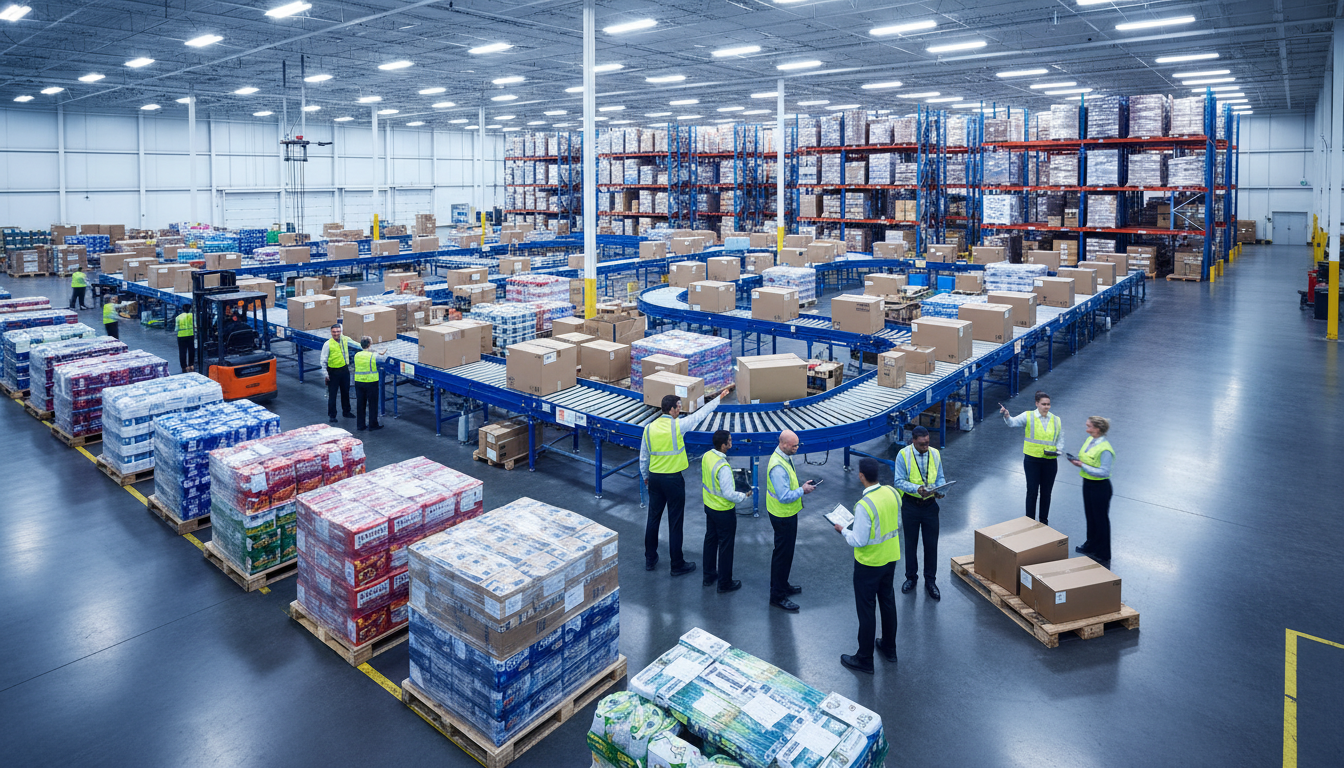
In many places, costco warehouses serve as both selling spaces and fast-moving inventory nodes. The layout prioritizes throughput over display, featuring industrial racks and wide aisles for forklifts and pallets. This setup reduces dwell time and limits extra touches that increase labor costs.
Warehouse-club scale and bulk purchasing as a logistics advantage
Bulk purchasing leads to fuller pallets, steadier truckload utilization, and fewer split cases. For the costco supply chain, this means more consistent cube efficiency and less time spent on mixed shipments. Standardized pack sizes also make receiving faster, with counts and handling rules remaining uniform.
Costco’s pricing model emphasizes execution. With a reported low markup structure, often capped at 15%, logistics costs must remain tight. In costco warehouse operations, velocity is a cost control lever. Faster turns reduce storage exposure and shrink the need for backroom staging.
| Operational lever | What Costco standardizes | Logistics effect |
|---|---|---|
| Purchase quantity | High-volume, bulk-ready order profiles | More truckload moves, lower per-unit freight cost, fewer partial pallets |
| Handling format | Pallet-friendly cases and stable stack patterns | Reduced rehandling, faster put-away, higher dock productivity |
| Assortment scope | Limited SKU count versus typical supermarkets | Simpler replenishment logic and fewer pick paths across facilities |
Customer value focus: efficiency, simplicity, and fast product flow
The member value promise is reinforced by operational choices that remove friction. Warehouses tend to keep décor minimal and prioritize open sightlines, clear signage, and rapid restocking cycles. In costco warehouse operations, the floor is part of the fulfillment system, not just a retail stage.
Simplicity also shows up in fewer decision points for replenishment and space planning. When items move in large batches, inventory can be slotted to reduce travel time and congestion at key aisles. For the costco supply chain, this supports stable service levels with lean labor hours per unit sold.
Throughput-first layouts that keep replenishment moving during trading hours
Repeatable receiving routines that limit exceptions and speed verification
High-velocity replenishment that reduces backroom buildup and rework
How selling through big-box channels shifts logistics demands to suppliers
For brands, access to Costco member traffic can deliver rapid volume, but it comes with tighter inbound discipline. The costco supply chain relies on on-time appointments, compliant labels, and bulk-ready quantities that flow cleanly across docks. Missed requirements can trigger delays that ripple into availability at the warehouse level.
Many suppliers use 3PL providers to meet these standards at scale. This includes pallet builds, carton markings, and routing guide compliance before freight reaches the network. In costco warehouse operations, the payoff is fewer receiving exceptions and smoother cross-facility movement, which keeps product flow aligned with thin-margin economics.
Costco Logistics and the Bulk Distribution Model
Bulk distribution focuses on speed and efficiency. Under costco logistics, suppliers must ship large volumes quickly. The aim is to minimize handling, reduce delays, and keep products moving through busy warehouses.
This model sets high standards for inbound shipments. Costco rewards suppliers for shipments that arrive on time, have accurate documentation, and require minimal corrections at the receiving end.
Moving high quantities at once: what “bulk-ready” shipments require
“Bulk-ready” shipments demand truckload discipline. Pallets must be square, have consistent case counts, and be wrapped securely for transit. If pallet integrity fails, unloading slows, and product staging becomes challenging.
3PL teams often assist by creating compliant pallets, verifying counts, and sequencing freight. In costco freight management, these efforts reduce dwell time and protect on-time delivery.
| Bulk-ready requirement | What the warehouse expects | Operational risk if missed |
|---|---|---|
| Stable pallet build | Uniform footprint, tight wrap, no leaning cases | Rework at dock, damaged product, longer unloading |
| Standard case configuration | Consistent pack size and predictable layers per pallet | Counting delays, mispicks, and inaccurate receiving |
| Accurate shipment quantities | Exact counts that match ASN and paperwork | Shorts, overages, and chargebacks tied to exceptions |
| Appointment-ready load | Freight staged to unload in sequence with minimal sorting | Dock congestion and missed delivery slots |
Packaging and labeling discipline to meet warehouse receiving expectations
Packaging choices significantly impact receiving times. Cases that crush, tear, or shift on pallets slow down manual handling. Strong corrugate and clean seals help maintain load integrity.
Labeling standards are equally strict. Clear case labels, scannable barcodes, and correct pallet IDs support fast verification in warehouse systems. In costco logistics, a single mislabeled pallet can cause hold steps, disrupting the entire load.
- Use consistent case printing and barcode placement for scan reliability.
- Keep pallet labels visible on the outside wrap and aligned with paperwork.
- Confirm case counts per layer to prevent recounts at receiving.
Preventing out-of-stocks through efficient restocking cycles
Shelf availability relies on predictable replenishment cycles. When inbound freight is compliant, warehouses can stage the next wave quickly. This reduces labor hours, minimizing downtime on shelves and boosting sales velocity.
Costco freight management ties these mechanics together through scheduling and exception control. Suppliers and 3PL partners that ship on a steady cadence, with ready-to-go pallets, help warehouses maintain flow without last-minute expediting or partial shipments.
Inside the Costco Distribution Network and Cross-Docking Strategy
The costco distribution network is designed for efficiency and consistency. It supports high-volume replenishment, limiting inventory storage time. This approach helps control costs and reduces exposure to slow-moving items.
Costco’s transportation services coordinate inbound and outbound movements across various lanes and schedules. The goal is to maintain a steady flow into warehouses, minimizing dock surprises.
Cross-docking: rapid movement from suppliers to warehouses with minimal storage time
In cross-docking, freight is quickly checked and moved to staging areas. This process focuses on pallet-level handling, supporting bulk merchandising and reducing unnecessary touches. Suppliers must ensure high-quality loads, accurate labeling, and trailer readiness.
Within the costco network, cross-docking emphasizes throughput over storage. costco transportation services manage the flow, as late trucks can disrupt the rhythm. Tight scheduling also minimizes the risk of product aging or damage.
Regional depots as hubs to reduce transportation distance and improve flow
Regional depots serve as hubs, collecting freight and sorting it for efficient warehouse runs. This structure can shorten delivery distances and enhance on-time performance. It also helps manage demand spikes in specific areas.
For many routes, the costco network uses these hubs to balance capacity. costco transportation services consolidate truckload moves, reducing empty miles. This results in more efficient dock, driver, and trailer utilization.
| Network element | Primary role | Typical freight unit | Operational focus | Cost driver most affected |
|---|---|---|---|---|
| Cross-dock platform | Fast transfer from inbound to outbound | Full pallets and bulk-ready loads | Short dwell time, appointment discipline | Inventory holding cost |
| Regional depot hub | Consolidate and route freight to nearby warehouses | Mixed outbound runs by destination | Lane planning, stable replenishment cadence | Linehaul miles per unit |
| Warehouse receiving | Rapid put-away to sales floor replenishment | Pallets designed for floor-ready selling | Dock-to-floor speed, minimal backstock | Labor per case handled |
Direct-to-warehouse replenishment vs. traditional retail distribution center models
Traditional retail DC models often rely on deeper storage and case picking. Costco, on the other hand, focuses on direct-to-warehouse replenishment and fast handling. This approach supports pallet-level selling and reduces the time spent on mixed-case shipments.
In this model, the costco network prioritizes predictable truckload cycles over large backstock buffers. costco transportation services play a key role in maintaining delivery windows and trailer readiness. The overall system is optimized for speed and consistent flow, not slow inventory accumulation.
Costco Warehouse Operations That Reduce Handling and Labor
High labor productivity in costco warehouse operations hinges on a simple principle: handle fewer individual cases. The layout, equipment, and receiving protocols are designed to ensure smooth freight flow with minimal handling. In costco logistics, every minute saved at the dock and aisle adds up over a week of restocking.
“No Touch” policy: keeping products on pallets to minimize handling
The “No Touch” policy keeps products on pallets throughout their time on the floor. Instead of breaking down loads into small picks, teams stage, move, and present full pallets. This approach reduces handling steps, minimizes repacking, and decreases congestion in active aisles.
This policy also enhances receiving standards in costco logistics. Pallet integrity, consistent labels, and stable stacking are critical because the pallet is the work unit. When loads arrive ready for quick placement, the warehouse avoids slow case-by-case stocking.
Dual-purpose warehouses that function as both retail space and distribution points
Many sites serve as both selling floors and high-velocity storage areas. In costco warehouse operations, this reduces the need for large backrooms and separate retail staging areas. The sales floor displays inventory in plain sight, shortening restock travel distances.
This layout supports faster replenishment cycles within costco logistics. Product can move from receiving to racking or directly to the floor without extra transfers. Less internal movement helps control labor costs and keeps docks available for the next appointment.
Pallet racks, forklifts, and selling off pallets to speed restocking
Steel pallet racks are designed for heavy loads and clear sightlines. Forklifts place pallets into rack positions or set them directly onto the floor for immediate selling. When product sells off the shipping pallet, restocking time drops because the display is also the inventory buffer.
Safety controls enable speed without adding friction. Dedicated safety teams run routine inspections, including rack checks and netting or wire mesh where needed to prevent falling items. Training at onboarding and recurring refreshers supports safe forklift travel, stable pallet placement, and cleaner aisles on slip-resistant concrete.
| Warehouse-floor practice | How it reduces labor | Common execution details | Safety and compliance support |
|---|---|---|---|
| No Touch pallet flow | Fewer case-handling steps and fewer repeat moves | Consistent pallet build, scannable labels, inbound loads staged by priority | Load stability checks, clear travel lanes, powered equipment training |
| Dual-purpose retail and storage floor | Shorter replenishment paths and less backroom sorting | High-velocity items placed near main aisles; minimal secondary storage | Aisle discipline, slip-resistant floors, routine housekeeping audits |
| Selling off pallets with pallet racking | Faster restock cycles and fewer shelf resets | Forklifts place full pallets; displays designed around pallet footprints | Rack inspections, guardrails where required, netting or wire mesh in risk zones |
Across these methods, costco logistics relies on predictable freight presentation and disciplined floor execution. In costco warehouse operations, the goal is steady throughput: fewer touches, fewer delays, and clearer work for each shift.
Costco Inventory Management: Fewer SKUs, Faster Turnover, Better Forecasting
In costco inventory management, assortment discipline is a planning tool, not a branding detail. Costco operates with roughly 4,000 SKUs, a stark contrast to the 30,000+ SKUs found in conventional supermarkets. This reduction in items simplifies slotting, shortens reorder decisions, and streamlines store-level replenishment across the costco supply chain.
Limited SKU strategy (about 4,000) vs. conventional supermarkets
A small SKU base concentrates volume per item. This concentration enhances purchase leverage and supports more predictable inbound patterns. It also leads to standardization, reducing exceptions that slow down docks and reserve storage in the costco supply chain.
| Operating metric | Costco model (approx.) | Conventional supermarket model (typical) | Inventory and flow impact |
|---|---|---|---|
| SKU count per store | ~4,000 | 30,000+ | Fewer forecasts, simpler planograms, tighter replenishment loops |
| Volume per SKU | High | Lower, spread across many items | More consistent ordering and supplier production runs |
| Inbound load profile | More standardized pallets and larger drops | Mixed assortment with smaller drops | Faster receiving and fewer handling touches |
| Supplier negotiations | Concentrated commitments | Fragmented across many SKUs | Clearer terms, fewer line-item changes, steadier lead times |
High inventory turnover to reduce long-term storage and maintain freshness
High turnover is central to costco inventory management, reducing the cost of carrying product for long periods. Faster sell-through lowers markdowns, shrink, and aging inventory, critical in categories where freshness and presentation drive repeat purchases. This approach fits a low-margin model, where profit relies on volume and pace.
Merchandising choices can add demand swings. Rotating placement and limited-time items create a “treasure hunt” effect that lifts unplanned purchases. This shifts the replenishment cadence, requiring the costco supply chain to adapt without expanding SKU count or inventory.
Demand planning with data analytics to improve replenishment timing
With fewer items carried deeper, planning accuracy becomes a daily discipline. Data analytics supports reorder timing by combining warehouse movement, store sell-through, lead times, and vendor performance signals. This approach in costco inventory management keeps shelves stocked while avoiding excess reserve stock that competes for space and labor.
For the costco supply chain, the goal is stable in-stock performance with controlled inventory days on hand. This requires tight alignment between item velocity, promotional calendars, and transportation schedules. Replenishment should arrive when it can move quickly from dock to floor.
Technology in Costco Supply Chain Visibility and Control
Technology plays a key role in managing high-volume warehouse operations and a growing digital channel. In the costco supply chain, visibility tools ensure products flow smoothly, reducing exceptions and manual counting. This leads to faster issue resolution. As online orders increase, costco shipping solutions rely on accurate data handoffs between inventory, routing, and delivery execution.

RFID technology for improved tracking and inventory accuracy
RFID enhances traceability at item and pallet levels in dynamic environments. It minimizes scan gaps, reducing count variance that often prompts rushed replenishment. For the costco supply chain, this results in better on-shelf availability without excessive labor.
RFID also aids in controlling shrinkage in high-throughput, low-dwell-time settings. This is critical for resolving exceptions quickly, essential for seasonal items that move in large quantities. Accurate tracking data supports downstream planning, influencing costco shipping solutions, including routing decisions based on store-level inventory.
Data analytics for demand forecasting and operational decisions
Data analytics transforms sales velocity, lead times, and vendor performance into replenishment decisions. With a limited SKU approach, forecasting errors are quickly apparent. Planners balance near-term trends with promotional cadence and regional demand patterns. This supports steady inventory turns while minimizing overstock risk.
Analytics also aids in operational controls like appointment planning, dock utilization, and exception management. When variance occurs—late arrivals, short ships, or damage—teams can pinpoint causes using structured metrics. These insights shape costco shipping solutions, influencing carrier selection, tender timing, and contingency routing.
| Technology layer | Visibility signal captured | Operational use in warehouses | Downstream impact on costco shipping solutions |
|---|---|---|---|
| RFID | Automated identification during movement | Faster cycle checks and fewer manual scans | Fewer inventory mismatches that trigger re-routes |
| POS and item movement data | Sales velocity by location | Replenishment triggers aligned to turnover | More stable tender volumes and pickup windows |
| Supplier performance metrics | On-time and in-full patterns | Prioritized receiving appointments and exception flags | Carrier planning based on predictable lane performance |
| Order management signals | Channel-specific demand (warehouse vs. online) | Inventory positioning and fulfillment routing rules | Improved last-mile planning and fewer split shipments |
E-commerce investments that require tighter coordination across channels
E-commerce introduces complexity by demanding accurate inventory across warehouses, depots, and online fulfillment paths. Delayed visibility can misdirect orders, increasing handling and transit costs. For the costco supply chain, maintaining real-time stock status and accurate item attributes is critical.
Online growth has also led to partnerships with delivery services, increasing integration demands. This affects customer expectations and service recovery when delays occur. In this context, costco shipping solutions rely on consistent event reporting, reliable cutoff times, and disciplined exception workflows.
Costco Transportation Services and Freight Management Fundamentals
Costco’s bulk model transforms freight into a cost lever. High-quantity orders, palletized, support stable lane planning and fewer touches. This approach ensures repeatable execution, protecting speed from supplier dock to sales floor.
Costco freight management is built on standardization. Consistent pallet patterns, accurate counts, and clean documentation reduce exceptions. This results in a tighter link between freight economics and in-warehouse throughput.
Optimizing truckload freight for bulk shipments and consistent replenishment
Truckload freight is cost-effective when loads are standardized. Full pallets, consistent cube, and predictable weights enhance trailer utilization, cutting the cost per case. This aligns shipping plans with store replenishment cycles.
Carrier performance improves with low variability. Consistent shipment profiles allow for better planning of tractors, hours, and backhauls. Suppliers benefit from fewer reworks, claims, and last-minute mode shifts.
Reducing dwell time with appointment readiness and compliant loads
Dwell time increases with unprepared inbound freight. Appointment compliance, accurate quantities, and scan-ready labels reduce friction. Costco treats receiving delays as a controllable cost, not a nuisance.
Load compliance is key. Pallet integrity, wrap quality, and correct item placement prevent re-stacking. Many shippers use 3PL partners to stage pallets, verify labeling, and audit paperwork.
Balancing inbound flow with warehouse capacity and dock scheduling
Inbound volume must match dock doors, labor, and floor space. Congestion slows unload times and pushes freight into overflow areas. Costco relies on appointment windows that reflect real warehouse capacity.
Warehouse systems track inbound status, exceptions, and turn times. This allows for better trailer sequencing and protects high-priority replenishment. Shippers and 3PLs share a cadence: stage the next compliant load without interrupting product flow.
| Freight control point | Execution standard | Operational effect at the dock | Cost impact |
|---|---|---|---|
| Trailer utilization | Full pallets with consistent cube and weight | Fewer partials to sort; faster unload sequence | Lower cost per case through higher fill rates |
| Appointment readiness | On-time arrival within scheduled window | Reduced queueing and fewer yard moves | Lower detention exposure and less schedule disruption |
| Packing and labeling compliance | Scan-ready labels, correct pallet patterns, stable wrap | Fewer receiving holds and rework steps | Lower labor waste and fewer chargebacks |
| Exception handling | Pre-ship audits by supplier or 3PL; clean documentation | Faster check-in and clearer put-away or cross-dock routing | Fewer claims, fewer re-deliveries, less expedite spend |
| Dock scheduling vs. capacity | Inbound flow matched to doors, labor, and space | Reduced congestion during peak receiving hours | More predictable throughput and less overtime pressure |
Costco Shipping Solutions for E-Commerce and Bulky Item Delivery Services
E-commerce has transformed the way warehouse clubs handle freight. A single online order can shift the focus from pallet flow to home delivery. This shift requires more stops, scans, and customer interactions. As a result, costco shipping solutions focus on timely delivery, preventing damage, and confirming delivery.
Costco delivery services also need better coordination between inventory, order release, and route planning. This ensures a smoother delivery process.
Why big-and-bulky orders need specialized last-mile capabilities
Big-and-bulky items pose unique challenges not seen in store replenishment. Items like appliances and large TVs require special handling. This includes lift-gate equipment, two-person crews, and scheduled appointments.
This approach increases the cost per stop and the risk of service issues. To mitigate these risks, costco shipping solutions rely on standardized handling rules and effective exception management.
Reverse logistics also becomes more complex with heavy items. Carriers must manage pickup timing, packaging condition, and safe loading. For Costco, this means more touchpoints, claims risk, and stricter tracking discipline.
Vertical integration signals: acquisition of Innovel Solutions to strengthen bulky-item logistics
Costco aimed to control bulky delivery by acquiring Innovel Solutions. This move shows a focus on reliable service for online purchases. Delays and damage can lead to costly refunds and re-delivery.
With clearer process control, costco shipping solutions benefit from better scheduling, dispatch, and driver performance. This integration also tightens feedback loops, reducing failed deliveries and improving first-attempt completion.
Partnerships with delivery providers to expand coverage and speed
Coverage is a challenge, mainly outside major metros. Costco uses third-party providers to reach more areas and handle peak demand. Partnerships help expand coverage while maintaining service standards.
Hybrid models rely on shared expectations for scanning, appointment confirmation, and damage reporting. Costco focuses on consistent scheduling and performance scorecards to ensure stable execution across carriers.
| Bulky Delivery Requirement | Operational Constraint | Execution Focus in costco shipping solutions | Service Outcome Targeted in costco delivery services |
|---|---|---|---|
| Appointment scheduling | Customer availability and narrow delivery windows reduce route flexibility | Time-window optimization, confirmation calls/texts, and exception queues | Higher on-time arrival and fewer failed delivery attempts |
| Two-person handling and lift equipment | Higher labor minutes per stop and elevated injury exposure | Crew planning, safety protocols, and standardized handling checklists | Lower damage rates and fewer incident-related delays |
| Threshold vs. room-of-choice delivery | Different service tiers change dwell time and liability | Clear service definitions at checkout and driver job coding | Fewer disputes and more consistent customer experience |
| Packaging integrity | Longer touch chain increases risk of dents, scratches, and missing parts | Condition scanning, photo capture at handoffs, and claims documentation | Faster claims resolution and reduced refund leakage |
| Returns and haul-away | Reverse moves require capacity, compliance, and secure handling | Pickup routing, disposition rules, and chain-of-custody tracking | Shorter return cycle time and improved recovery value |
Sustainability and Risk Resilience in the Costco Supply Chain
Sustainability and risk planning are not just slogans; they are integral to daily operations. In the realm of costco logistics, procurement, freight selection, and warehouse operations significantly influence both environmental impact and reliability.
Within the costco distribution network, efficient operations and strict receiving protocols minimize idle inventory and unnecessary handling. This model also enhances control when there are changes in suppliers, lanes, or lead times.
Sustainable sourcing expectations and supplier alignment
Supplier alignment begins with clear, measurable standards that influence bidding, audits, and corrective actions. For many categories, these standards include packaging specifications, material disclosures, and compliance documentation at the factory level.
costco logistics relies on consistent pallet quality and accurate labeling. Sustainability goals often overlap with packaging redesign efforts. Lighter or more recyclable packaging must maintain load stability and adhere to warehouse constraints.
Waste reduction through cross-docking and efficient inventory flow
Cross-docking minimizes dwell time, reducing the risk of damage, spoilage, and write-offs due to slow movement. In the costco distribution network, this rapid transfer reduces the need for prolonged storage, which can lead to shrinkage and rework.
High-throughput operations also reduce operational waste associated with extra handling, repalletizing, and problem loads. costco logistics prefers bulk-ready shipments that can transition from inbound to the floor with minimal intervention.
Managing disruption risk, rising costs, and e-commerce competition pressures
Recent global disruptions highlighted vulnerabilities in ocean capacity, port congestion, and domestic trucking. A low-markup model is vulnerable to inflation in labor, fuel, and packaging costs, making variability a significant margin concern.
E-commerce growth intensifies the need for tighter channel coordination, with a focus on big-and-bulky delivery windows and return flows. For costco logistics, resilience is largely operational, relying on faster throughput, higher inventory turnover, and clear supplier readiness signals across the costco distribution network.
| Pressure point | Where it shows up operationally | Primary mitigation lever in costco logistics | Why it matters in the costco distribution network |
|---|---|---|---|
| Supplier noncompliance | Chargebacks, rejected loads, relabeling, delayed receiving | Stricter onboarding, audits, and packaging specs tied to PO accuracy | Protects dock capacity and keeps cross-dock schedules intact |
| Waste and shrink | Damage, spoilage, excess handling, aging inventory | Cross-docking, faster turns, and bulk-ready pallets that reduce touches | Limits dwell time and reduces backroom congestion at warehouses |
| Disruption and inflation | Lane volatility, labor cost spikes, packaging input swings | Route discipline, appointment readiness, and more predictable replenishment cycles | Supports stable regional flow even when transit times widen |
| E-commerce competition | Higher service expectations, complex returns, last-mile constraints | Better inventory positioning and tighter coordination across channels | Prevents stock imbalances between warehouses and online fulfillment needs |
Conclusion
Costco’s success is not just one strategy. It’s a combination of structural choices that drive volume through a streamlined system. Their logistics depend on bulk purchases, cross-docking, and dual-use warehouses. These serve as both retail spaces and distribution centers.
The “No Touch” approach, centered on pallets, minimizes handling, shrinkage, and labor costs. This method is integral to their operational design. It aligns with their financial model, which caps product markups at about 15%. Profits mainly come from membership fees.
This financial structure necessitates high inventory turnover. Costco manages its inventory with a narrow range of SKUs, around 4,000 items. They focus on quick replenishment cycles to limit storage time.
For suppliers and logistics experts, the expectations are clear. They must prepare shipments in bulk, adhere to packaging and labeling standards, and manage appointments efficiently. This ensures smooth dock operations and prevents delays. Costco rewards those who deliver on time, with minimal dwell time, and accurate documentation.
The model is evolving to meet omnichannel demands. Costco has expanded its capacity through Innovel Solutions and delivery partnerships. This allows for handling of large orders and tighter delivery windows. Now, their inventory management must balance store demand with e-commerce needs while maintaining in-stock rates.
Costco’s approach sets a high standard for facility design, labor efficiency, transportation, and inventory management. It serves as a model for others to follow and improve upon.
FAQ
Why does Costco logistics matter so much to suppliers and operators?
Costco’s success relies on high-volume throughput and bulk purchasing. Its membership-fee model supports low product markups, often capped at 15%. This financial structure makes logistics discipline essential. Suppliers must focus on palletized handling, fast receiving, and strict compliance with inbound standards across the Costco distribution network.
What does “bulk-ready” mean in the Costco supply chain?
“Bulk-ready” shipments are designed for speed, with high-quantity shipments built for quick handling. Pallets must be stable, case configurations standardized, and quantities must match purchase orders exactly. This approach minimizes touches and protects velocity from receiving through replenishment.
What inbound compliance issues most often disrupt Costco warehouse receiving?
Packaging and labeling errors are common causes of delays. Non-compliant carton markings, incorrect labels, unstable pallets, or mismatched counts can extend dwell time and trigger rework. These errors can create dock congestion and slow replenishment in Costco’s logistics.
How does cross-docking work in Costco’s distribution network?
Costco uses cross-docking to move product quickly from inbound supplier freight to outbound warehouse replenishment. Regional depots consolidate and redirect freight to nearby warehouses. This approach lowers inventory holding costs, reduces obsolescence risk, and ensures more predictable replenishment cycles.
What is Costco’s “No Touch” approach in warehouse operations?
The “No Touch” approach keeps products on pallets through most of the handling lifecycle. Teams use forklifts to position pallets into steel pallet racks or directly onto the sales floor. This method reduces labor time, rehandling, and restocking delays while supporting safe, repeatable execution.
How does Costco inventory management benefit from carrying fewer SKUs?
Costco carries roughly 4,000 SKUs, far fewer than conventional supermarkets. A limited assortment simplifies forecasting, slotting, and replenishment. Higher velocity improves inventory turnover and reduces the need for deep backstock, aligning with low-markup economics.
What role do RFID and analytics play in Costco supply chain visibility?
RFID and data analytics enhance inventory accuracy and item tracking in high-throughput environments. Better visibility reduces shrink and count variance while supporting demand forecasting and allocation decisions. These tools also help coordinate inventory visibility across warehouse and online channels for tighter fulfillment routing and service execution.
How does Costco freight management reduce per-unit transportation cost?
Costco freight management benefits from truckload optimization due to palletized and high-quantity shipments. Standard configurations and consistent flows reduce handling time and improve trailer utilization. Appointment discipline and compliant loads also reduce dwell time, protecting cross-docking speed and keeping inbound capacity aligned with dock scheduling.
When do suppliers typically need 3PL support for Costco delivery services?
Many suppliers use 3PL providers for shipment prep that meets retailer specifications. This includes pallet builds, labeling, packaging compliance, and delivery readiness for scheduled appointments. A capable 3PL can also support staging and warehouse systems that track product flow, helping suppliers maintain service levels within Costco transportation services requirements.
Why are Costco shipping solutions different for big-and-bulky e-commerce orders?
Big-and-bulky categories require scheduled delivery, specialized handling, and higher-touch customer coordination. Costco’s acquisition of Innovel Solutions signaled a push toward tighter control of bulky-item last-mile performance. These shipments also increase exposure to reverse logistics and service-level failures, raising the bar for execution.
How does Costco manage sustainability and risk resilience in its supply chain?
Costco emphasizes sustainable sourcing expectations that require supplier alignment on environmental standards. Cross-docking and efficient inventory flow can reduce waste tied to excess storage time and spoilage risk. Operationally, the model addresses disruption risk and rising costs by leaning on throughput, high inventory turnover, and disciplined omnichannel coordination across the Costco distribution network.