

Optimize with Supplier Relationship Management (SRM)
Supplier Relationship Management (SRM) offers procurement teams a structured method to transform key suppliers into long-term assets. It enhances procurement efficiency, boosts service levels, and reduces the total cost of ownership. Doug Roginson, Head of Supplier Relationship Management at JPMorgan Chase, emphasizes SRM’s role in fostering sustained, mutual benefits through structured engagement with priority suppliers.
This approach transcends simple buying to focus on measurable performance and trust-based collaboration. It integrates segmentation, risk management, and joint planning for optimal supply chain performance. North West London Procurement Services exemplifies this with its “Stronger Together” 2022–2025 strategy, demonstrating the effectiveness of structured governance across various categories and regions.
Today’s SRM solutions seamlessly integrate with ERP systems from SAP, Oracle, and Microsoft. These platforms offer real-time insights, automate procurement processes, and enhance data quality for analytics. Clean data then fuels AI and machine learning to identify risks, predict demand, and guide strategic partnerships.
The subsequent sections detail how SRM boosts reliability, innovation, and cost management. Readers will discover actionable strategies for forging strategic partnerships, embedding KPIs, and aligning incentives. The aim is to achieve superior outcomes through SRM, driving procurement efficiency and supply chain optimization.
What Supplier Relationship Management Is and Why It Matters for Procurement Efficiency
Supplier Relationship Management (SRM) transforms how companies interact with key suppliers, boosting procurement efficiency and supply chain performance. As JPMorgan Chase’s Doug Roginson notes, SRM targets the most critical partners to enhance long-term value and mutual success. It goes beyond simple vendor management by aligning goals, governance, and data across various functions.
Organizations like NWLPS demonstrate the benefits of formal SRM. It reduces fragmented interactions and fosters a unified view of quality, delivery, and continuity planning. This leads to clearer accountability, quicker decision-making, and strategic partnerships that drive growth.
Definition and strategic scope beyond day-to-day vendor management
SRM involves structured engagement with top suppliers through segmentation, governance, and joint planning. Unlike vendor management, which focuses on transactions and contract adherence, SRM aims at long-term value creation and cross-functional alignment. This includes shared roadmaps, clear performance benchmarks, and decision-making authority.
This approach embeds risk assessments and continuity measures, elevating supply chain performance across all tiers.
How SRM drives innovation, reliability, and cost-effectiveness
SRM accelerates innovation by guiding supplier R&D agendas and tailoring solutions to product needs. Co-developed roadmaps shorten cycle times and enable early design-for-manufacture decisions.
Reliability improves with standard metrics, regular reviews, and corrective actions. This reduces defects and boosts on-time delivery. Cost-effectiveness is achieved through process optimization, efficient scaling, and leveraging economies of scale for sustained procurement efficiency.
Turning suppliers into strategic allies for growth and competitive advantage
SRM transforms suppliers into collaborators on market entry, capacity, and quality, not just order fulfillment. With transparent data and shared goals, partners can reallocate resources to meet demand spikes and mitigate risks.
By setting clear expectations and establishing feedback loops, companies turn key relationships into strategic partnerships. This strengthens resilience and enhances supply chain performance.
| Dimension | Vendor Management | Supplier Relationship Management (SRM) | Business Impact |
|---|---|---|---|
| Time Horizon | Short-term, transaction-focused | Multi-year, value-focused | Stability and predictable planning |
| Governance | Basic contract oversight | Structured reviews, executive sponsorship | Faster issue resolution and escalation |
| Innovation | Ad hoc requests | Joint R&D and product roadmaps | Reduced time-to-market and higher ROI |
| Performance Management | Operational KPIs only | End-to-end metrics with risk and quality | Improved reliability and fewer defects |
| Cost Levers | Unit price negotiation | Process redesign and scale efficiencies | Sustainable cost reductions |
| Risk and Continuity | Reactive mitigation | Proactive ecosystem and continuity planning | Greater resilience to disruptions |
Supplier Relationship Management (SRM)
Supplier Relationship Management (SRM) aligns procurement, finance, and operations to create lasting value. It goes beyond basic vendor management by fostering long-term partnerships. This involves disciplined supplier performance evaluation and risk control, all supported by SRM software and solutions.
Core components: segmentation, collaboration, performance, and risk
Effective SRM programs begin with supplier segmentation. This ranks partners based on spend, criticality, and capability. Teams then set engagement models that align with each tier.
Collaboration is key, relying on structured governance and shared plans. Clear escalation paths are also essential. Performance management tracks quality, cost, and delivery to keep total cost of ownership in check.
Risk management is a continuous cycle of monitoring, evaluating, and mitigating risks. This aligns with frameworks like NWLPS, addressing financial, operational, and geopolitical risks. SRM software aids in this cycle with alerts, analytics, and documentation.
SRM vs. vendor management: transactional oversight vs. long-term value
Vendor management focuses on transactional aspects like orders, rates, and compliance checks. Its horizon is short, with activities centered around transactions.
Supplier Relationship Management, on the other hand, aims for long-term value, innovation, and capacity assurance. It leverages SRM solutions to align goals, co-plan roadmaps, and expand market access beyond purchase orders. This approach strengthens bargaining power and improves resilience while maintaining stable service levels.
KPIs and relationship health metrics that guide continuous improvement
JPMorgan Chase advocates for regular KPI reviews and health scoring with suppliers. This enables joint problem-solving. Quantitative metrics include on-time delivery, defect rates, dispute resolution time, cost savings, and disruption rates.
Qualitative assessment covers communication quality, early risk signals, collaboration effectiveness, and satisfaction. These inputs guide supplier performance evaluation and targeted action plans.
| Dimension | Metric | Target Benchmark | Business Impact | Enabling Tools |
|---|---|---|---|---|
| Delivery | On-time delivery (%) | ≥ 97% | Reduces expediting and stockouts | SRM software alerts; ERP ASN tracking |
| Quality | Defect rate (PPM) | ≤ 500 PPM | Lowers rework and warranty costs | SPC dashboards; SRM solutions for CAPA |
| Cost | Verified cost savings (% YoY) | 2–5% | Improves margin and cash flow | Should-cost models; total cost analytics |
| Service | Dispute resolution time (days) | ≤ 10 | Stabilizes supply and cycle time | Workflow in SRM software; e-invoicing |
| Resilience | Supply disruption rate (per quarter) | 0–1 | Protects revenue and OTIF | Risk heatmaps; multi-tier visibility |
| Relationship | Collaboration score (1–5) | ≥ 4.0 | Fuels co-innovation and speed | Joint QBRs; action trackers in SRM solutions |
Regular reviews turn data into action, ensuring disciplined governance and sustained value creation in Supplier Relationship Management across the supplier base.
Supplier Segmentation Strategies That Maximize Value
Supplier segmentation transforms a vast array of vendors into distinct tiers, enabling management to focus efforts effectively. Within the realm of Supplier Relationship Management (SRM), it streamlines governance, investment, and escalation paths. This approach enhances procurement efficiency and supports supply chain optimization without introducing unnecessary complexity.
Evaluating strategic importance, risk level, performance, and relationship status
Effective segmentation goes beyond mere spend analysis. It considers strategic importance, disruption risk, pricing volatility, compliance, quality, and service levels. Performance trends and current relationship status dictate whether to deepen engagement or pause, aligning with JPMorgan Chase’s advice to concentrate on high-impact areas.
These assessments form the foundation of SRM playbooks. They ensure category leaders, finance, and operations are aligned on which suppliers deserve executive attention and which need corrective actions before any elevation.
Tiering suppliers to prioritize resources and scalability
Tiering turns analysis into actionable steps. By establishing levels, such as Level 1 through Level 3, it sets the pace, data depth, and collaboration scope. NWLPS implemented a Level 1 tier, segmenting thirty suppliers, and initiated a pilot with five, with four participating, showing a structured approach and early adoption.
Top tiers receive joint planning and risk drills, while mid tiers follow standard governance. Noncritical categories maintain streamlined oversight to preserve procurement efficiency as the portfolio grows.
Using spend, operational criticality, and performance history to segment
Segmentation criteria focus on spend concentration, operational criticality, historical SLA adherence, defect rates, on-time delivery, and collaboration responsiveness. This mix reflects each market’s risk profile and the firm’s stance on continuity and innovation.
Outputs guide SRM routines that inform contract strategies, executive reviews, and capability-building efforts. The outcome is targeted investment that fortifies key partnerships and supports supply chain optimization across the network.
- Strategic importance: role in revenue, technology roadmaps, or core operations
- Risk level: single-source exposure, geopolitical and pricing volatility, substitution options
- Performance history: quality yield, SLA adherence, corrective-action closure rates
- Relationship status: responsiveness, data transparency, issue-resolution speed
- Spend concentration: share of total spend and category dependency
| Tier | Primary Criteria | Governance Cadence | Capabilities Applied | Intended Outcome |
|---|---|---|---|---|
| Level 1 | High strategic importance; high operational criticality; strong or improvable performance | Monthly executive and cross-functional reviews | Joint forecasting, risk mapping, cost-to-serve analysis | Value expansion and assured continuity |
| Level 2 | Moderate spend; stable service; manageable risk | Quarterly performance reviews | Scorecards, corrective actions, targeted improvement plans | Reliability at optimized effort |
| Level 3 | Low criticality; diversified alternatives; low risk | Semiannual checks | Catalog controls, automated procure-to-pay workflows | Lean oversight and reduced complexity |
Consistent application of supplier segmentation embeds discipline in SRM. It prioritizes resources where results compound, maintains proportional oversight, and preserves momentum on procurement efficiency amidst changing market conditions.
Data-Driven Supplier Performance Evaluation and Continuous Improvement
Effective Supplier Relationship Management hinges on precise measurement and transparent reporting. A structured evaluation of supplier performance boosts procurement efficiency. This is achieved by capturing metrics at the source, validating them, and sharing them across functions. Modern SRM software centralizes this data, standardizing review schedules.
Quantitative KPIs: on-time delivery, defect rates, dispute resolution, cost savings
Quantitative indicators include on-time delivery, defect and return rates, dispute resolution cycle time, order fill rates, and cost savings. It’s essential to track compliance with contractual terms and regulatory requirements alongside price variance.
SRM software from providers like SAP, Oracle, and Coupa automates the capture of these metrics. It aligns them with category strategies. This approach strengthens Supplier Relationship Management, revealing trends by plant, part, and carrier. It improves procurement efficiency at scale.
Qualitative measures: communication quality, risk signals, satisfaction
Qualitative assessment covers relationship satisfaction, communication clarity, responsiveness, early risk signals, and collaboration quality. Short surveys after key milestones and structured scorecards add context to hard data.
Supplier performance evaluation should combine narrative evidence with audit trails from SRM software. This blend prevents a narrow focus on price. It elevates behaviors that reduce volatility and protect service levels.
Sharing performance data to enable collaborative problem-solving
Leading programs use a shared portal to expose performance, backlog status, invoicing health, and upcoming demand. JPMorgan Chase shows strong practice by granting suppliers access to relevant company news, financial and risk metrics, invoicing details, and strategic initiative updates. This aligns account management.
Regular review meetings convert data into corrective actions, with root-cause analysis and time-bound owners. This closed-loop rhythm stabilizes output, reduces defects and delays, and raises compliance. It creates conditions for innovation discussions once baseline performance is steady.
- Data pipeline: Automated intake from ERP, logistics, quality, and AP systems to SRM software.
- Governance: Monthly operating reviews, quarterly business reviews, and corrective action tracking.
- Analytics: Trend lines, Pareto analysis, and control charts for defects and cycle times.
- Collaboration: Shared dashboards, playbooks, and escalation paths across Supplier Relationship Management teams.
| Metric | Definition | Target Practice | Business Impact |
|---|---|---|---|
| On-Time Delivery | Shipments arriving by need date | ≥ 95% with weekly trend review | Lower expediting and buffer stock |
| Defect Rate (PPM) | Parts per million nonconforming | Year-over-year reduction plan | Quality cost and warranty reduction |
| Dispute Cycle Time | Days to resolve invoice or PO issues | Improved cash flow and supplier trust | |
| Cost Savings | Verified process or pricing gains | Signed-off finance validation | Margin improvement and reinvestment |
| Communication Quality | Cadence, clarity, and responsiveness | Codified SLAs and scorecards | Faster issue resolution and fewer errors |
When supplier performance evaluation is integrated into Supplier Relationship Management, the result is a single source of truth. This leads to predictable review cycles and measurable gains in procurement efficiency. SRM software provides the framework; disciplined execution turns data into durable operational outcomes.
Building Strategic Supplier Partnerships Through Trust and Alignment
Creating lasting value requires disciplined practices for strategic supplier partnerships. A robust Supplier Relationship Management model enhances trust, accelerates decision-making, and boosts supply chain performance. This is true across various categories.
Structured governance: review meetings, transparent communication, accountability
Trust flourishes with formal, repeatable governance. Quarterly reviews, open scorecards, and action logs foster accountability. JPMorgan Chase champions truth and transparency through structured channels. These support honest discussions on performance and strategy.
Sharing data on cost drivers, lead times, and forecasts reduces uncertainty. This regular exchange enables swift problem-solving and reliable commitments. It enhances supply chain performance and solidifies Supplier Relationship Management discipline.
Aligning objectives for mutual benefit and growth commitments
Alignment is achieved through joint planning and measurable goals. Minimum order commitments and credible demand signals help suppliers fund capacity with less risk. These strategies turn plans into shared investments, strengthening strategic partnerships.
Working capital programs, like commercial cards and supply chain finance, speed up payments. Suppliers gain liquidity and credit access. This leads to more consistent production, fewer disruptions, and higher service reliability through collaboration.
Preferred supplier programs that reward contributions and develop capability
Preferred supplier programs establish incentives and honor excellence. JPMorgan Chase’s Gold Supplier Program offers streamlined access, simplified processes, and strategic insights. It also provides networking opportunities with peers. Such recognition boosts engagement and encourages ongoing improvement.
Linking preferred status to clear metrics, training, and fast issue resolution accelerates quality and innovation. This approach connects Supplier Relationship Management to tangible rewards. It elevates collaboration and supports sustained supply chain performance gains.
SRM Software, ERP Integration, and Digital Tooling
Modern procurement is heavily reliant on tight ERP integration with Supplier Relationship Management (SRM). These SRM solutions merge fragmented workflows into a unified, auditable process. This supports supply chain optimization and delivers high-quality reports.
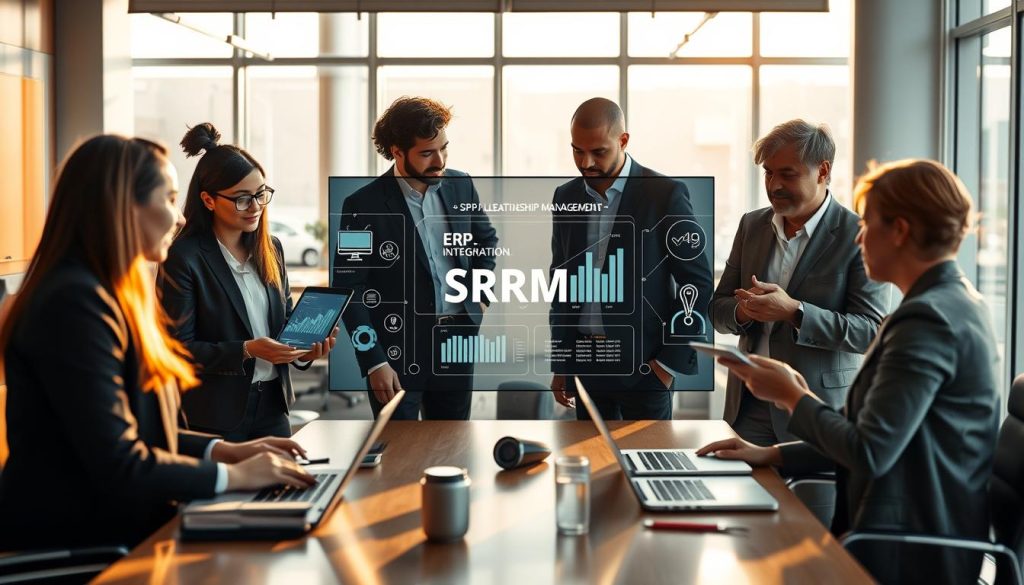
How ERPs enable real-time visibility, automate procure-to-pay, and improve data quality
Platforms like SAP S/4HANA, Oracle Fusion Cloud, and Microsoft Dynamics 365 integrate finance, manufacturing, HR, and more. They offer real-time views of supplier performance and inventory. This reduces blind spots.
Automated procure-to-pay processes cut down on manual errors and cycle time. Centralized master data enhances expense management and strategic sourcing. It also ensures reliable audit trails.
SRM software for analytics, alerts, collaboration, and compliance
SRM software extends ERP capabilities with dashboards, KPI tracking, and risk alerts. Platforms like SAP Ariba and Coupa provide analytics and compliance monitoring. These tools support proactive SRM.
These solutions standardize templates and workflows, improving category consistency. They accelerate onboarding and align procurement, quality, and operations through shared scorecards.
Clean data as the foundation for AI- and ML-enabled supply chain optimization
High-quality master data is key for forecasting and risk sensing. Clean records enable AI and machine learning to detect anomalies and predict delays. This leads to optimized supply chain operations.
With disciplined governance and ERP integration, SRM software delivers trustworthy analytics. This results in faster, more informed decisions, reducing variance and improving supply chain optimization at scale.
| Capability | ERP Integration Role | SRM Software Role | Business Outcome |
|---|---|---|---|
| Data Quality | Centralizes master data; enforces validation rules | Maintains supplier profiles; tracks certifications and SLAs | Reduced errors, consistent reporting, audit-ready records |
| Procure-to-Pay | Automates POs, invoicing, and payments | Flags exceptions; routes approvals and disputes | Shorter cycle time, fewer discrepancies, better cash control |
| Performance Analytics | Aggregates transactional history and costs | Calculates OTIF, defect rates, and corrective actions | Targeted improvement plans and supplier accountability |
| Risk and Alerts | Feeds inventory and logistics data in real time | Issues late-order and compliance alerts; risk scoring | Faster mitigation and continuity across categories |
| Collaboration | Provides common data layer for stakeholders | Offers shared workspaces and structured workflows | Aligned actions, clearer ownership, quicker resolution |
| AI/ML Readiness | Supplies clean, labeled datasets | Operationalizes models in supplier workflows | More accurate forecasts and prescriptive decisions |
Supplier Collaboration Models that Unlock Innovation
Supplier collaboration evolves under a mature Supplier Relationship Management program. It moves from focusing on rates to creating shared value. Strategic partnerships use governance, data, and incentives to enhance design cycles and optimize the supply chain across tiers.
Co-developing R&D Roadmaps and Accelerating Time-to-Market
Structured discovery sessions align product roadmaps, materials, and manufacturability early. JPMorgan Chase highlights that shaping a supplier’s R&D plan accelerates tailored solutions to market. Clear IP terms and milestone gates ensure pace, while Supplier Relationship Management clarifies roles and data access.
Joint labs, design for manufacturability reviews, and rapid prototyping reduce handoffs. Engineering teams using shared PLM data and quality histories decrease rework and launch risk.
Scaling Production Efficiently with Shared Forecasting and Capacity Planning
Shared forecasting reduces bullwhip effects and balances loads across sites. Weekly consensus plans, capacity reservations, and dual-sourcing playbooks support continuity during demand spikes. These practices strengthen strategic partnerships and enhance supply chain optimization with measurable service stability.
Suppliers gain SKU-level visibility, constraint maps, and agreed buffers. This improves yield and protects critical inventory without inflating working capital.
Joint Value Creation Beyond Rates and Service Levels
Formal collaboration includes innovation workshops, access to strategic initiative pipelines, and transparent cost and risk metrics for joint decisions. NWLPS used web-based analytics to pinpoint margin and waste opportunities, demonstrating data-informed collaboration’s financial gains.
As execution stabilizes, governance shifts to innovation sprints, co-investment proposals, and commercialization paths. These create differentiated offerings under disciplined Supplier Relationship Management.
| Collaboration Mechanism | Primary Objective | Operational Enabler | Indicative Metric | Business Outcome |
|---|---|---|---|---|
| Joint R&D Roadmaps | Faster, better-fit products | Shared PLM data and IP frameworks | Time-to-market cycle reduction (%) | Higher launch hit rate and revenue lift |
| Shared Forecasting & Capacity | Stable, scalable supply | S&OP alignment and capacity reservations | On-time-in-full and schedule adherence (%) | Reduced expedites and lower total cost |
| Innovation Workshops | New value pools | Design sprints and cost-transparency models | Pipeline conversion rate (%) | Differentiated features and margin expansion |
| Data-Driven Analytics | Targeted improvements | Web-based dashboards and root-cause tools | Defect and waste reduction (%) | Sustainable savings and quality gains |
Risk Management and Business Continuity within SRM
Supplier Relationship Management (SRM) adopts a strict risk management strategy. It safeguards supply, cost, and quality. By doing so, it boosts procurement efficiency by aligning finance, operations, and category teams. This approach fortifies business continuity in complex, multi-tiered networks.
Identifying ecosystem risks, pricing volatility, and supply disruptions
SRM identifies risks across the ecosystem’s tiers, signaling early on about pricing, logistics, and compliance issues. It tracks quality and lead-time with KPIs tied to demand, capacity, and freight markets. This method enhances business continuity and boosts procurement efficiency through data-driven decision-making.
Risk registers compile material categories, sole-source flags, commodity indices, and dependency ratios. Continuous monitoring reveals suppliers vulnerable to currency or energy price changes. This allows for timely hedging and contract adjustments, underpinned by disciplined risk management.
Governance for risk, continuity plans, and multi-sourcing considerations
Structured governance in SRM employs quarterly reviews, risk registers, and continuity playbooks with scenario planning. It promotes multi-sourcing to prevent single points of failure and ensure continuity during regional disruptions.
NWLPS successfully transitioned two suppliers into normal governance through risk mitigation and continuity planning. Formal reviews track risk signals, remediation, and escalation paths. This improves procurement efficiency and ensures cross-functional alignment for sustained supply assurance.
Working capital and payment programs that reduce supplier cash-flow risk
Cash-flow stability is key to reducing disruption risk and strengthening risk management. JPMorgan Chase highlights the benefits of corporate card programs, single-use accounts, and supply chain finance. These accelerate settlement and extend liquidity to vital partners, bolstering business continuity.
In SRM, payment terms are tied to performance and risk levels, balancing DPO goals with supplier health. Dynamic discounting and approved payables finance ensure timely delivery. This protects procurement efficiency without overextending small and mid-sized vendors.
Case-Backed SRM Best Practices and Capability Building
NWLPS implemented Supplier Relationship Management (SRM) through a structured program, linking strategy to execution. They utilized SRM software and centralized toolkits to standardize methods, enhance data quality, and expand adoption across teams. In 2023, Deloitte found that 61% of Chief Procurement Officers focus on supplier collaboration, highlighting the importance of SRM solutions and skill development.
Framework pillars: segmentation, relationship management, performance, risk
The model was structured around four pillars: supplier segmentation, relationship management, performance management, and risk management. NWLPS divided thirty suppliers into segments, focusing on five for a pilot and engaging four through workshops. They used clear scorecards for evaluating supplier performance and risk reviews for continuity oversight.
Web-based analytics provided insights into cost, quality, and delivery. These practices established a consistent cycle for reviews, corrective actions, and capturing value. Two suppliers were transitioned into regular governance with defined KPIs and escalation procedures.
SRM academies and certifications to standardize skills and drive adoption
NWLPS created an SRM Skills Academy and enrolled professionals in World Commerce & Contracting SRM Certification programs. The curriculum aimed to develop skills in collaborative engagement, value-based segmentation, and performance setting. It also covered risk and continuity governance, innovation, problem-solving, conflict resolution, and data analytics.
The training focused on digital tools, AI, sustainable procurement, and optimizing contracts and performance. Standardized playbooks within SRM software and solutions ensured compliance and quick onboarding for teams.
Launching pilots, securing leadership buy-in, and embedding BAU governance
Execution started with a pilot to test the model. Launch communications secured leadership support and clarified roles, decision-making, and timelines. Workshops were held to align expectations with pilot suppliers and establish shared metrics for evaluating supplier performance.
Centralized digital toolkits and dashboards supported weekly reviews, variance analysis, and issue resolution. The outcomes guided the scale-up plan and ensured a smooth transition into BAU governance. This included clear meeting cycles, risk triggers, and action tracking across the SRM best practices portfolio.
Conclusion
Supplier Relationship Management (SRM) transforms disorganized buying into a structured process. It introduces segmentation, performance management, collaboration, and risk governance to enhance procurement efficiency and supply chain performance. JPMorgan Chase’s success showcases the importance of reliable data sharing, structured reviews, and trust-based alignment. These elements move relationships beyond mere price negotiations to joint value creation and innovation.
Strategic supplier partnerships lead to co-developed roadmaps, scalable production plans, and quicker ramp-ups. NWLPS exemplifies how a formal framework, a skills academy, and accredited certifications ensure leadership alignment and embed governance into daily operations. This approach yields tangible results: sustainable financial gains, tighter continuity controls, and fewer disruption events.
ERP integration and SRM software offer real-time visibility and automate procure-to-pay workflows. Clean data enhances analytics, supporting AI and ML for forecasting and quality assurance. Working capital programs also boost supplier liquidity, reducing failure risk and stabilizing deliveries.
In the U.S., SRM has become a critical capability for enterprises. It boosts procurement efficiency, strengthens supply chain performance, and fosters strategic supplier partnerships. These partnerships compress time-to-market and solidify competitive advantage. Organizations that implement SRM with dedication transform their supplier ecosystems into robust, scalable assets.
FAQ
What is Supplier Relationship Management (SRM) and how is it different from vendor management?
SRM is a strategic approach to engage with key suppliers for mutual growth and value, as outlined by Doug Roginson of JPMorgan Chase. It differs from vendor management, which focuses on daily oversight and contract adherence. SRM emphasizes strategic alignment, cross-functional collaboration, and governance to transform suppliers into growth partners.
How does SRM improve innovation, reliability, and cost-effectiveness?
SRM software and governance enable shared roadmaps, faster market entry, and higher delivery rates. Organizations evaluate supplier performance using KPIs like defect rates and cost savings to drive improvement. Joint planning and economies of scale reduce costs while improving quality and service continuity.
What are the core components of SRM and how do they support procurement efficiency?
SRM’s core includes supplier segmentation, relationship management, performance management, and risk management. Segmentation focuses resources; collaboration aligns goals; performance metrics optimize costs; and risk frameworks monitor disruptions. These elements boost procurement efficiency and supply chain optimization.
Which KPIs and qualitative metrics matter most for supplier performance?
Key KPIs include on-time delivery, defect rates, and cost savings. Qualitative measures assess communication quality and satisfaction. Regular reviews lead to corrective actions and sustained improvements.
How should companies segment suppliers to maximize value?
Effective segmentation evaluates spend, operational criticality, and risk exposure. Tiering assigns governance intensity to strategic suppliers while overseeing noncritical categories.
How do ERPs and SRM solutions work together to improve results?
ERPs centralize data and automate processes, improving data quality. SRM solutions add analytics and risk alerts. Clean data supports AI for forecasting and optimization.
What collaboration models turn suppliers into strategic partners?
Joint value creation involves co-developing roadmaps and innovation workshops. This approach accelerates market entry and scales production efficiently, aligning investments with demand.
How does SRM strengthen risk management and business continuity?
SRM establishes risk registers and early-warning KPIs. It uses scenario planning and multi-sourcing to manage risks. Working capital programs improve supplier liquidity, reducing disruption risk.
What governance practices build trust and accountability with suppliers?
Structured reviews and transparent data sharing create accountability. Preferred supplier programs reward performance, deepening collaboration.
Which case-backed practices show how to scale SRM effectively?
North West London Procurement Services scaled SRM through four pillars and targeted pilots. A digital toolkit and analytics supported adoption and financial benefits, standardizing processes.
How can organizations build SRM capability and ensure adoption?
Establish an SRM Skills Academy and leverage certifications. Launch pilots to prove value and secure leadership sponsorship. Integrate SRM software and track KPIs to embed governance and sustain performance gains.