Procurement vs Purchasing: Key Differences Explained
Many organizations confuse procurement and purchasing, seeing them as interchangeable terms. Yet, they represent distinct disciplines with different scopes, intentions, and levels of control. This section aims to clarify the differences for business leaders who oversee budgets, suppliers, and compliance.
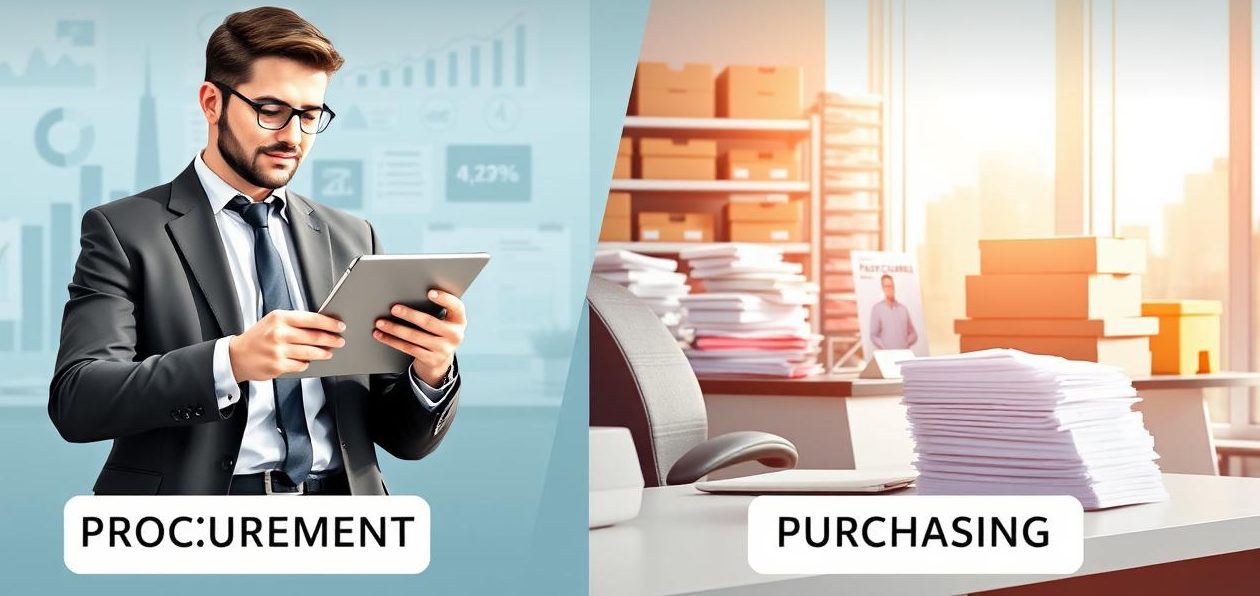
Procurement is a strategic process that guides decisions before, during, and after a purchase. It involves needs analysis, market research, supplier evaluation, negotiation, and contracting. It also includes managing supplier relationships and analyzing spend. When executed effectively, procurement enables strategic sourcing, enhances governance, and boosts supply chain efficiency.
Purchasing, on the other hand, is the transactional aspect of procurement. It handles requisitions, purchase orders, receiving, and payment processing. Without proper controls, purchasing can lead to unapproved spending and cash leaks, increasing risk and reducing visibility.
Statistics underscore the importance of distinguishing between procurement and purchasing. In 2021, procurement teams aimed to save around 8% through strategic sourcing and category management. Boston Consulting Group found that digital procurement tools can lead to 5–10% annual savings. Gartner also highlights the need for formal approvals and workflows in B2B buying, involving multiple stakeholders.
Grasping the differences between procurement and purchasing is critical for clarifying roles, ensuring compliance, and protecting profit margins. It showcases the value creation, risk management, and scalability advantages of procurement over purchasing. The following sections will explore these distinctions further, illustrating how each function contributes to lasting success.
Procurement vs Purchasing Definition: Clear Concepts and why the Distinction Matters
Clear terms are essential for making better decisions throughout the buying lifecycle. A precise definition of procurement vs purchasing helps leaders align their strategies, budgets, and risk controls. When these concepts are correctly framed, teams can coordinate activities from sourcing-to-pay more efficiently. This results in fewer delays and tighter audit readiness.
Procurement as a strategic, multi-step business process
Procurement is a detailed, value-driven process that begins with needs analysis and market research. It encompasses RFI and RFQ design, negotiation, contracting, supplier relationship management, and logistics coordination. The goal is to achieve long-term value, align with policies, and measure outcomes that enhance spend control and compliance.
Teams develop category strategies, evaluate total costs, and use performance metrics to guide supplier actions. Contracts outline service levels, rebates, and risk terms, shaping downstream execution.
Purchasing as the transactional subset within procurement
Purchasing oversees the transactions that fulfill approved demand. It starts at PO creation and includes PO transmittal, fulfillment, receiving, three-way match, invoicing, and payment. The focus is on timely service to operations, cost accuracy, and documented controls.
These steps apply the upstream strategy. They use preferred suppliers, agreed rates, and standard terms to protect budgets and ensure traceability.
How the two functions interconnect across the buying lifecycle
Procurement defines policy, supplier selection, and contract rules; purchasing executes orders within those rules. This connection turns plans into actions within a sourcing-to-pay framework. Data moves both ways: performance and invoice data inform category strategy, while strategy guides requisitions and POs.
The result is consistent pricing, fewer exceptions, and clearer accountability. This interlock clarifies differences between procurement and purchasing without creating silos.
Why clarity boosts spend control, compliance, and growth
Role clarity enables standardized approvals, segregation of duties, and auditable trails. It curbs maverick buying and raises on-contract spend, improving spend control and compliance outcomes. Firms that digitize this model report measurable gains; industry research from Boston Consulting Group cites 5–10% cost reduction from digital adoption.
With sharper governance, organizations scale faster, negotiate better terms, and sustain value across cycles. The distinctions in procurement vs purchasing guide resource allocation and support disciplined expansion.
| Aspect | Procurement | Purchasing | Business Effect |
|---|---|---|---|
| Primary Role | Strategy, supplier selection, contracting | Order execution, receipt, payment | Aligns demand with market supply; ensures timely fulfillment |
| Time Horizon | Long-term, category roadmaps | Near-term, request-driven | Stability in pricing and service levels vs rapid response |
| Process Span | End-to-end planning within sourcing-to-pay | PO to payment steps | Policy coverage vs transactional accuracy |
| Risk and Governance | Due diligence, contracts, and controls | Three-way match, approvals, documentation | Regulatory compliance and audit readiness |
| Data Utilization | Market analysis, supplier KPIs, total cost models | Invoice data, receipt records, exception logs | Optimized categories and tighter spend control |
| Interdependence | Sets policies and preferred suppliers | Applies policies through transactions | Reduces differences between procurement and purchasing in execution gaps |
Procurement vs Purchasing: Key Differences
Executives often ponder the impact of procurement and purchasing differences on results. This section highlights the main distinctions used by practitioners. They focus on planning budgets, setting controls, and managing supplier relationships strategically and tactically.
Scope and time horizon: Strategic vs tactical focus
Procurement spans medium- to long-term horizons, involving market analysis, supplier selection, and contract management. In contrast, purchasing deals with short-term orders to meet immediate needs. This difference influences priorities, staffing, KPIs, and decision-making.
Value vs cost orientation: Long-term value vs immediate price
Procurement assesses total cost of ownership, quality, delivery risk, and service levels over time. Purchasing, on the other hand, focuses on unit price, budget alignment, and speed. Companies that balance TCO with immediate price control achieve value without inventory or service gaps.
Supplier relationship management: Partnership vs transaction
Procurement fosters supplier relationships that support innovation and resilience. Toyota’s partnership with Denso and Aisin exemplifies how structured SRM and lean practices enhance flow and design. In contrast, purchasing engages in transactional interactions with approved vendors, enabling quick resolution of price or lead-time issues.
Process complexity: End-to-end cycle vs order-to-pay steps
Procurement encompasses needs planning, RFI/RFQ, negotiations, contracting, performance reviews, and continuous improvement. Boeing’s sourcing programs demonstrate multi-step audits and risk checks before award. Purchasing, by contrast, follows a defined order-to-pay path for efficient execution, akin to Zara’s frequent, small-batch purchases.
Governance and risk: Controls, due diligence, and visibility
Procurement integrates governance and risk measures, including third-party due diligence, segregation of duties, and spend visibility. PwC’s report on ransomware and breach incident costs highlights the importance of exposure in global supply chains. Weak purchasing controls lead to maverick spend, cash leakage, and audit issues.
These differences clarify the distinctions between procurement and purchasing in scope, value metrics, supplier relationships, and governance and risk. They guide policy design and operating models that grow with the organization.
Core Definitions and Roles Compared: Procurement Compared to Purchasing in the Supply Chain
In large enterprises and midmarket firms, leaders evaluate procurement vs purchasing to clarify decision rights and workflows. Clear separation improves supply chain governance, strengthens audit trails, and reduces cycle time. The comparison below outlines procurement roles and responsibilities against day-to-day buying tasks, and shows how each function fits within the org structure.
Procurement responsibilities: Strategy, sourcing, negotiation, SRM
Procurement sets the buying strategy, links demand plans to budgeting and forecasting, and runs market research and due diligence. Teams manage RFI and RFQ events, negotiate commercial and legal terms, and establish contract frameworks with measurable service levels.
Responsibilities extend to supplier relationship management, delivery tracking, and performance analysis. Leaders conduct spend analysis to find consolidation and bundling opportunities that reduce total cost. These procurement roles and responsibilities anchor risk controls and supply chain governance across business units.
Purchasing responsibilities: Requisitions, POs, receiving, payment
Purchasing validates requests, routes approvals, and issues requisitions and POs aligned to policy. Buyers transmit orders to suppliers, monitor fulfillment, and coordinate receiving with operations and warehousing.
The function completes three-way match, processes invoices, and schedules payment. Accurate data capture at each step links purchasing activity to contracts and budgets, supporting procurement compared to purchasing benchmarks and audit readiness.
Where each function sits in modern org structures
In small companies, one team may cover both areas, which can tilt decisions toward short-term availability. In larger organizations, the org structure separates the roles: procurement focuses on supplier markets and multi-year value, while purchasing runs internal execution and near-term supply.
Many firms decentralize non-strategic buys through punch-out catalogs under policy oversight, preserving compliance and speed. A typical B2B decision engages about seven stakeholders, from requesters and department heads to legal, IT, security, finance, and executives, making defined workflows for procurement vs purchasing essential.
| Dimension | Procurement | Purchasing |
|---|---|---|
| Primary focus | Strategy, sourcing, negotiation, SRM | Order execution, receiving, payment |
| Time horizon | Medium to long term | Immediate to short term |
| Key activities | Market research, due diligence, contracts, spend analysis | Requisitions and POs, fulfillment tracking, three-way match |
| Governance | Policy design and supply chain governance | Policy execution and transaction controls |
| Org placement | Strategic sourcing or corporate procurement | Shared services or operations support |
The Procurement Process: From Needs Analysis to Supplier Performance
The procurement process aligns demand, risk control, and value capture into one flow. It also clarifies procurement vs purchasing roles, so strategy and execution move in concert.
Needs analysis, market research, and due diligence
Teams begin by mapping internal demand and removing duplicate buys across departments. They benchmark volume, specs, and lifecycle costs to set a clear baseline.
Market scans follow, covering capacity, pricing trends, and logistics constraints. Due diligence verifies ethics, financial stability, quality systems, and data security to reduce operational and reputational risk.
RFI, RFQ, negotiation, and contracting
RFI RFQ steps refine scope and price discovery. An RFI tests supplier capabilities and informs the spec. An RFQ gathers comparable quotes and service levels.
Negotiation uses cost breakdowns, benchmarks, and risk clauses to secure value. Contracts formalize SLAs, KPIs, and compliance, linking obligations to delivery and payment terms.
Strategic sourcing and bundling for savings
Strategic sourcing consolidates categories, standardizes specifications, and builds leverage. Bundling routes volume to a curated panel, cutting unit prices and cycle time.
Preferred supplier programs streamline audits and quality checks. The approach strengthens governance and clarifies procurement vs purchasing handoffs.
Supplier and vendor management post-award
Post-award, supplier performance is tracked with on-time delivery, defect rates, and responsiveness. Scorecards guide quarterly reviews and corrective actions.
Logistics milestones, inventory positions, and risk alerts inform decisions. Escalation paths and dual sourcing maintain continuity when conditions change.
Spend data and analytics for continuous improvement
Spend analytics centralize contract, invoice, and performance data for visibility. Dashboards flag maverick spend, tail suppliers, and consolidation opportunities.
Automated alerts prompt renegotiation when volumes rise or rates drift. Findings loop back into category strategies, improving supplier performance and compliance.
| Stage | Primary Objective | Key Actions | Metrics | Business Impact |
|---|---|---|---|---|
| Needs Analysis | Eliminate waste and clarify demand | Baseline volumes, align specs, validate stakeholders | Demand accuracy, duplicate buy reduction | Lower total cost and tighter forecasting |
| Market Research & Due Diligence | Reduce risk and expand options | Assess capacity, verify finances, audit ethics and quality | Qualified supplier ratio, risk flags resolved | Higher reliability and fewer disruptions |
| RFI RFQ & Negotiation | Set requirements and capture value | Structure RFIs/RFQs, compare bids, negotiate terms | Savings vs baseline, service-level commitments | Competitive pricing and clear SLAs |
| Contracting | Formalize obligations and governance | Define KPIs, penalties, data and compliance clauses | Contract cycle time, compliance rate | Reduced leakage and stronger controls |
| Strategic Sourcing & Bundling | Optimize supplier portfolio | Bundle categories, standardize SKUs, set preferred panels | Supplier count reduction, volume leverage | Sustained savings and quality consistency |
| Post-Award SRM | Maintain service and mitigate risk | Review scorecards, corrective actions, dual sourcing | On-time delivery, defect rates, issue resolution time | Stable supply and improved supplier performance |
| Spend Analytics | Drive continuous improvement | Monitor contracts, spot maverick spend, re-source | Savings realized, compliance, tail spend share | Better decisions and measurable ROI |
The Purchasing Process: Order Execution and Payment Workflow
The purchasing process transforms approved demands into completed orders and timely payments. It operates within a controlled cycle. Clear checkpoints, documented handoffs, and aligned data fields enhance accuracy and speed. This clarity helps distinguish procurement from purchasing for all stakeholders.
Purchase requisitions and approvals
Employees submit purchase requisitions with detailed item specs, budget codes, and required dates. Routing rules direct approvals to various stakeholders, including department heads, procurement, finance, and legal or IT when necessary. This is based on thresholds and category risk.
Structured approvals streamline the process, reducing cycle time and ensuring records are audit-ready. They also set controls that limit maverick spend in the order-to-pay chain.
PO creation, transmittal, and fulfillment
After approval, requisitions are converted into POs with all necessary details. These POs are then sent via EDI, supplier portals, or email. They are tracked against agreed-upon dates and specifications.
The fulfillment status is monitored against PO lines for any discrepancies. This operational focus highlights the distinct roles of procurement and purchasing.
Receiving, three-way match, invoicing, and payment
Upon receipt, goods or services are inspected and a goods receipt is captured. A three-way match is then conducted to verify quantity, price, and tax against the PO and supplier invoice. This ensures accurate invoice processing.
Any discrepancies trigger resolution workflows for credits or corrected invoices. Payments are then issued according to contract terms. This supports cash management and accurate accruals throughout the order-to-pay cycle.
Stakeholder coordination to prevent maverick spend
Mid-sized companies typically involve about seven stakeholders across finance, operations, and compliance. Coordinated roles, documented approvals, and catalog controls prevent maverick spend and accidental orders.
These measures also reduce rework in invoice processing and protect accounting capacity. They ensure the purchasing process remains efficient and defensible during audits.
Key Distinctions Procurement and Purchasing: Strategic Impact vs Operational Execution
Procurement and purchasing have distinct roles, differing in intent, scope, and time frame. Procurement focuses on strategic value creation, while purchasing ensures timely and accurate order fulfillment. These roles are essential for aligning strategic goals with daily operations.
Analytical vs strategic decision-making in practice
Procurement employs structured analytics to shape demand and supply dynamics. It sets sourcing objectives, maps markets, and negotiates with data. The goal is to secure quality, continuity, and cost savings over the long term.
Purchasing, on the other hand, emphasizes execution. Buyers compare quotes, check inventory levels, and place compliant orders. The focus is on cycle time, order accuracy, and receipt confirmation to drive operational results.
Supplier evaluation depth and contract management
Procurement conducts in-depth supplier evaluations before awarding contracts. It assesses financial strength, ethics, capacity, certifications, and quality systems. This information guides contract management, ensuring clear SLAs, KPIs, and multi-year pricing structures.
Purchasing operates within established agreements. It issues POs, validates terms, and tracks delivery against the contract. Any escalations follow procurement’s playbook.
Performance monitoring beyond the initial purchase
After award, procurement leads performance reviews and risk assessments. It uses quarterly scorecards, audits, and corrective actions to sustain value and protect supply. Sourcing strategies adapt to market shifts or service level changes.
Purchasing typically closes the activity after receipt and payment. Exceptions or issues may reopen the case. Yet, routine supplier oversight is limited compared to procurement’s broader scope.
Examples that highlight strategic vs transactional outcomes
- Boeing applies rigorous audits and continuous performance management across an aerospace supply base to secure strategic impact under complex compliance regimes.
- Toyota develops long-term supplier partnerships under lean and just-in-time, aligning engineering, quality, and delivery for stability and cost control.
- Zara runs fast, transactional purchasing cycles for materials to support rapid season turns, prioritizing speed and near-term price.
- Major fast-food chains place standardized orders from approved suppliers, switching vendors quickly if cost or delivery targets are missed to protect operational execution.
| Dimension | Procurement | Purchasing |
|---|---|---|
| Objective | Enterprise value creation and risk control | Timely, accurate order fulfillment |
| Decision Mode | Strategic, market-backed analysis | Tactical, quote and inventory analysis |
| Supplier Evaluation | Deep due diligence: finance, ethics, capacity, quality | Checks approved list and delivery performance |
| Contract Management | Negotiates terms, SLAs, and multi-year frameworks | Executes POs and enforces agreed terms |
| Time Horizon | Long-term lifecycle outcomes | Immediate need and short lead time |
| Metrics | Total cost, risk, continuity, innovation | Cycle time, on-time delivery, price-to-quote |
| Example | Toyota’s long-term supplier partnerships | Zara’s rapid material buys for new drops |
Business Benefits: How Effective Procurement and Purchasing Drive Results
Organizations that align procurement vs purchasing gain significant advantages. They achieve lower costs, tighter controls, and faster cycle times. This integration supports stable cash flow and healthier margins.
Cost reduction and total cost of ownership optimization
Strategic sourcing, category bundling, and standardized contracts reduce unit prices and process waste. Benchmark studies show procurement teams often deliver about 8% annual savings. Digitalization can add 5–10% more, compounding year over year. Focusing on total cost of ownership captures freight, inventory, quality, and lifecycle expenses, not just the invoice price.
Clear specs and demand management also cut rework and returns. Automation shrinks approval delays and error rates, lowering the cost to serve internal stakeholders.
Improved negotiating outcomes and preferred supplier programs
Data-backed bids and clean spend baselines strengthen bargaining power on pricing, terms, and service levels. Preferred suppliers streamline compliance, reduce transaction costs, and stabilize lead times. Structured playbooks with rate cards and service catalogs prevent off-contract buys and protect negotiated value.
Scorecards and quarterly reviews drive accountability while enabling continuous improvement. The result is better performance without widening the supplier base.
Risk reduction through due diligence and controls
Thorough screening addresses financial, cyber, and ESG exposure. Documented attacks and breaches have generated sizable losses across industries, underscoring the need for robust assessment and monitoring. Approval workflows and three-way match reduce maverick spending, duplicate invoices, and accidental orders that strain liquidity.
Clear contract clauses on data security, continuity, and quality standards help contain liabilities and maintain audit readiness.
Operational resilience, continuity, and data visibility
Supplier relationship management and performance tracking improve continuity when markets shift. Diversified sources, capacity buffers, and logistics contingencies support operational resilience during demand spikes or disruptions. Centralized data visibility accelerates exception handling by flagging delivery and quality variance early.
Unified dashboards align teams on lead times, backlog, and fulfillment status, enabling quicker interventions and steadier service levels.
| Outcome Area | Mechanism | Measured Effect | Procurement vs Purchasing Role |
|---|---|---|---|
| Cost and total cost of ownership | Strategic sourcing, bundling, contract standardization | ~8% annual savings; digital adds 5–10% on average | Procurement sets strategy; purchasing executes orders accurately |
| Negotiation and preferred suppliers | Clean spend baselines, rate cards, service catalogs | Lower unit prices, stronger terms, higher compliance | Procurement manages supplier programs; purchasing enforces catalogs |
| Risk reduction | Due diligence, approvals, three-way match, contract controls | Fewer maverick buys, reduced fraud and error exposure | Procurement governs policies; purchasing applies controls at transaction |
| Operational resilience | Dual sourcing, SRM, logistics contingencies | Faster recovery from disruptions, steadier service levels | Procurement designs continuity; purchasing maintains order flow |
| Data visibility | Centralized spend and supplier data, real-time dashboards | Shorter cycle times, early variance detection | Procurement analyzes trends; purchasing updates records in-system |
Technology Enablement: Digital Tools that Elevate Procurement and Purchasing
Today’s teams use procurement software to align strategy with execution throughout the buying lifecycle. This software connects sourcing decisions with order, receipt, and payment actions. It reduces manual effort and tightens controls.
Procurement software to automate sourcing-to-pay
Sourcing-to-pay automation issues RFIs and RFQs, compares bids, and standardizes contracting. It supports supplier performance dashboards and SRM workflows across categories and regions. Vendors like SAP, Coupa, Oracle, Jaggaer, and Ivalua provide audit-ready records and unified policy enforcement.
Approval routing, PO creation, and invoice management
Digital approval routing applies role-based thresholds and tracks cycle time by step. Once cleared, the system creates POs, transmits orders, and monitors delivery status. Invoice management executes three-way match and routes exceptions, improving accuracy and shortening payment lead times. Platforms like Order.co demonstrate automated requisitions, PO issuance, and invoice organization.
Centralized data for transparency and spend analytics
A single database consolidates suppliers, contracts, POs, receipts, and invoices for traceable audit trails. Teams use spend analytics to compare vendors, flag maverick orders, and validate contract compliance. This central record improves visibility across plants, business units, and cost centers.
Documented savings with digital adoption
Independent analysis from Boston Consulting Group reports 5–10% annual reductions in addressable spend with integrated suites. These savings come from standardized controls, better demand management, and faster cycle times enabled by sourcing-to-pay automation.
| Capability | Primary Function | Operational Effect | Financial Outcome | Relevance to procurement vs purchasing |
|---|---|---|---|---|
| Procurement software | End-to-end orchestration from sourcing to payment | Lower manual touchpoints; policy enforcement | 5–10% cost reduction (BCG) | Bridges strategic sourcing with transactional buying |
| Sourcing-to-pay automation | RFI/RFQ, bid analysis, contract workflows | Shorter cycle times; standardized processes | Improved discount capture; fewer errors | Extends strategy into execution steps |
| Approval routing | Role-based approvals and threshold controls | Reduced rework; faster requisition clearance | Prevents maverick spend and overbuying | Aligns governance for both functions |
| Invoice management | Three-way match and exception handling | Fewer mismatches; on-time payments | Better cash flow and avoided late fees | Links receiving accuracy to payment quality |
| Spend analytics | Consolidated data and supplier comparisons | Transparent category performance | Negotiation leverage and optimized TCO | Informs strategy and day-to-day orders |
As adoption scales, organizations consolidate data, upgrade controls, and capture measurable gains across categories. The result is consistent execution, stronger supplier outcomes, and verifiable efficiency from integrated tools.
Organization Size and Structure: Aligning Functions for Growth
As organizations grow, their structure plays a critical role in balancing strategy and execution. In smaller firms, procurement and purchasing often fall under one leader. This can divert focus to immediate needs. In contrast, larger enterprises separate these roles. Category leaders focus on market trends and strategy, while buying teams handle the execution and securing goods.
The placement of governance is also significant. Some companies unite both functions under one umbrella. Others place them within the broader supply chain function. This integration includes planning, logistics, and inventory management. Clear roles lead to faster cycle times, better policy adherence, and improved audit readiness.
Deciding between centralization and decentralization is not a simple choice. Many firms centralize strategic categories but allow end users to order low-risk items through punch-out catalogs. This approach maintains speed while keeping contracts, pricing, and data under control. It ensures local agility with consistent standards and preferred supplier use.
As complexity increases, teams formalize category strategies, supplier relationship programs, and analytics. They also standardize purchasing workflows. These efforts enhance role clarity, align with the supply chain function’s goals, and highlight the differences between procurement and purchasing in daily operations.

Practical Steps to Mature From Purchasing-only to Strategic Procurement
Transitioning from transactional to strategic procurement demands a clear plan. The steps outlined here translate procurement and purchasing into actionable strategies. They ensure measurable outcomes and data-driven improvements.
Evaluate current spend and identify consolidation opportunities
Start by mapping all expenses across various locations and cost centers. This includes software, hardware, office supplies, equipment, and services. Such groundwork is essential for spend consolidation, leading to lower prices and faster processing times.
Group similar categories and rebid them in bundles. This approach strengthens your bargaining power with suppliers by leveraging cross-business volume.
Implement vendor selection and ongoing evaluation policies
Establish standardized criteria for vendor selection, focusing on quality, ethics, and delivery reliability. Use scorecards to track cost, service, and risk. Create a preferred supplier panel to streamline sourcing while maintaining quality standards.
Regularly review and adjust your vendor list. Remove underperformers and add new suppliers as market conditions change.
Create controls, approvals, and role-based buying parameters
Define who can purchase, from whom, and within what limits. Role-based buying aligns spending thresholds with department, location, and authorization level. Ensure all purchases are approved through legal, IT, security, finance, and procurement.
Centralize purchases in an approved platform to prevent unauthorized orders and ensure consistent terms.
Adopt strategic sourcing and long-term contracting
Run RFIs and RFQs with clear specifications and total cost models. Negotiate long-term contracts that secure pricing, service levels, and delivery performance. Multi-year contracts often result in better rates due to predictable demand.
Align contract cycles with budget windows to minimize renegotiation and price volatility.
Leverage analytics to uncover inefficiencies and risks
Deploy centralized dashboards to identify maverick spend, contract leakage, and bottlenecks. Data visibility supports strategic procurement actions and timely interventions.
Use analytics to benchmark savings by category and track cycle times. Refine sourcing strategies and training based on these insights.
| Action | Objective | Primary Metric | Expected Outcome | Notes |
|---|---|---|---|---|
| Spend consolidation | Aggregate volume across units | Price per unit; suppliers per category | Reduced prices and fewer contracts | Bundle commodity items and standard services |
| Vendor evaluation | Assure quality and compliance | On-time delivery; defect rate; SLA adherence | Higher service levels and lower risk | Maintain preferred supplier panel |
| Role-based buying | Control who buys and at what level | Approval cycle time; off-contract rate | Stronger governance and fewer exceptions | Automate thresholds and routes by role |
| Long-term contracts | Stabilize pricing and service | Price variance; contract coverage | Predictable costs and supply continuity | Use indexed clauses for volatile inputs |
| Analytics and reporting | Expose waste and process gaps | Maverick spend; cycle time; savings realized | Targeted improvements at category level | Drives strategic procurement discipline |
These steps transform ad hoc buying into a structured model. It’s built on data, policy, and market leverage. This approach reinforces procurement and purchasing distinctions while ensuring practical and accountable execution.
Conclusion
Procurement vs purchasing outlines the flow of value within an enterprise. Procurement focuses on setting strategies, conducting strategic sourcing, negotiating contracts, and overseeing supplier performance. On the other hand, purchasing handles requisitions, issues purchase orders, receives goods, and processes payments within this framework. Recognizing these differences enhances roles, accountability, and spend control across various categories and business units.
Studies reveal the significant impact of these distinctions. Teams with mature procurement practices see cost reductions of nearly 8% through category strategies and supplier consolidation. Digital tools contribute an additional 5–10% savings by automating processes and ensuring data accuracy. Better negotiation outcomes, disciplined risk management, and enhanced service levels result from distinguishing procurement from purchasing and aligning workflows seamlessly.
To scale effectively, organizations need the right structure and systems. As complexity increases, separate strategic and transactional roles become essential. Standardizing policies helps curb maverick spending, while sourcing-to-pay platforms provide centralized data and audit trails. This approach ensures price, quality, delivery, and compliance are linked, fostering transparency and reliable performance.
Companies that grasp the Procurement vs Purchasing: Key Differences shift from short-term purchases to long-term value creation. With clear mandates, practical analytics, and repeatable processes, procurement and purchasing become a unified force for growth. This leads to resilient supply chains, lower total costs, and sustained competitive advantage, backed by strategic sourcing, spend control, and robust governance and risk practices.
FAQ
What is the difference between procurement and purchasing?
Procurement is a strategic process that includes needs analysis, market research, and supplier evaluation. It also involves negotiation, contracting, and supplier relationship management. Purchasing, on the other hand, is the transactional part that deals with orders and payments. It includes requisitions, purchase orders, and receiving.
Why does the procurement vs purchasing distinction matter for spend control and risk?
Clear separation improves accountability and visibility, limits maverick spend, and strengthens governance. Procurement embeds due diligence, approvals, and preferred supplier programs. Purchasing follows those controls, reducing cash leaks and audit risk. Gartner notes about seven stakeholders are involved in typical B2B buying, making formal workflows essential for compliance and continuity.
How do procurement and purchasing interconnect across the buying lifecycle?
Procurement sets strategy, runs sourcing, negotiates terms, and manages contracts and SRM. Purchasing then executes within that framework: routes approvals, issues POs, tracks fulfillment, performs three-way match, and processes payment. Performance data flows back to procurement for ongoing vendor evaluation and category strategy updates.
What are the key differences in scope and time horizon?
Procurement operates on a medium- to long-term horizon, aligning spend with corporate strategy and total cost of ownership (TCO). Purchasing operates on short-term execution timelines focused on fulfilling immediate needs accurately and on budget.
How do value vs cost priorities differ between procurement and purchasing?
Procurement evaluates total value and TCO—quality, reliability, service levels, and lifecycle costs. Purchasing prioritizes immediate price, lead time, and order accuracy for specific transactions while adhering to budget and policy.
What is SRM, and who is responsible for it?
Supplier Relationship Management (SRM) belongs to procurement. It builds strategic partnerships, sets performance KPIs, manages risk signals, and drives innovation. Purchasing maintains transactional interactions within approved contracts and suppliers.
How complex are the processes in procurement compared to purchasing?
Procurement spans needs planning, market analysis, RFI/RFQ, negotiations, contracting, compliance, and post-award performance monitoring. Purchasing follows a streamlined order-to-pay workflow: requisition, approval, PO, receipt, and payment.
What governance and risk controls sit in procurement vs purchasing?
Procurement defines policy, vendor due diligence, approval thresholds, and contract compliance. Purchasing enforces these controls on each order—verifying suppliers, pricing, quantities, and terms through three-way match to mitigate fraud and errors. PwC reported billion in ransomware and breach costs among 2020 respondents, underscoring the need for robust controls.
What are standard procurement responsibilities?
Typical responsibilities include category strategy, budgeting alignment, market research, RFI/RFQ management, data-driven negotiation, contract lifecycle management, SRM, logistics coordination, and spend analytics to identify bundling and consolidation opportunities.
What are standard purchasing responsibilities?
Core tasks include validating purchase requests, routing approvals, issuing and transmitting POs, monitoring fulfillment, receiving and inspection, three-way matching, resolving discrepancies, and processing invoices and payments per contract terms.
Where do procurement and purchasing sit within modern organizational structures?
Smaller companies often combine them under one leader, which can tilt priorities toward short-term needs. Larger enterprises separate roles: procurement focuses on external supplier markets and strategy; purchasing and operations focus on internal execution and availability. Some firms decentralize low-risk buys via punch-out catalogs under procurement policy.
What does the end-to-end procurement process include?
It begins with needs analysis and market research, proceeds through RFI and RFQ, negotiation and contracting, and continues with SRM, performance reviews, logistics coordination, and continuous improvement driven by centralized spend analytics.
What are the steps in the purchasing workflow?
Employees submit requisitions, approvals route to the right stakeholders, approved requests become POs, POs are transmitted, deliveries are tracked, goods are received and inspected, a three-way match is performed, discrepancies are resolved, and payment is processed according to terms.
How do analytical vs strategic decisions play out between the two functions?
Procurement applies strategic analysis—market dynamics, supplier risk, and TCO—to set sourcing objectives and negotiate long-term value. Purchasing uses tactical analysis—quotes, inventory status, and lead times—to place timely, compliant orders at contracted rates.
How deep is supplier evaluation in procurement compared to purchasing?
Procurement conducts in-depth due diligence on financial stability, ethics, capacity, and quality systems, then manages multi-year contracts and compliance. Purchasing executes within those agreements, ensuring each order aligns with contract terms and delivery requirements.
What are real-world examples of strategic procurement vs transactional purchasing?
Strategic procurement includes Boeing’s multi-step supplier audits and continuous performance oversight, and Toyota’s long-term partnerships with Denso and Aisin under lean/JIT. Transactional purchasing appears in Zara’s fast, frequent orders for materials and standardized fast-food chain orders from approved suppliers.
How do effective procurement and purchasing reduce costs?
Strategic sourcing, bundling, and contract standardization cut operating costs. Procurement teams anticipated nearly 8% savings in 2021. Boston Consulting Group reported 5–10% annual expenditure reductions with digital procurement tools, reflecting combined gains from process and technology.
What role do negotiations and preferred supplier programs play?
Data-backed negotiations secure favorable pricing, payment terms, and service levels. Preferred supplier programs standardize quality, reduce transaction costs, streamline compliance, and strengthen leverage across categories and locations.
How does procurement reduce risk beyond purchasing controls?
Procurement embeds due diligence for cyber, fraud, ESG, and continuity risks; sets approval thresholds; and maintains vendor monitoring. This reduces maverick spend and contract leakage, and supports audit readiness and brand protection.
How do these functions improve resilience and visibility?
SRM and performance tracking enable early intervention when delivery or quality issues arise. Centralized spend and supplier data accelerate cycle times and provide transparency across requisitions, POs, receipts, and invoices.
Which digital tools elevate procurement and purchasing?
Sourcing-to-pay platforms automate RFI/RFQ, bid analysis, contract workflows, SRM, approvals, PO creation, delivery tracking, and invoice reconciliation with three-way match. Solutions such as SAP Ariba, Coupa, Jaggaer, and Order.co exemplify category coverage and automation depth.
How does approval routing and PO automation improve outcomes?
Automated routing enforces policy, reduces delays, and ensures the right stakeholders—legal, IT, security, finance, procurement—approve based on risk and value. PO automation reduces errors, speeds cycle times, and improves supplier communication and on-time fulfillment.
Why is centralized data critical for spend analytics?
A single system consolidates suppliers, contracts, POs, receipts, and invoices, enabling vendor comparisons, delivery performance tracking, and organized payment data. Analytics reveal maverick spend, contract leakage, and bottlenecks for targeted remediation.
What documented savings can digital procurement deliver?
Boston Consulting Group reports 5–10% reductions in annual expenditures after adopting digital procurement tools. Automation and analytics reduce manual effort, enforce compliance, and scale best practices across geographies and categories.
How should organizations align structure as they grow?
Separate strategic procurement from transactional purchasing to match skills and priorities. Centralize strategic categories, allow guided buying for low-risk items, and embed policy in systems. Clear accountability strengthens performance and risk management.
What practical steps move a firm from purchasing-only to strategic procurement?
Map all spend to identify consolidation and bundling opportunities. Implement vendor selection and ongoing evaluation policies. Define role-based buying parameters and approval workflows. Adopt RFIs/RFQs with multi-year contracting. Deploy analytics to detect inefficiencies and risks, and track savings and compliance over time.
How do procurement vs purchasing definitions apply in day-to-day operations?
Procurement defines the playbook—what to buy, from whom, under which terms—and monitors outcomes. Purchasing runs the plays—issues POs, tracks deliveries, validates invoices, and pays accurately. Together they convert strategy into reliable, compliant execution.