
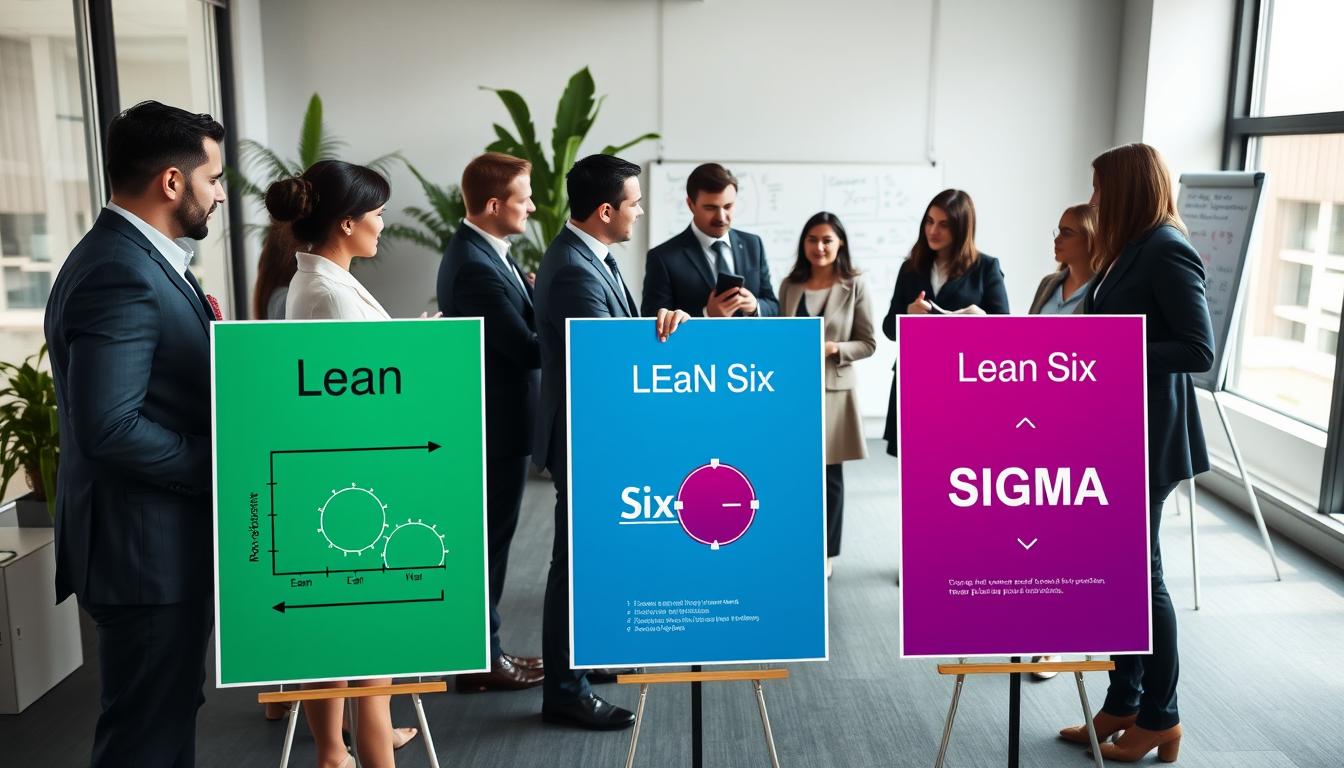
Lean vs Six Sigma vs Lean Six Sigma: Best Practices
In the U.S., companies aim for performance excellence to enhance quality, reduce costs, and expedite delivery. This piece compares Lean, Six Sigma, and Lean Six Sigma, highlighting best practices for leaders. It focuses on practical process improvement to boost operational efficiency and lower risk.
Lean originated from Toyota’s Production System, focusing on eliminating waste to maximize customer value. Six Sigma, developed at Motorola by Bill Smith and expanded at General Electric, Bank of America, Toshiba, and Intel, targets defects with statistical methods. Lean Six Sigma combines both, ensuring end-to-end flow with stable, capable processes.
Studies show significant improvements with disciplined application of these methods. For example, Royal Caribbean’s Symphony of the Seas applied Lean to enhance turnaround logistics and cycle time. On the other hand, quality failures like Takata airbags and the Boeing 737 MAX underscore the high stakes of unchecked variation and inadequate process oversight.
This guide offers a detailed look at tools and roadmaps, including DMAIC and DMADV, Value Stream Mapping, 5S, and Kaizen. It compares the strengths, limitations, and steps to adoption, aiding in process improvement decisions. The aim is clear: to achieve operational efficiency with consistent, verified outcomes across various functions.
Difference Between Lean and Six Sigma and Where Lean Six Sigma Fits
Professionals often seek a clear evaluation of the difference between Lean and Six Sigma to guide investment, staffing, and operating models. A balanced Lean vs Six Sigma comparison helps align teams on scope, metrics, and expected outcomes. Lean Six Sigma principles show how both disciplines can operate as a single, end-to-end system.
Lean focus: eliminating waste and maximizing customer value
Lean targets non–value-added work and compresses cycle time across functions. Rooted in the Toyota Production System, it redirects resources from delays, rework, and excess inventory to customer value.
Beyond factories, Lean shapes daily management in finance, healthcare, logistics, and IT by streamlining handoffs and improving flow. In a Lean vs Six Sigma comparison, Lean focuses on speed, cost, and throughput.
Six Sigma focus: reducing variation and defects with data and statistics
Six Sigma uses statistical methods to cut variation and defects, most often through DMAIC and DMADV. Motorola reported major savings from this discipline, and GE scaled it enterprise-wide to improve yield and reliability.
Its toolset—control charts, capability analysis, and hypothesis tests—drives stable, predictable outputs. In the difference between Lean and Six Sigma, this approach emphasizes precision, error prevention, and measurable defect reduction.
Lean Six Sigma: integrating efficiency and quality for end‑to‑end improvement
Lean Six Sigma principles combine waste elimination with rigorous variability control. Teams apply standard work, mistake-proofing, and data-driven root cause analysis to prevent issues instead of detecting them late.
This integrated model supports hospitals, government agencies, manufacturers, and carriers by uniting flow with quality. A practical Lean vs Six Sigma comparison shows that the hybrid secures both speed and consistency, aligned to customer value and sustainable performance.
Core Principles of Lean for Efficiency and Flow
Lean efficiency hinges on understanding what customers are willing to pay for and how quickly value is delivered. By applying Lean Six Sigma principles, organizations align teams, eliminate obstacles, and speed up processes without sacrificing quality. Value stream mapping helps leaders pinpoint where time, cost, and risk accumulate, enabling them to act with precision.
Defining value from the customer’s perspective
Value is determined by the customer, not by internal preferences. Teams map out customer needs, lead times, and service levels. They then eliminate steps that do not add value. This approach grounds Lean Six Sigma tools in real demand, supporting pricing, fulfillment, and service goals.
In practice, hospitals focus on door-to-doctor time and safe handoffs. E-commerce networks aim for one-day delivery with reliable cutoffs and accurate picks. Manufacturing cells are designed to match takt time, ensuring throughput aligns with actual orders.
Value Stream Mapping, 5S, and Kaizen as foundational Lean tools
Value stream mapping outlines every action from order to receipt, revealing delays, rework loops, and excess motion. 5S organizes workspaces, making tools and materials visible, safe, and standard. Kaizen drives rapid, team-based improvement, closing gaps swiftly.
The Royal Caribbean Symphony of the Seas turnaround exemplifies large-scale orchestration. About 7,000 guests disembark and another 7,000 board in roughly seven hours. Over 20,000 luggage pieces move, and 2,759 staterooms are cleaned. This showcases Lean Six Sigma principles in action, with coordinated checklists, paced flow, and clear signals.
Targeting delays, errors, and waste across processes and functions
Lean efficiency aims to eliminate bottlenecks, handoff errors, and excess inventory with disciplined standards and visible cues. Leaders use Lean Six Sigma tools like standard work, kanban, and mistake-proofing to stabilize flow and prevent defects.
This system is applied in clinics, fulfillment centers, and assembly lines. By linking value stream mapping to metrics like lead time, first-pass yield, and on-time delivery, teams focus on high-impact fixes. They sustain gains through daily management.
| Lean Focus Area | Primary Objective | Key Practice | Measured Outcome | Example Context |
|---|---|---|---|---|
| Customer Value | Deliver only what customers value | Voice of Customer aligned with value stream mapping | Higher conversion and repeat purchases | E-commerce promise dates matched to fulfillment capacity |
| Flow | Reduce wait and idle time | Cell design, takt time setting | Shorter lead time and lower WIP | Mixed-model assembly paced to demand |
| Workplace Organization | Standardize and simplify tasks | 5S with visual controls | Fewer errors and faster setup | Clinical supply rooms with labeled, fixed locations |
| Continuous Improvement | Iterate small changes daily | Kaizen events and daily huddles | Steady gains in first-pass yield | Picking accuracy raised through quick trials and audits |
| Cross-Functional Coordination | Synchronize handoffs | Kanban and standard work | Lower variability and rework | Cruise turnaround with timed crew and luggage flows |
Core Principles of Six Sigma for Quality and Consistency
Six Sigma quality focuses on preventing defects through variation reduction. It uses strict measurement, data-driven improvement, and structured problem-solving. The goal is to ensure outputs meet standards in both manufacturing and services. This leads to stable, predictable performance from shift to shift.
At Motorola, under Bill Smith, the discipline emerged. It involved sustained analysis and statistical process control to reduce defects and costs. Programs at GE, Bank of America, Toshiba, and Intel further solidified its relevance across industries. They introduced common metrics, capability studies, and verified controls.
High-profile failures highlight the importance of managing variation. Takata’s ammonium nitrate inflator issues led to 37 million U.S. vehicle recalls and over 50 million airbag replacements. The Boeing 737 MAX crashes, caused by MCAS software and control problems, resulted in 346 deaths. These incidents emphasize the need for statistical process control, robust design, and data-driven improvement in achieving Six Sigma quality.
Six Sigma frameworks are designed to prevent and verify quality. DMAIC and DMADV use root-cause analysis, capability indices, and control charts. Teams focus on variation reduction for critical features. They confirm stability with ongoing sampling and align actions with risk and total cost of quality.
Six Sigma Methodologies: DMAIC and DMADV Explained
Organizations use a disciplined approach to improve processes and reduce defects. They employ Six Sigma DMAIC and DMADV methodologies. These methods rely on data and structured reviews to manage risk and ensure sustained results.
When to use DMAIC for improving existing processes
Six Sigma DMAIC focuses on refining processes that fall short of quality or delivery goals. Teams first define the problem and understand customer needs. They then measure the current state and analyze data to find root causes.
Next, they implement targeted improvements through pilots and standardize work. This method is ideal for improving supply chain reliability, reducing service cycle times, and increasing manufacturing yield. It’s about making incremental changes without a complete overhaul.
When to use DMADV for designing new solutions
For processes that can’t meet customer needs even after optimization, Six Sigma DMADV is the choice. Teams define, measure, and analyze before designing a new product or process. The goal is to meet critical quality metrics.
The verify step checks the design’s performance in real-world conditions. This approach is best for new service models, greenfield plants, and digital workflows. It’s about creating a new architecture from scratch.
Control and Verify phases to sustain gains over time
DMAIC’s Control phase solidifies improvements through control charts and documented procedures. Leaders monitor performance and intervene early to prevent decline. This phase ensures the process remains stable.
DMADV’s Verify phase confirms the design’s effectiveness at scale. Teams monitor early runs and validate the process for operations. This phase updates standards to maintain stability under load.
| Dimension | Six Sigma DMAIC | Six Sigma DMADV | Typical Metrics |
|---|---|---|---|
| Primary Purpose | Optimize an existing process to reduce defects and variation | Create a new process or product aligned to customer needs | DPMO, yield, cycle time, on‑time delivery, NPS |
| Key Phases | Define, Measure, Analyze, Improve, Control | Define, Measure, Analyze, Design, Verify | CTQ, capability indices (Cp/Cpk), VOC to CTQ flowdown |
| Typical Triggers | Chronic rework, bottlenecks, cost overrun, unstable output | New market entry, new product launch, major regulatory shifts | Gap-to-target, stage-gate readiness, PPAP/launch readiness |
| Analysis Tools | Root cause analysis, regression, hypothesis tests, control charts | QFD, design for reliability, simulation, tolerance analysis | p‑charts, X‑bar/R, DOE results, risk priority numbers |
| Sustainment | Control plans, owner KPIs, layered process audits | Pilot verification, ramp-up monitoring, design standards | SPC conformance, first-pass yield, service-level adherence |
Lean’s Eight Wastes and How Lean Six Sigma Eliminates Them
Organizations identify non-value-added activities through Lean’s eight wastes, which increase costs and slow down processes. Lean Six Sigma tools turn these issues into measurable risks, enabling waste reduction while maintaining quality. Teams use data, short cycles, and standard work to protect service levels and streamline operations.
Defects, Overproduction, Waiting, Non‑Utilized Talent
Defects lead to scrap, rework, and returns. DMAIC quantifies the cost of defects by establishing a baseline yield and sigma level. It then applies root-cause analysis to remove variation at its source.
Overproduction ties up cash and hides bottlenecks. Takt-based scheduling, heijunka leveling, and pull signals curb early or excess output. This supports waste reduction at scale.
Waiting emerges from unbalanced cycle times and unreliable changeovers. Value stream maps reveal idle queues. SMED and line balancing compress gaps and remove non-value-added activities.
Non‑Utilized Talent reflects misaligned skills and underused expertise. Cross-training, standard work, and suggestion systems convert hidden capacity into throughput gains.
Transportation, Inventory, Motion, Extra Processing
Transportation adds cost without adding value. Layout redesign, milk runs, and point-of-use storage shorten travel distance and cut handling steps.
Inventory swells from forecast error and long lead times. Kanban and EOQ reviews right-size stock, expose true demand, and improve material turns with Lean Six Sigma tools.
Motion wastes operator time and energy. 5S, ergonomics, and visual controls reduce reach, search, and bend. This improves safety and cycle time together.
Extra Processing signals unclear specifications. Standard work, CTQs, and mistake-proofing align process steps with customer needs and prevent rework loops.
Using DMAIC to systematically remove non‑value activities
In Define and Measure, teams map end-to-end flow, baseline lead time, and convert delays into hard costs. Analyze uses cause-and-effect matrices, regression, and control charts to isolate drivers of variation.
Improve pilots countermeasures: 5S to cut motion, setup reduction to slash waiting, and right-sized batch rules to prevent overproduction. Control locks in gains with SPC, layered audits, and visual management.
| Waste Type | Primary Signal | Financial Impact (Typical) | Root-Cause Tools | Flow Redesign Actions | Control Mechanisms |
|---|---|---|---|---|---|
| Defects | High rework/returns | Scrap cost, warranty, lost sales | Fishbone, 5 Whys, regression | Poka‑Yoke, CTQ alignment, SOP updates | SPC charts, first‑pass yield tracking |
| Overproduction | Inventory piling before demand | Carrying cost, obsolescence | Takt analysis, capacity modeling | Pull/Kanban, heijunka leveling | WIP caps, visual pull signals |
| Waiting | Idle time and queues | Labor downtime, longer lead time | Time study, bottleneck analysis | SMED, line balancing, parallel paths | Throughput dashboards, ANDON |
| Non‑Utilized Talent | Skills unused in role | Lost productivity, turnover risk | Skills matrix, RACI evaluation | Cross‑training, idea systems | Standard work audits, skills refresh |
| Transportation | Excess moves and handling | Freight, damage risk | Spaghetti diagram, layout study | Point‑of‑use storage, route optimization | Milk runs, dock appointment control |
| Inventory | High stock vs. turns | Carrying cost, write‑downs | Demand variability analysis | EOQ tuning, safety stock reset | Kanban sizing, cycle counts |
| Motion | Searching, reaching, bending | Lost time, injury risk | Motion study, ergonomics review | 5S, tool shadow boards | 5S audits, takt-based cell checks |
| Extra Processing | Steps beyond spec | Labor and energy overuse | CTQ flowdown, SIPOC | Spec clarity, Jidoka checks | Layered process audits, checklists |
Lean vs Six Sigma vs Lean Six Sigma
Lean focuses on eliminating waste and improving flow around customer value. Six Sigma, on the other hand, aims to reduce variation and defects through statistical analysis. This comparison highlights the trade-off between speed and cost versus precision and stability.
Lean enhances cycle time, handoffs, and throughput by streamlining processes. It employs tools like 5S, Kanban, and Value Stream Mapping for daily management. Six Sigma, with its DMAIC methodology, targets high-variation causes using statistics and control charts. It excels in defect prevention in data-rich industries like semiconductors and pharmaceuticals.
When teams combine Lean and Six Sigma, they create a hybrid approach. This method stabilizes flow with Lean and then uses Six Sigma to eliminate variation. Many organizations, including PMOs, adopt DMAIC as a unified roadmap for change management.
This hybrid is widely adopted across sectors like healthcare, government, and manufacturing. For instance, Mayo Clinic and Cleveland Clinic use Lean for patient flow and Six Sigma for lab accuracy. Automotive giants like Toyota and Ford apply Lean for efficiency and Six Sigma for quality control.
This approach targets both cost reduction and defect prevention. Leaders align portfolios by mapping value streams and quantifying variation. They prioritize projects based on their financial impact, linking improvement to CFO metrics.
A disciplined comparison of Lean and Six Sigma clarifies roles within teams. Lean coaches focus on daily Kaizen and visual management. Black Belts and data analysts validate causes and design controls. Together, they prevent rework, protect throughput, and standardize processes at scale.
Industry Applications and Case Contexts for Best Practices
Lean and Six Sigma are most effective when tailored to specific operational settings. They align with measurable objectives, such as quality yield and on-time delivery. Organizations leverage these tools to minimize waste, reduce variation, and optimize supply chains in complex networks.
Manufacturing: continuous improvement, on‑time and higher‑quality output
Manufacturers employ visual management, andon, and standardized work to address issues promptly. This approach maintains line stability, ensures teams meet takt times, and maintains quality standards.
Companies like Motorola, GE, Toshiba, and Intel have achieved material savings by integrating Lean flow with DMAIC control. This combination fosters continuous improvement and minimizes rework at the source.
Healthcare and services: reducing delays and improving flow
Hospitals use value stream mapping to decrease emergency department wait times and streamline admissions. Six Sigma methods help stabilize triage and lab turnaround, lowering error rates in high-risk steps.
Service operations and government programs apply Lean Six Sigma tools to enhance throughput without compromising service quality. The Royal Caribbean turnaround model exemplifies the large-scale coordination of crews, assets, and passenger flows under tight schedules.
Supply chain and logistics: minimizing variation and bottlenecks
Networks benefit from pull systems, milk runs, and heijunka to balance loads. Statistical process control and capability analysis reduce demand and lead-time variation, which can create bottlenecks.
Supply chain optimization links carrier performance, inventory policies, and dock capacity to on-time metrics. Cautionary cases at Takata and Boeing highlight the risks of neglecting verification and variability controls.
| Context | Primary Goal | Key Lean Six Sigma Tools | Operational Metric Improved | Representative Examples |
|---|---|---|---|---|
| Discrete Manufacturing | Stable flow with high first‑pass yield | Standard work, andon, 5S, DMAIC, SPC | FPY, defects per million opportunities, takt adherence | Motorola, GE, Toshiba, Intel programs |
| Healthcare Delivery | Faster patient movement with fewer errors | Value stream mapping, Kaizen, control charts, SIPOC | ED length of stay, lab turnaround, medication error rate | Emergency departments and labs adopting SPC |
| Services and Hospitality | High throughput with consistent service levels | Queue design, takt‑based staffing, root‑cause analysis | Wait time, service level, schedule adherence | Royal Caribbean port and ship turnaround operations |
| Supply Chain and Logistics | Reduced variability and fewer bottlenecks | Heijunka, kanban, PFMEA, capability analysis | On‑time delivery, dwell time, order cycle time | Carrier and warehouse networks using SPC and kanban |
Lean Six Sigma Benefits for Organizations
Organizations adopt this hybrid system to achieve measurable gains in cost reduction, throughput, and reliability. The combined discipline advances operational excellence by uniting speed with precision. Leaders value the predictable impact on margins and the resulting lift in customer satisfaction.

Increasing profits and decreasing costs through waste and defect reduction
Lean tools cut waiting, rework, and excess inventory, while Six Sigma reduces variation and scrap. Motorola and General Electric reported multimillion-dollar savings through structured deployment and verified control plans. The result is sustained cost reduction, higher first-pass yield, and faster cash conversion.
Improving efficiency, quality, and customer satisfaction
Value Stream Mapping exposes bottlenecks, and DMAIC stabilizes critical process inputs. As cycle times fall and defects decline, on-time delivery improves and service variability narrows. These Lean Six Sigma benefits strengthen brand trust and raise customer satisfaction across manufacturing, healthcare, and services.
Enhancing employee development and cross-functional collaboration
Cross-functional teams apply root-cause analysis, standard work, and visual controls to align on shared targets. This practice deepens capability and accelerates knowledge transfer between operations, quality, finance, and supply chain. The governance model supports operational excellence with clear metrics, audit routines, and preventive controls.
Choosing the Right Approach: Factors That Influence Selection
When selecting an approach, process maturity, data quality, and the operating context are key. Companies like Toyota, Caterpillar, and Intel, with machinery-intensive lines, often choose Six Sigma to manage variation. On the other hand, labor-intensive service centers, such as those at Kaiser Permanente or American Express, lean towards Lean to enhance flow and eliminate delays.
The choice between Lean and Six Sigma hinges on the presence of waste and defects. For workflows that can be fine-tuned, DMAIC is ideal for incremental improvements. In cases where new products or facilities require a clean slate, DMADV is preferred for its structured approach with immediate measurement and verification.
Benchmarking studies reveal that about 60% of first-time initiatives underperform without sustained effort. A disciplined deployment strategy is essential, including leadership commitment, standard work, control plans, and regular reviews. These steps help mitigate risks in cost, schedule, and quality.
Data availability determines the depth of tools used. High-frequency sensor data in sectors like semiconductors or automotive supports advanced statistical models. In contrast, industries like contact centers and clinics benefit from visual management and quick changeover practices to stabilize flow before adding analytics.
Lean Six Sigma programs offer a balanced approach, combining speed with rigor. Early Lean gains free up capacity, while Six Sigma methods tackle chronic variation. This hybrid approach aligns resources with the problem’s nature and timeline.
| Decision Factor | Lean Preference | Six Sigma Preference | Lean Six Sigma Blend | Deployment Strategy and Risk Mitigation Notes |
|---|---|---|---|---|
| Process maturity | Young or unstable flow needing quick stabilization | Stable but variable outcomes needing tighter control | Stabilize first, then reduce variation | Stage gates with control plans reduce rework risk |
| Primary problem type | Waste, delays, handoffs, excess motion | Defects, yield loss, measurement error | Waste removal followed by defect reduction | Define metrics early; verify with pilot trials |
| Data availability | Limited, qualitative, time‑study ready | Rich, high‑frequency, statistically robust | Build data discipline while improving flow | Standard work improves data integrity for analysis |
| Industry context | Healthcare, contact centers, warehousing | Semiconductor, automotive, pharmaceuticals | Mixed operations with both manual and automated steps | Select tools per cell; manage change impact by area |
| Change scope | Incremental improvements | Deep defect reduction or tolerance redesign | Incremental steps plus targeted redesign | Use DMAIC for adjustments; DMADV for new designs |
| Time horizon | Weeks to stabilize and free capacity | Months to model, test, and validate | Quick wins that fund longer initiatives | Phased roadmap mitigates schedule and budget risk |
Organizations starting from scratch can embed models early and retain flexibility for adjustments. In existing settings, leaders can focus projects by value stream, link incentives to verified results, and track both throughput and defect trends.
Clear governance ensures the right approach is chosen based on objective criteria. With a structured selection process, a tailored deployment strategy, and effective risk mitigation, teams align tools with the problem at hand.
Lean Six Sigma Tools and Roadmaps that Drive Results
Organizations need a structured roadmap to turn data into tangible gains. Lean Six Sigma tools bridge strategy and daily operations, ensuring customer value translates into measurable results. Motorola and GE’s success stories highlight how systematic deployment slashes costs, shortens cycle times, and cuts defects.
Statistical analysis and control charts to reduce variability
Statistical analysis is the bedrock of informed decision-making. Teams employ hypothesis testing, regression, and capability analysis to discern signal from noise. Control charts monitor process stability in real-time, prompting action before issues reach customers.
Control charts, when used with SPC rules, reveal special causes and confirm sustained improvements post-pilot. This evidence guides focused investments and prevents overcorrection.
Standard work and flow to prevent defects before they occur
Prevention-focused design begins with standard work. It ensures consistent methods across shifts and sites through clear sequences, takt alignment, and visual management. Balanced flow minimizes handoff errors and shortens lead times.
5S maintains order in the workplace, while leader standard work and audits enforce consistency. These practices reduce firefighting, freeing up resources for improvement.
Value Stream Mapping plus root-cause analysis for end-to-end optimization
Value Stream Mapping uncovers bottlenecks, rework loops, and wait states across functions. It measures touch time, queue time, and First Pass Yield to pinpoint high-impact areas.
Within DMAIC or DMADV, teams use root-cause analysis tools like cause-and-effect diagrams, Pareto charts, and verification tests. Solutions are piloted, validated, and scaled, then secured through control charts, audits, and visual controls.
- Define–Measure–Analyze–Improve–Control: customer CTQs, baseline metrics, verified causes, pilot solutions, and SPC sustainment.
- Enablers: Kaizen events for focused change, 5S for stability, and cross-functional huddles for rapid issue escalation.
This holistic approach marries statistical precision with practical application. Standard work, control charts, and root-cause analysis work in tandem to achieve stable, predictable performance across the value stream.
Lean Six Sigma Certification Paths and Skills Development
Organizations employ Lean Six Sigma certification to establish clear skill benchmarks for process enhancement. Professionals progress through distinct Six Sigma belts, finishing structured training programs. These programs enhance analytical and leadership skills.
White, Yellow, Green, Black, and Master Black Belts
White and Yellow belts introduce foundational knowledge, key terms, and team roles. Learners engage in basic problem-solving and data collection through short, focused sprints. These are ideal for frontline contributors.
Green Belt training expands to include DMAIC, root-cause analysis, and statistical process control. Graduates lead projects, achieving significant improvements in cost, quality, and delivery.
Black Belts oversee complex portfolios and employ advanced analytics. This includes regression, design of experiments, and capability analysis. Master Black Belts, on the other hand, guide enterprise-wide deployment, coach leaders, and align strategies.
What to learn first: Lean, Six Sigma, or Lean Six Sigma
An integrated Lean Six Sigma certification sequence is often the most efficient path. This combined approach enables learners to master flow, waste removal, and variation reduction within a single curriculum.
Market programs from universities and institutes support this integrated approach. For instance, Purdue University offers online Lean, Six Sigma Green Belt, and Black Belt courses for working managers.
Graduates become proficient in project scoping, running DMAIC or DMADV, and applying SPC with standard work. This pathway accelerates professional growth and enhances cross-functional execution.
Career relevance across industries and leadership roles
Six Sigma belts are universally applicable across manufacturing, healthcare, financial services, technology, government, and supply chains. Employers value the consistent application of methods that increase throughput, stabilize quality, and protect margins.
Supervisors, analysts, and operations leaders leverage these training programs to standardize decision-making and scale improvements. The skill set supports career advancement in plant operations, service delivery, and PMO oversight.
With portable credentials and proven tools, practitioners align metrics to customer value and risk. This results in lasting capability that fortifies performance management across the enterprise.
Conclusion
The debate between Lean, Six Sigma, and Lean Six Sigma centers on the problem’s nature and data quality. Lean focuses on eliminating waste and improving flow for speed and stability. Six Sigma, on the other hand, aims to reduce variation and defects for reliability. A balanced comparison reveals that Lean Six Sigma combines both, leading to efficient, high-quality operations with significant performance improvements.
Motorola and GE’s success stories highlight the lasting benefits of disciplined DMAIC and DMADV application. Statistical Process Control and control/verify steps are key to maintaining results. Lean tools like Value Stream Mapping, 5S, and Kaizen help reduce cycle time and standardize work. These methods have proven effective in various U.S. sectors, including service and logistics.
The consequences of failure are stark. Takata and Boeing’s setbacks demonstrate the high cost of neglecting variation control and verification. Strong data, clear problem definition, and consistent governance are essential. Organizations should choose Lean for flow issues, Six Sigma for defect reduction, and Lean Six Sigma for both speed and precision.
For leaders aiming for performance excellence, a practical approach is advisable. Begin with the biggest value loss, use the right roadmap, and measure outcomes rigorously. A hybrid approach, combining Lean stabilization with Six Sigma analytics, often produces the most lasting results in the U.S. This method enhances continuous improvement while addressing the Lean vs Six Sigma vs Lean Six Sigma trade-offs.
FAQ
What is the difference between Lean and Six Sigma, and how does Lean Six Sigma combine them?
Lean focuses on eliminating waste and improving flow to enhance customer value. It employs tools like Value Stream Mapping, 5S, and Kaizen. On the other hand, Six Sigma targets reducing defects through statistical analysis using DMAIC and DMADV. Lean Six Sigma merges these, aiming to remove waste while stabilizing processes with data. This approach leads to faster, more consistent outcomes across various operations.
When should an organization use DMAIC versus DMADV?
DMAIC is suitable for improving existing processes that can meet requirements with targeted fixes. It involves Define, Measure, Analyze, Improve, and Control phases. DMADV, on the other hand, is for designing new products or processes when current systems cannot meet customer needs. It includes Define, Measure, Analyze, Design, and Verify phases. Control and Verify phases are used to institutionalize gains with standard work, SPC, and reviews.
What are the Lean Eight Wastes and how does Lean Six Sigma eliminate them?
The eight wastes include Defects, Overproduction, Waiting, Non-Utilized Talent, Transportation, Inventory, Motion, and Extra Processing. Lean tools help expose and remove these wastes. For instance, Value Stream Mapping reveals bottlenecks, while 5S reduces motion. Standard work curbs extra processing. Six Sigma quantifies the impact of these wastes and reduces variation through hypothesis testing and capability analysis. DMAIC sequences these actions to systematically remove waste and sustain results.
Which industries benefit most from Lean Six Sigma and what cases illustrate impact?
Industries like manufacturing, healthcare, services, government, and logistics benefit from Lean Six Sigma. It balances throughput and quality. Motorola, General Electric, Toshiba, and Intel have seen significant savings from Six Sigma programs. Royal Caribbean’s Symphony of the Seas turnaround is a prime example of Lean’s impact in service logistics. The failures at Takata and Boeing highlight the cost of unmanaged variation and weak verification, reinforcing the need for Six Sigma controls.
What are the core benefits of Lean Six Sigma for organizations?
Lean Six Sigma offers several benefits, including lower costs through reduced rework, scrap, and inventory. It also improves on-time delivery and throughput, lowers defect rates, and increases customer satisfaction. It enhances employee capability through cross-functional problem-solving and root-cause analysis. This leads to better collaboration and accountability within the organization.
How should a company choose between Lean, Six Sigma, and Lean Six Sigma?
The choice depends on the problem at hand. Lean is ideal for addressing flow constraints and visible waste in labor-intensive processes. Six Sigma is better for high defect rates and complex, data-rich variation. Many U.S. organizations use Lean Six Sigma for quick waste-reduction wins and DMAIC for deeper statistical problem-solving. Consider data availability, process maturity, and sustainment capacity when selecting the approach.
What are the main Lean Six Sigma tools and principles that drive results?
Key Lean Six Sigma tools include Value Stream Mapping, 5S, Kaizen, standard work, visual management, root-cause analysis, SPC, control charts, hypothesis testing, regression, and capability analysis. The core principles emphasize customer value, prevention over detection, end-to-end flow, and disciplined governance via DMAIC/DMADV to maintain gains over time.
What are the Lean Six Sigma certification levels and where can professionals train?
Certifications progress from White and Yellow Belts (foundations) to Green Belt (project leadership), Black Belt (program leadership and advanced analytics), and Master Black Belt (enterprise deployment). Universities and institutes offer programs. For example, Purdue University provides online Lean, Six Sigma Green Belt, and Black Belt courses. Starting with Lean Six Sigma equips professionals to lead cross-functional initiatives across various sectors.
How does Lean Six Sigma support supply chain and logistics performance?
Lean streamlines end-to-end flow, reduces waiting and transport waste, and stabilizes handoffs. Six Sigma reduces variation in lead times, pick accuracy, and on-time delivery using SPC and root-cause analysis. The combined approach minimizes bottlenecks, stabilizes cycle times, and improves service levels across procurement, warehousing, and last-mile operations.