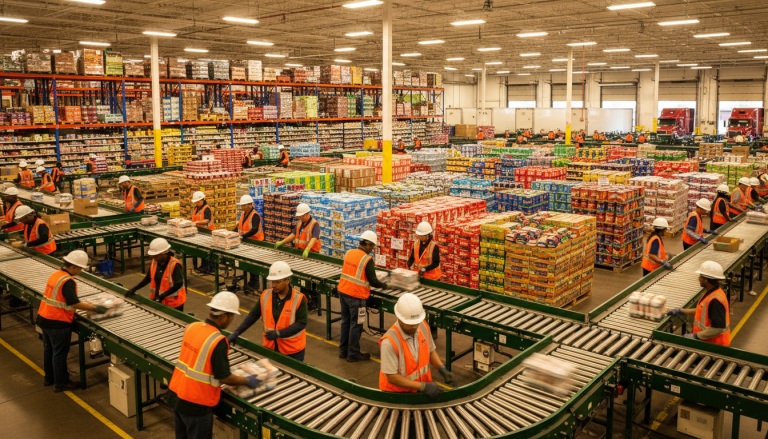

Find Fulfilling Amazon Warehouse Jobs Near You
In the United States, Amazon warehouse jobs attract those seeking reliable employment, clear objectives, and quantifiable performance metrics. This introduction outlines the criteria for determining suitability before applying. It emphasizes the importance of role alignment, schedule constraints, safety protocols, and career progression avenues.
Amazon fulfillment centers are bustling with activity. Workers often find themselves near heavy machinery, towering shelves, and uneven floors. As such, it’s essential to assess one’s comfort with physical demands and adherence to strict site regulations.
This guide helps streamline the search for warehouse positions by categorizing roles. It covers associate work, support functions, and operations roles. It also discusses flexible work schedules and essential safety measures, such as wearing flat, closed-toed shoes and adhering to clothing guidelines.
Opportunities in warehouse jobs also extend to long-term career growth. The article highlights indicators of job satisfaction and advancement, including training frequency, leadership expectations, and the overall work environment. These factors significantly influence one’s readiness for promotions over time.
Why Amazon Warehouse Work Can Be a Fulfilling Career Path
Amazon warehouse jobs are appealing to many in the U.S. because they align daily tasks with clear goals. The environment is structured, with specific steps and time limits for tasks. This setup is attractive to those who value clear feedback and seeing progress.
Fast-paced, supportive fulfillment center environment
In active sites, teams follow repeatable processes to ensure quality and reduce errors. The pace is quick, but there’s a formal support system. This includes coaching, safety briefings, and clear paths for resolving issues.
Key elements of a well-run shift include:
Standard work instructions that define pick, pack, sort, and stage sequences
Real-time scanning and exception handling to protect inventory accuracy
Team-based handoffs that reduce delays between inbound, outbound, and last-mile lanes
Career mobility for people who start as associates and grow into leadership
Amazon has shown that many managers started as associates. This makes internal mobility a key path for operations leadership. Performance is measurable, skills are transferable, and roles build on the same systems. Associates who demonstrate reliability and problem-solving can move up.
The path to growth is clear when expectations are set:
| Starting point | Operational focus | Capability built | How growth is measured |
|---|---|---|---|
| Hourly associate | Executing standard workflows under throughput targets | Quality control, scanning accuracy, pace management | Safety compliance, error rates, steady output |
| Process guide or peer support | Coordinating handoffs and helping remove blockers | Communication, queue awareness, short-interval control | Stable flow, fewer defects, faster recoveries |
| People leadership track | Managing team execution across a shift window | Coaching, staffing decisions, performance management | Service levels, productivity trends, adherence to standards |
Making an impact on the future of order fulfillment and customer experience
Fulfillment work directly impacts customer outcomes like speed, accuracy, and quality. The expansion of the network raises the bar for consistency. In Amazon Mexico, the company has expanded its catalog and operates numerous warehouses.
This growth shows why amazon warehouse jobs are tied to customer obsession and continuous improvement. As the network grows, the focus remains on reducing errors and improving delivery times. For those considering amazon jobs, this model makes the work feel impactful, as each task supports a larger system.
Amazon Warehouse Jobs: Roles You Can Apply for Locally
Local amazon warehouse jobs focus on repetitive tasks to maintain high-throughput fulfillment. The environment is active, with moving equipment and tall shelving. Training ensures safe motion, scan accuracy, and steady output.
Role fit depends on physical readiness, shift timing, and comfort with workflows. Many roles combine similar duties in a single posting. Tasks vary by department and volume, allowing sites to adjust labor to demand.
Warehouse associate positions in picking, packing, and sorting
Warehouse associate positions involve moving units and ensuring order quality. Picking requires locating items, scanning barcodes, and preparing totes for the next step. Packing involves selecting cartons, using dunnage, and checking for damage.
Sorting directs units to the right lane or pallet based on scan logic and cutoff times. Metrics track scan compliance, error rates, and pace. Teams rotate stations to reduce fatigue and support training.
Warehouse staff positions supporting inbound, outbound, and inventory
Warehouse staff positions keep the flow of goods moving. Inbound work unloads trailers, receives goods, and moves them to storage. Inventory support handles cycle counts and audits to ensure accuracy.
Outbound support stages pallets and manages dock door activity. These functions prevent stockouts and congestion. The best matches are detail-focused and comfortable working near equipment.
Operations and shift support roles in an Amazon fulfillment center
Operations and shift support roles coordinate labor plans and hourly execution. They track performance targets and monitor staffing gaps. They also support shift handoffs to prevent issues.
These roles rely on dashboards, checklists, and structured communication. Candidates should have strong attendance, clear documentation habits, and decision-making skills during peaks.
| Role group | Primary workflow focus | Common tasks on shift | Operational value | Work setting factors |
|---|---|---|---|---|
| Warehouse associate positions | Unit-level execution | Pick to tote, pack to carton, sort to lane, scan validation | Drives order speed and accuracy at the item level | Frequent walking or standing; work near conveyors and shelving |
| Warehouse staff positions | Flow enablement across departments | Receive and stow, cycle count, dock staging, inventory fixes | Prevents constraints by balancing inbound supply and outbound demand | Trailer and dock activity; forklifts or pallet jacks may operate nearby |
| Operations and shift support | Coordination and performance control | Labor moves, backlog tracking, shift handoff notes, barrier escalation | Keeps targets aligned across shifts and stabilizes throughput | Time-sensitive decisions; work occurs on the floor and at support stations |
Amazon Fulfillment Center Careers and Growth Into Management
In U.S. distribution networks, careers at Amazon’s fulfillment centers often evolve from hourly tasks to leading teams. For those exploring employment opportunities, moving into management can be a natural progression after mastering core tasks. Many job openings highlight the importance of leadership development within the warehouse environment.
What fulfillment center managers do: lead, mentor, and manage associate teams
Fulfillment center managers oversee teams in a dynamic warehouse setting. Their role involves daily coaching, removing obstacles, and ensuring teams meet quality and efficiency standards. This focus aligns with the structure of Amazon’s fulfillment center careers, which emphasize measurable outcomes.
They also spearhead employee safety initiatives through training, establishing clear rules, and responding swiftly to hazards. This approach supports compliance and minimizes preventable disruptions. In many roles, safety is viewed as a critical performance metric, not an afterthought.
Improving processes, setting performance targets, and working with new tech
Operational leaders are tasked with refining processes, setting goals, and integrating new technologies. They focus on steady productivity increases without compromising quality. This involves standardizing work, planning labor, and conducting thorough reviews when issues arise.
Amazon’s Leadership Principles guide decision-making, influencing how managers justify decisions. This means using data to support arguments, establishing clear escalation paths, and ensuring consistent follow-through. Many leadership roles reflect this structured approach to evaluation.
Managing flexible shift timetables while keeping operations running smoothly
Managers oversee flexible schedules while maintaining operational flow across shifts. They plan for peak volumes, unexpected absences, and training needs. Strong scheduling ensures continuous throughput and reduces delays.
These roles also involve coordinating with support functions to manage constraints, from equipment availability to trailer flow. Clear communication at the start and during shifts minimizes rework. This operational rhythm is a key aspect of Amazon’s fulfillment center careers.
Multiple routes into management: promoted from within, school hires, and industry hires
Amazon employs various paths to management: internal promotions, school hires, and industry professionals. Internal promotions reward those who excel in process knowledge and performance under pressure. School hires bring analytical skills for labor planning and continuous improvement.
Industry hires often possess lean operations expertise and safety leadership experience. Across these paths, Amazon seeks candidates with a track record of measurable achievements and leadership. Those exploring job openings can use these routes to plan a realistic path to management.
| Management pathway | Common starting point | Primary strengths brought into operations | Early performance focus |
|---|---|---|---|
| Promoted from within | Associate or process guide experience | Deep knowledge of pick, pack, sort, and problem-solve routines | Stabilize daily execution, coach teams, and maintain safety compliance |
| School hires | Recent graduate pipeline roles | Data analysis, project discipline, and structured problem-solving | Set performance targets, run continuous improvement, and track KPIs |
| Industry hires | Prior logistics or manufacturing supervision | Lean methods, workforce planning, and mature safety governance | Improve processes, scale best practices, and strengthen shift coverage |
Part-Time Warehouse Jobs and Flexible Scheduling Options
In large fulfillment networks, labor planning is critical due to fluctuating order volumes. Many part-time warehouse jobs are designed to meet specific demand periods. This approach supports efficient operations while allowing workers to manage their availability. It’s a common strategy in amazon warehouse jobs, where flexible scheduling is a key staffing tool.
How flexible shifts can fit school, caregiving, or a second job
Flexible scheduling helps balance work with fixed commitments like school or caregiving. Job listings in amazon warehouses often specify start times and hours, making it easier for candidates to find suitable roles. Yet, the nature of fulfillment work means that tardiness can impact productivity and efficiency.
Shifts are designed to cover various periods, including nights, weekends, and unexpected demand spikes. This strategy ensures labor aligns with critical operations like trailer arrivals and sort deadlines. For job seekers, it means schedule fit is a tangible aspect, not just a promise.
What to consider when choosing shift length, days, and start times
When evaluating part-time warehouse jobs, a structured approach is essential. Key factors include shift length, start time, and weekly workdays. Small variations in these can significantly affect commute times, sleep quality, and childcare costs.
Shift length: Shorter shifts may reduce fatigue; longer shifts can reduce commute days and improve schedule stability.
Start time: Early starts may lower traffic delays; late starts can increase conflict with school or evening caregiving.
Days required: Weekends often carry higher demand; weekday-only preferences may narrow available amazon warehouse jobs.
Commute radius: Longer distances increase attendance risk during severe weather and peak traffic periods.
| Scheduling factor | Operational reason in fulfillment centers | Candidate evaluation lens | Common risk to plan for |
|---|---|---|---|
| Short shifts (about 4–6 hours) | Fills tight demand windows around carrier cutoffs and sort cycles | Fits classes or split caregiving blocks; easier to add a second job | More commute days can raise time cost and increase lateness exposure |
| Longer shifts (about 8–10 hours) | Stabilizes staffing for sustained inbound or outbound volume | Fewer commute days; steadier weekly routine | Higher fatigue can affect pace, specially in high-step roles |
| Early start times | Supports inbound receiving, early pick waves, and same-day processing | May reduce traffic and improve on-time reliability | Sleep constraints can reduce recovery and increase injury risk |
| Late start times | Extends coverage into evening dispatch and backlog reduction | Can match school schedules and daytime appointments | Conflicts with evening family needs and limits public transit options |
| Weekend coverage | Matches higher consumer demand patterns and network balancing | May open more job vacancies in amazon warehouse postings | Reduced availability for family events and recurring obligations |
Balancing peak seasons with your long-term schedule preferences
Peak periods increase volume and tighten service-level windows, making staffing flexibility critical. During these times, amazon warehouse jobs may offer more overtime, added shifts, or stricter attendance to maintain capacity. Candidates should consider whether temporary schedule changes align with their long-term plans.
For many part-time warehouse jobs, setting a non-negotiable schedule is practical. This could be a school schedule, a caregiving block, or a second job with fixed hours. This approach ensures comparisons are grounded in real constraints while aligning with the fast-paced nature of fulfillment work.
Where to Find Warehouse Job Openings and Job Vacancies in Amazon Warehouse Locations
Locating warehouse job openings is more effective with a systematic approach, not trial and error. Amazon’s recruiting pages often begin with “View open roles,” indicating the first step in exploring available positions. For candidates in the U.S., a structured search minimizes the risk of mismatched hires and early turnover. This is due to factors like commute time, shift compatibility, and role expectations.
Searching by city, ZIP code, and commute radius in the United States
Begin by searching by city or ZIP code, then set a commute radius that reflects actual travel times during peak hours. This approach filters out job openings that appear close on maps but are far in reality. A precise radius also aids in comparing different sites based on consistent criteria, such as highway access or public transit.
Consistency in searches across nearby metros is also beneficial. In densely populated areas, a slight change in ZIP code can reveal different fulfillment centers or delivery stations with unique staffing needs and schedules.
Using filters to spot warehouse job opportunities that match your availability
Filters are essential for narrowing down a broad list to positions that fit specific constraints. The most critical filters include shift type, weekly hours, and start time windows. For those with limited availability due to school, caregiving, or a second job, filtering first reduces unnecessary applications and boosts the likelihood of accepting an offer.
Regularly monitoring changes in postings is also beneficial. During peak demand periods, new job openings may emerge in clusters, and the best shifts can fill quickly. By maintaining a consistent set of filters, applicants can make informed decisions without rushing into choices.
| Search input | What it screens for | Why it matters operationally |
|---|---|---|
| City or ZIP + commute radius | Distance, travel time, site density | Commute stability supports on-time attendance and lowers churn risk |
| Shift pattern (day, night, weekend) | Start times and weekly rhythm | Predictable coverage improves staffing plans and throughput targets |
| Hours (part-time vs full-time) | Workload capacity and eligibility fit | Reduces role mismatch that can trigger early exits |
| Role family filter | Associate, support, operations support | Clarifies expectations for pace, training, and responsibility |
Evaluating listings for role type, shift pattern, and work location details
Before applying, thoroughly evaluate each listing as if it were an operations checklist. Confirm the role family, as roles in picking or packing differ from support roles tied to inventory management or problem-solving. Next, verify the shift pattern, including weekend requirements, as small schedule details can significantly impact retention.
Work location details also require careful review. Some job openings in Amazon’s warehouse network are listed under a metro area but assigned to a different suburb. Ensuring alignment between location, shift, and role requirements transforms warehouse job opportunities into sustainable, repeatable options, not one-time attempts.
What to Expect Inside an Active Warehouse Work Environment
Amazon warehouses operate in environments designed for continuous unit flow. Floors may have uneven surfaces and narrow travel lanes between shelving lines. This setup supports quick movement and ensures tasks are consistent across shifts.
Working around moving equipment, shelving, and uneven surfaces
Every day, workers navigate around carts, pallet jacks, and other equipment. Warehouse associate roles require frequent walking, turning, and lifting. It’s essential to stay alert to traffic patterns. Shelving, guardrails, and marked lanes help separate people and equipment, but constant attention is necessary.
Staff in warehouse positions may move between fixed stations and short distances for replenishment or support tasks. The varying surfaces across zones require stable footwear and a controlled pace. These conditions are common in high-throughput facilities designed for high volumes.
Common workflow rhythms in fulfillment: scanning, staging, and routing
Fulfillment work follows a structured sequence to keep inventory traceable. Scanning confirms item identity and location, staging groups units for the next step, and routing directs work to the correct dock or area. This process reduces errors and ensures predictable cycle times.
| Workflow step | Primary purpose | Common metrics used on the floor | Typical handoff point |
|---|---|---|---|
| Scanning | Confirm item, container, and location accuracy | Scan compliance, error rate, units per hour | To a tote, cart, or assigned staging area |
| Staging | Organize work into ready-to-move batches | Dwell time, lane accuracy, on-time readiness | To sort, pack, or dock-facing lanes |
| Routing | Direct units to the correct next destination | Missorts, rework volume, departure timing | To outbound, carrier pickup, or internal transfer |
How pace and teamwork show up day-to-day for warehouse associates
Teams operate under shift coordination, with leaders setting performance targets and adjusting labor as needed. Warehouse associates work at a steady pace, reinforced by standard work, coaching, and real-time problem solving. Delays in one area can impact the entire workflow.
Warehouse staff positions often support the line by clearing exceptions, restocking supplies, or handling peak volumes. Teamwork is evident in quick status updates, shared lanes, and coordinated breaks. Supervisors monitor throughput and safety, focusing on areas with increased traffic near docks and staging zones.
Safety Standards and On-Site Rules That Shape Daily Work
Safety measures in a fulfillment center are integral to the workflow, not an afterthought. Daily rules for many amazon warehouse jobs include attire, identification, and movement around equipment. These rules aim to minimize incident exposure and enhance site security.
For those comparing warehouse job opportunities, these standards reveal how operations are managed at scale. They outline what to expect before starting work, including during tours and onboarding.
Employee safety programs and how leaders help deploy them
Fulfillment leaders prioritize employee safety programs as a core duty. They focus on coaching safe work methods, reinforcing traffic patterns, and tracking corrective actions. This is part of their daily operations.
This approach shapes amazon employment opportunities by setting clear expectations for floor behavior. It also supports stable output by reducing preventable downtime due to injuries and near misses.
Footwear expectations: flat, closed-toed, and closed-heeled shoes for safety
Footwear rules are strict due to the presence of heavy carts, powered equipment, and uneven surfaces. Flat, closed-toed, and closed-heeled shoes are the minimum requirement. Sandals, clogs, Crocs, and high heels are prohibited in active areas.
Comfortable shoes or sneakers are recommended for long shifts. For warehouse jobs involving frequent walking and lifting, footwear is a practical risk control, not a style choice.
Why loose clothing and long-hanging accessories are restricted in work areas
Loose-fitting clothing and long-hanging accessories can catch on conveyors, shelving, and moving equipment. This includes long-hanging jewelry, scarves, and ties, which are typically restricted on the active floor.
These limits are enforced in controlled settings, including tours, to maintain consistent standards across shifts. In many amazon warehouse jobs, compliance is a basic condition for entering certain work zones.
Hair and head covering guidance to reduce hazards while respecting religious needs
Hair controls aim to prevent snag and entanglement risks. Long hair must be pulled back at or above shoulder length in active work areas.
Religious head coverings are permitted if they do not pose a safety hazard. Headscarves worn for religious reasons are allowed when tucked in securely. Other religious coverings are evaluated based on hazard risk.
| On-site standard | Operational purpose | Common enforcement signal |
|---|---|---|
| Visitor badge worn at all times | Access control, fast identification, and incident accountability | Check-in issues a badge and breakaway-type lanyard; entry can be denied without it |
| Approved footwear in active areas | Slip, trip, and crush-risk reduction near equipment and uneven surfaces | Flat, closed-toed, closed-heeled shoes required; non-compliant footwear is not allowed |
| Restrictions on loose clothing and hanging items | Prevents snag hazards and interference with material flow paths | Scarves, ties, and long-hanging jewelry are restricted in work zones |
| Hair secured; head coverings evaluated for hazard risk | Reduces entanglement risk while maintaining religious accommodation | Long hair pulled back; headscarves allowed when tucked in securely |
Across amazon employment opportunities, these controls are essential for safety and security, not just style. For professionals evaluating warehouse job opportunities, these rules reflect a process-driven operation. Compliance supports both throughput and workforce protection.
Pay, Benefits, and Amazon Employment Opportunities to Look For
When reviewing compensation, it’s essential to consider both what’s stated and what’s not. In the realm of amazon employment opportunities, pay, shift differentials, and location premiums are key. These elements help estimate the total hourly rate under real working conditions.
Shift pay can significantly alter the compensation calculation. Night, weekend, and peak-period shifts often come with differentials. This affects staffing levels and overtime needs. For part-time warehouse jobs, the posted schedule is critical. It determines weekly hours, impacting benefits and job security.
Benefits are more than just a list of programs; they come with eligibility rules. Part-time warehouse jobs vary by classification and hours. It’s important to check for minimum hours, waiting periods, and coverage start dates. Look for specific details on medical, dental, vision, retirement plans, and paid time off accrual in warehouse job openings.
Total rewards also include career progression. Amazon emphasizes internal development, with many managers starting from within. When reviewing warehouse job openings, look for training access, internal transfer mechanisms, and leadership pathways. These can significantly increase lifetime earnings.
| Posting detail to extract | Why it matters for staffing and cost control | What to confirm in warehouse job openings |
|---|---|---|
| Base pay (hourly rate or range) | Sets the compensation floor and supports market benchmarking by metro area | Whether the rate is a range, whether experience changes placement, and whether pay is updated during peak demand |
| Shift differential (nights, weekends, peak) | Explains effective hourly earnings and helps forecast coverage for hard-to-fill shifts | Eligible shifts, the differential amount, and whether it stacks with overtime or premiums |
| Schedule and hour band | Impacts attendance stability, turnover probability, and labor planning for inbound/outbound volume | Days per week, shift length, start times, and how often schedules change for part time warehouse jobs |
| Benefit eligibility thresholds | Determines the true value of total rewards and affects recruiting competitiveness | Minimum hours, waiting periods, and which benefits apply to each employment classification |
| Training and internal mobility | Links hiring cost to longer-term capability building and supervisory pipeline strength | Paid training details, internal transfer steps, and pathways into operations leadership roles |
A systematic approach to reviewing postings ensures fair comparisons. It helps distinguish between short-term needs and long-term talent goals. For part-time warehouse jobs, this method prevents misinterpretation of eligibility criteria, which can vary across postings.
Amazon Culture, Leadership Principles, and Inclusive Experiences
In U.S. operations, Amazon culture is likened to an operating system. The company emphasizes its Leadership Principles as a daily guide. This influences decision-making and performance evaluation on the floor.
This approach is critical for those seeking careers in Amazon’s fulfillment centers. Promotion reviews and decision-making processes rely on these principles. Managers use them to set priorities and explain their choices, ensuring clarity during peak demand.

“Learn and Be Curious” and how it supports long-term development
Amazon values “Learn and Be Curious” as a Leadership Principle, linking it to career growth. Cecilia Hefferan’s MBA experience is cited as an example of ongoing learning. This principle manifests in cross-training, audits, and coaching, boosting job skills beyond a single role.
For those exploring Amazon’s employment opportunities, this principle indicates that skill development is integral to operations. Teams focus on quality, safety, and productivity metrics to target training. This focus prepares associates for roles requiring broader scope and analytical skills.
Day 1 mindset and what it means for problem-solving and innovation
Amazon’s “Day 1 mindset” emphasizes continuous improvement and proactive problem-solving. In warehouses, this mindset leads to quick analysis and rapid testing of updates. It also emphasizes documenting changes and their reasons.
In Amazon’s warehouse jobs, this mindset results in frequent feedback on rate drivers and defect prevention. Leaders view barriers as operational risks, requiring corrective action plans. This approach shapes safety controls and workflow stability over time.
Inclusive experiences: valuing diverse backgrounds and perspectives
Amazon’s inclusion scope spans race, ethnicity, gender, and more. It values professional and life experiences, relevant in a diverse workforce. Clear inclusion definitions guide workforce policy evaluation in fulfillment center careers.
Structured progression is evident globally, as seen in Amazon Mexico. Juanjo Sancho’s career path shows how scope expansion can be formalized. In U.S. operations, similar pathways support mobility from associate roles to leadership positions.
Sustainability goals and how Amazon works backward from big commitments
Amazon combines data, science, and invention to set big goals. It works backward to achieve them, focusing on environmental and societal challenges. Sustainability governance impacts daily work through packaging, energy, and waste reduction, tied to measurable targets.
| Culture mechanism | How it shows up in operations | What it can affect in U.S. hiring and progression |
|---|---|---|
| Leadership Principles used “every day” | Decision memos, shift handoffs, problem-solving standards, promotion narratives | Consistency in evaluation criteria for internal moves and expanded responsibilities |
| Learn and Be Curious | Cross-training plans, coaching cycles, quality reviews tied to skill gaps | Readiness signals for roles with broader scope in amazon fulfillment center careers |
| Day 1 mindset | Continuous improvement cadence, fast experiments, corrective action tracking | Preference for candidates who document results and close operational gaps |
| Documented inclusion scope | Workplace norms that account for language, religion, and accessibility needs | Clear baseline for workforce policy review across amazon warehouse jobs |
| Sustainability governance | Metrics-led initiatives, process changes tied to environmental targets | Operational roles that connect cost, compliance, and performance reporting |
Conclusion
Deciding on amazon warehouse jobs requires a structured approach. Candidates should compare different roles within the warehouse, such as pick, pack, and sort, with positions in inbound, outbound, and inventory support. For those seeking more responsibility, operations and shift support roles offer a broader scope. These roles involve managing metrics, staffing, and flow control daily.
When considering long-term opportunities, scheduling is key. Flexible schedules can benefit students, caregivers, and those with second jobs. Yet, it’s essential to plan for commute times and adhere to safety protocols. Safety rules, from proper footwear to avoiding loose clothing, are strict to prevent accidents.
Advancement in Amazon is based on performance and consistency. Roles in operations management require leading teams, implementing safety programs, and setting performance goals. These roles also involve improving processes and adopting new technologies. Entry into management often comes through internal promotions, school hiring, and experienced industry professionals.
Retention at Amazon is influenced by culture and governance, not just wages and schedules. The company’s Leadership Principles, such as “Learn and Be Curious,” foster continuous problem-solving. Amazon’s commitment to inclusion and sustainability, backed by data and science, adds stability for those considering warehouse jobs.
FAQ
How should candidates evaluate amazon warehouse jobs for fit before applying?
When evaluating Amazon warehouse jobs, focus on three key areas: role category, schedule constraints, and safety readiness. Most on-floor work is time-bound and standardized. It’s essential to confirm you can meet throughput expectations in a fast-paced, supportive setting.
Amazon’s facilities are active work environments with moving equipment, shelving, and uneven surfaces. Role fit also depends on your comfort with physical work and compliance with site rules.
What warehouse associate positions are most common in Amazon fulfillment centers?
Common warehouse associate positions include picking, packing, and sorting. These roles move inventory through a high-throughput system. Accuracy and speed are measured through scanning and workflow checkpoints.
The work directly impacts customer outcomes such as delivery speed, order accuracy, and service quality.
What are warehouse staff positions, and how do they differ from associate roles?
Warehouse staff positions often function as enabling roles that support inbound, outbound, and inventory control. The goal is to keep flow balanced across the building and prevent bottlenecks. These roles emphasize coordination, problem-solving, and maintaining consistent process adherence across shifts.
What do operations and shift support roles do in an Amazon fulfillment center?
Operations and shift support functions act as coordination layers. They help maintain performance targets and staffing alignment across shift changes. Amazon describes leaders as managing flexible shift timetables while keeping operations running smoothly.
These roles typically sit closer to workforce planning, daily execution reviews, and cross-team issue resolution.
What does an Amazon fulfillment center manager do, and how does advancement work?
Amazon states that fulfillment center managers lead, mentor, and manage a team of associates in a fast-paced warehouse environment. Responsibilities include improving processes, setting performance targets, working with new technology, and deploying employee safety programs.
Entry pathways into management are multi-channel—promoted from within, school hires, and industry hires. Amazon notes that many managers grew their career from within, making internal mobility a core pipeline.
Are part time warehouse jobs available, and how should candidates choose a shift?
Part time warehouse jobs can be a practical option when candidates need work that fits school, caregiving, or a second job. Amazon references leaders managing flexible shift timetables, which signals that scheduling variability is built into operations.
When reviewing part-time warehouse jobs, candidates should align shift length, start times, and days worked with real-life constraints. Recognize the environment is paced and time-sensitive.
Where can applicants find warehouse job openings and job vacancies in amazon warehouse locations?
A practical approach is to search warehouse job openings by city or ZIP code, then set a commute radius to control travel time and reliability. Use filters for shift pattern, job type, and location requirements to identify warehouse job opportunities that match availability.
Many Amazon recruiting pages use a “View open roles” approach, which reflects the company’s standard entry point for exploring amazon employment opportunities.
What should candidates expect inside an active warehouse work environment?
Amazon warehouse settings are described as active work environments with moving equipment, shelving, and uneven surfaces. Daily work commonly follows repeatable rhythms such as scanning, staging, and routing to move units efficiently through the facility.
Associates typically work in supervised teams where leaders set targets and coordinate pace across shifts.
What safety rules and attire requirements are common in Amazon warehouse settings?
Safety and security controls are strict due to equipment movement and uneven surfaces. Footwear standards used for warehouse tours provide a clear benchmark: flat, closed-toed, and closed-heeled shoes are required, and sandals, clogs, Crocs, and high heels are not permitted; comfortable shoes or sneakers are recommended.
Loose-fitting clothing and long-hanging accessories—such as long-hanging jewelry, scarves, or ties—are restricted due to hazard exposure, and long hair must be pulled at or above shoulder length; religious headscarves and other religious head coverings are permitted when secured and not creating a safety hazard.
What identification and security protocols should visitors and new hires expect onsite?
Controlled-access norms are common in fulfillment environments. Visitor badges must be worn at all times, and breakaway-type lanyards are typically issued at check-in. Amazon’s tour guidance notes that individuals who do not meet attire or ID requirements will not be permitted to join, underscoring compliance expectations that also translate to daily operational discipline.
What should applicants look for in postings about pay, differentials, and benefits?
For compensation comparisons, postings should be reviewed for base pay disclosure, shift differential language, and benefit eligibility thresholds. Because benefit eligibility can vary by hours and classification, candidates considering part time warehouse jobs should confirm the specific benefit terms in each listing.
For long-term economics, postings that mention training access, internal transfers, or leadership pathways may signal stronger lifetime earnings given Amazon’s documented internal mobility into operations leadership.
How do Amazon’s culture and Leadership Principles influence retention and promotion decisions?
Amazon states it uses its Leadership Principles every day, including when discussing ideas for new projects and deciding how to solve problems. This creates a consistent evaluation framework. The company highlights “Learn and Be Curious” as a development norm and has shared examples such as Cecilia Hefferan studying for her MBA while growing professionally.
Amazon also emphasizes a Day 1 mindset, and it describes inclusive experiences across dimensions that include race, ethnicity, gender, age, physical and mental ability, sexual orientation, religious beliefs, culture, language, education, and professional and life experience.
How does Amazon’s global expansion relate to fulfillment work priorities and customer outcomes?
Amazon positions “customer obsession” and innovation as drivers of network expansion and operational priorities. A comparable example comes from Amazon Mexico: operations grew from a Seattle-origin concept launched in 2013, expanded its catalog to 12 retail categories, operates about 40 warehouses throughout Mexico, and opened its largest last-mile delivery center in Latin America in September 2023 in Mexico City.
This scale narrative reinforces why fulfillment work prioritizes measurable outcomes—speed, accuracy, and service quality—because network growth raises expectations for consistent execution.
What leadership progression signals show Amazon’s structured internal mobility model?
Amazon’s staffing model combines promoted-from-within pathways with school and industry hiring, and it points to examples of scope expansion in leadership careers. In Amazon Mexico content, Juanjo Sancho joined Amazon Stores Mexico as Head of Vendor Management (Consumables) and later led the largest business in Amazon MX Stores as Category Leader for Consumer Electronics and Media.
While that example is outside U.S. warehouse operations, it supports the broader claim that Amazon uses structured progression, defined decision norms, and performance-based scope growth across its organization.