5S Methodology with Examples in Lean Management
The 5S Methodology offers a clear path to creating organized and productive workspaces. It emerged in the 1950s within the Toyota Production System to combat waste. This waste includes unnecessary search time, excess motion, and misplaced materials. The methodology’s steps—Sort, Set in order, Shine, Standardize, Sustain—encourage daily discipline. This discipline supports continuous improvement, known as Kaizen, and enhances Lean management.
Based on Seiri, Seiton, Seisou, Seiketsu, and Shitsuke, 5S establishes a solid foundation for Lean manufacturing and consistent organization. The Association for Manufacturing Excellence views 5S as a method to solve business problems, not just a cleaning routine. The U.S. Environmental Protection Agency also sees 5S as a key part of Lean management, leading to safer, cleaner, and more efficient operations.
This article delves into each step with real-world examples—such as using red tags, setting up shadow boards, and ergonomic placement. It also covers clean-to-understand inspections, checklists, and audits. Readers will discover how 5S links to significant improvements in quality, speed, and safety in various settings. Kaizen remains at the heart of these efforts.
Expect straightforward advice, including a weekly routine and tools to track progress. The aim is to make Lean manufacturing goals achievable through daily organization. This ensures continuous momentum from the start.
What Is 5S? Foundation of Lean Manufacturing and Workplace Organization
The 5S Methodology is a disciplined system for workplace organization. It enhances flow, quality, and safety in Lean manufacturing. It structures daily routines to minimize loss and motion. U.S. agencies, including the Environmental Protection Agency, recognize its role in efficiency and sustainability programs across operations.
In factories and offices, 5S aligns layout, visual cues, and upkeep with the Toyota Production System’s goals. It enables stable processes that support Kaizen by making problems visible and actions repeatable.
Origin in the Toyota Production System and Japanese “S” terms
Developed at Toyota Motor Company in the 1950s, the practice targeted muda—waste in motion, waiting, and search time. Engineers embedded workplace organization into daily work to cut tool hunts and misplacement of raw material.
- Seiri: remove items not needed.
- Seiton: arrange what remains for fast access.
- Seisou: clean and inspect equipment and areas.
- Seiketsu: set clear, shared standards.
- Shitsuke: sustain discipline through routine.
This lineage links 5S directly to the Toyota Production System, where visual control and stable flow create the base for Lean manufacturing.
English equivalents: Sort, Set in order (Straighten), Shine, Standardize, Sustain
In English, the steps translate to Sort, Set in order, Shine, Standardize, and Sustain. Each step has a clear purpose that builds operational reliability.
| Step | Primary Objective | Key Actions | Operational Effect |
|---|---|---|---|
| Sort | Eliminate what is not needed | Red-tag, remove duplicates, clear aisles | Less clutter, fewer errors, faster setup |
| Set in order | Arrange for point-of-use access | Label locations, shadow boards, right-height storage | Lower motion, shorter retrieval time |
| Shine | Clean while inspecting | Daily wipe-downs, fluid checks, defect tagging | Early fault detection, higher uptime |
| Standardize | Make best practices consistent | Checklists, visual standards, role-based cadence | Predictable results, stable quality |
| Sustain | Maintain discipline and audits | Routine reviews, coaching, KPI tracking | Durable habits, continuous adherence |
Why 5S underpins Kaizen and advanced Lean tools
By clarifying locations and conditions, 5S exposes abnormalities that Kaizen teams can solve quickly. It prepares lines and offices for advanced methods such as SMED, TPM, and pull systems by ensuring clean, visible, and standardized baselines.
Organizations adopt 5S Methodology to enable measurable gains before larger transformations. With consistent audits and feedback, teams keep Sort, Set in order, Shine, Standardize, and Sustain active. This supports data-driven improvement and reliable performance across industries.
Business Benefits: From Reduced Waste to Higher Quality and Safety
5S Methodology brings immediate results in operations. Sort and Set in Order streamline processes, cutting down on waste and speeding up cycles. This leads to Higher quality as defects decrease with tools and parts in their proper places. Workplace organization also enhances Safety by removing clutter that hides problems and blocks paths.
The U.S. Environmental Protection Agency notes that disciplined Workplace organization and Visual management lead to cleaner, safer environments. Shine uncovers issues like leaks and cracks early, preventing downtime. Standardize ensures consistent steps with checklists, improving audit scores and product quality. Sustain maintains these improvements through key performance indicators like defect rates and lead times.
In manufacturing, Visual management and scheduled cleaning lead to fewer stoppages and Reduced waste. Hospitals see fewer medication errors with clear labeling and organized storage, boosting Safety and patient care. Offices benefit from decluttered desks and consistent filing systems, leading to Higher quality work and less rework.
Retail checkout lanes using Standardize reduce queues and improve accuracy. On construction sites, regular 5S walks identify hazards early, ensuring Safety while maintaining productivity. The 5S Methodology benefits extend across industries by aligning people, space, and materials through Visual management and tight Workplace organization.
Sort: Remove the Unnecessary to Reveal Flow
Sort is the initial step in Lean manufacturing, aimed at exposing waste and improving Workplace organization. Teams separate essential items from the non-essential, making decisions swiftly. This step ensures the 5S Methodology with Examples is grounded in data, not speculation.
By eliminating obstacles, material flow becomes clear. Visual cues and a consistent review schedule prevent backsliding. Organizations like the U.S. EPA advocate for visible tags to clear clutter and ensure safety.
Red tag strategy and decision categories
A Red tag identifies items in question from those in use. Each tag includes details on who tagged it, the reason, the review date, and the approving manager. A designated holding area is organized by review month, facilitating traceability and swift decision-making.
- Keep here: items required for this work area and current takt.
- Move elsewhere: items needed in another area; repatriate with documented owner.
- Unsure: Red tag and place in the monthly holding zone for timed review.
- Not needed: discard, recycle, donate, or sell with documented approval.
This method standardizes decision-making, reinforcing Workplace organization without hindering operations.
Examples: Electronics manufacturing and office decluttering
In electronics assembly at firms like Intel and Texas Instruments, Sort removes duplicate tools, worn-out components, and outdated fixtures. Red tag controls prevent the misplacement of small parts, reducing damage risk and ensuring product safety.
In offices at companies like Microsoft and Cisco, teams declutter desks and shared spaces. They archive unnecessary paperwork, return unused peripherals, and remove non-essential items. This results in a quieter environment and fewer distractions for focused work.
Outcomes: Space gains, fewer distractions, safer paths
- Space released: benches, racks, and digital storage freed for priority tasks.
- Fewer distractions: less visual noise and faster retrieval of needed items.
- Safer paths: open aisles and clear egress that reduce trips and near misses.
| Decision Category | Action | Evidence to Record | Primary Benefit |
|---|---|---|---|
| Keep Here | Store at point of use with visual marks | Owner, quantity, location code | Faster picks; stable cycle time |
| Move Elsewhere | Repatriate to correct area | Receiving area, date, approver | Reduced cross-traffic and motion |
| Unsure (Red Tag) | Hold by review month; audit on date | Who tagged, reason, review date | Controlled trials; fewer errors |
| Not Needed | Discard, recycle, donate, or sell | Disposition, compliance check | Space gains and lower cost |
Applied with discipline, Sort aligns with Lean manufacturing goals while keeping the 5S Methodology with Examples practical for daily use.
Set in Order: Visual Management and Ergonomics for Speed
Set in order transforms available space into a streamlined workflow. Teams organize what remains, placing frequently used items within easy reach. They also create clear paths for movement. Visual management enhances efficiency by reducing search time and error rates through labels and color cues. Ergonomics guides the layout to minimize movement and ensure safety.
Shadow boards, grouping, labeling, and floor markings
Shadow boards outline a designated spot for each tool, making it easy to spot missing items. Organizing tools by task—such as cutting, assembly, or packing—reduces movement and facilitates cross-training. Clear labels on storage containers standardize naming, reducing confusion. Floor markings, as advised by U.S. EPA guidelines, define safe paths, work zones, and danger areas, improving workflow and adherence to safety standards.
- Time-box setup sessions to rearrange benches and carts with measurable goals.
- Place daily-use tools at waist height; store heavy items between knee and chest for sound Ergonomics.
- Use hooks, pegboards, and bins; add color bands and large-font labels for quick reads.
- Audit weekly and adjust locations based on reach, frequency, and travel distance.
Examples: Textile lines, restaurant kitchens, and digital file systems
On apparel lines at HanesBrands and Levi Strauss & Co., operators organize trims for efficient use. Shadow boards near machines reduce retrieval time, while Floor markings guide fabric flow and finished-goods staging. This setup minimizes strain and maintains steady production rates.
Restaurant kitchens, modeled after the brigade system, organize tools by station. Labels on spice jars, FIFO-dated inserts, and color-coded boards streamline prep during busy hours. Ergonomics is enhanced with heavy stock pots on mid-height shelves and frequently used utensils within easy reach.
Digital systems mirror the physical workspace. Teams organize project files in labeled folders, archive outdated versions, and pin current documents. Consistent naming and metadata serve as Visual management, reducing search time in platforms like Microsoft SharePoint and Google Drive.
Outcomes: Less motion, faster retrieval, clearer communication
- Reduced walking and reaching through Straighten and proximity placement.
- Faster retrieval via Shadow boards, bold labeling, and disciplined grouping.
- Clearer handoffs with Floor markings, zone names, and common identifiers.
- Lower fatigue and incident risk due to Ergonomics that fits the task.
Regularly review the workspace every two weeks to confirm organization, adjust stock levels, and eliminate clutter. Consistent Visual management and Set in order practices enable the workspace to communicate the next step without words.
Shine: Clean, Inspect, and Maintain to Prevent Problems
Shine connects cleanliness with reliable performance. Teams use Visual management to spot leaks, wear, and loose parts at a glance. This practice links directly to Total productive maintenance, turning daily cleaning into focused inspection that protects throughput.
Federal lean guidance classifies cleaning and inspection as safety and environmental controls. In modern Workplace organization, this step limits grime, cuts tool damage, and supports stable cycle times.
Clean-to-understand principle and checklists
Apply the Clean to understand rule: remove residue, then trace its source. Oil streaks reveal bearing wear; powder buildup flags seal failure; metal shavings signal misalignment. Document causes and act before downtime spreads.
Use a concise checklist by asset and area. Include items, frequency, and owners; supply approved detergents, wipes, and PPE; and schedule routine plus unannounced checks. Structured logs feed Total productive maintenance tasks and make Visual management credible on the floor.
- Items: surfaces, guards, nozzles, belts, sensors, panels
- Frequency: start-of-shift, end-of-shift, weekly deep clean
- Owner: operator, technician, supervisor
- Evidence: photo, timestamp, anomaly note
Examples: Beverage bottling lines and shared workspaces
On beverage lines at plants run by Coca‑Cola and PepsiCo, Shine controls glass and PET debris, sugar film, and moisture. Clean conveyors, fillers, and cappers reduce breakage and cross‑contamination. It stabilizes flow through rinsing, filling, capping, labeling, and packaging, improving constraint reliability and uptime.
In shared workspaces at companies like Procter & Gamble and 3M, consistent routines clear crumbs, dust, and clutter. Monitors, keyboards, and benches stay sanitary, while tools return to marked zones under Visual management. The result is orderly traffic, faster handoffs, and a better employee experience.
Outcomes: Early defect detection, uptime, pride of ownership
Early finds include loose fasteners, frayed cables, and seal wear. Simple actions prevent jams and protect yield. Operators build pride of ownership as they see how Shine supports Workplace organization and Total productive maintenance.
| Practice | Operational Effect | Quality/Safety Effect | Runtime Cadence |
|---|---|---|---|
| Clean to understand at start-of-shift | Faster warm-up; fewer minor stops | Early leak detection reduces contamination risk | 10–15 minutes per line |
| Visual management tags for anomalies | Quicker maintenance response | Clear ownership of fixes | Immediate on discovery |
| Operator-led wipe-down and torque check | Lower unplanned downtime | Prevents fastener-related failures | Daily |
| Weekly deep clean with TPM tasks | Extended asset life and stable speeds | Better audit readiness | Weekly |
| PPE and approved supplies at point of use | Less time lost searching | Consistent, compliant cleaning | Continuous availability |
Standardize: Make Best Practices Repeatable
To Standardize is to transform proven steps into clear routines. These routines connect Sort, Set in Order, and Shine with ongoing discipline. In Lean manufacturing, this ensures gains through concise documentation, defined ownership, and regular review. Strong Workplace organization relies on stable methods that people can follow and improve.
Regulators and industry groups, including the U.S. Environmental Protection Agency, highlight standard work and Visual standards as key stabilizers. They help teams distinguish normal from abnormal, reduce variation, and enhance process control across shifts.
Simple checklists by role, shift, and frequency
Implement short Checklists with task names, brief descriptions, and acceptance criteria. Organize them by role, shift, and frequency—daily, weekly, and monthly—to avoid overload and missed steps. Pair authors to draft and review, then date-stamp versions for traceability.
Assign ownership for each list to a supervisor or lead. Keep formats uniform to ensure teams move between areas without confusion. This approach boosts consistency, compliance, and attention to detail. It also supports measurable productivity and quality.
Visual standards: photos, infographics, and short videos
Visual standards make the right way obvious. Post photographs of finished setups, use infographics for sequences, and add short videos for motion-intensive tasks. Place visuals at the point of use to reduce search time and errors.
Refresh media during quarterly reviews to reflect process changes. Clear visuals reduce training time for new hires and stabilize outcomes across rotating crews.
Examples: Warehousing pack standards and retail checkout consistency
Warehouses that Standardize packing—box selection, dunnage rules, and label placement—cut mis-ships and rework. For example, uniform carton maps and seal patterns help teams verify orders in seconds. In retail, standardized checkout scripts, bagging rules, and exception paths reduce wait times and improve transaction accuracy.
Both cases rely on Checklists supported by Visual standards at the station. The result is faster throughput and dependable Workplace organization across roles and shifts.
Sustain: Culture, Coaching, and Audits for Continuous Improvement
Sustain transforms 5S from a project to a daily routine. Teams develop habits through short, hands-on coaching and visible feedback. Leaders connect routine tasks to KPIs, ensuring Kaizen remains active on the floor.
Embedding routines, KPIs, and PDCA cadence
Routines are scheduled by role, shift, and frequency. Trainers demonstrate tasks, then move from supervise to solo to reinforce capability. Checklists and brief huddles align work with KPIs such as defect rate, cycle time, and first-pass yield.
Teams run PDCA weekly. Plan the target condition, Do the trial, Check with data, and Act to lock the standard. When gaps appear, the 5 Whys guides cause analysis. Feedback flows through email or a suggestion box so standards evolve without delay.
Monthly and quarterly audits; 5S boards and digital tools
Supervisors and plant managers conduct monthly and quarterly audits. The U.S. EPA highlights that auditing and visual management help maintain compliance and safety, which supports reliable 5S performance in operations.
5S boards display rules, training status, audit scores, and corrective actions. Digital tools and mobile apps issue reminders, host microlearning, and document audit results with photos. These assets keep Kaizen visible and actionable each shift.
Examples: Construction safety checks and office workspace audits
On construction sites, forepersons verify walkways, tool storage, and signage at the start of each shift. Findings feed PDCA actions, and KPIs track near-miss reductions. In offices, workspace audits cover cable routing, labeling, and shared supply areas to Sustain clarity and reduce time lost searching.
| Practice | Cadence | Owner | Measured by KPIs | Visual/Digital Enablement |
|---|---|---|---|---|
| Role-based 5S tasks | Daily by shift | Team members | Cycle time, first-pass yield | 5S boards; Digital tools with checklists |
| PDCA reviews | Weekly | Supervisors | Defect rate trend, rework hours | Visual charts; mobile PDCA logs |
| Audit inspections | Monthly/Quarterly | Plant managers | Audit scores, compliance findings | Standard audit forms; photo evidence in apps |
| Feedback loop | Continuous | Trainers and teams | Closure time for actions | Suggestion box; email hotline |
| Visual refresh | Quarterly | Lean office | 5S adherence rate | Updated 5S boards; QR codes to standards |
5S Tools and Visual Controls That Accelerate Adoption
Effective Visual management accelerates training, reduces search time, and minimizes safety risks. In the 5S Methodology, Red tags are used during Sort to distinguish between items to keep and those to discard. Tools are then kept visible and organized using Shadow boards, peg boards, and hooks. Floor markings, adhering to OSHA and EPA guidelines, establish clear paths for movement and storage.
Labels and signs clearly identify items, their quantities, and any hazards. Color coding organizes parts, bins, and carts by model, shift, or status, streamlining changeovers and reducing picking errors. Version-controlled checklists, photos, and brief guides reinforce standards and support audits.
Today, mobile apps are used for digital audits, photo evidence, and tracking PDCA cycles. Industrial printers from Brady and Brother produce durable Labels and signs on demand, ensuring clarity as layouts evolve. These tools transform policy into daily practice, making deviations instantly apparent.
| Tool | Primary 5S Phase | Operational Purpose | Measured Effect | Typical Providers/Equipment |
|---|---|---|---|---|
| Red tags | Sort | Quarantine and decide on excess items | Faster disposition; reclaimed floor space | Durable tag stock, barcode tags, mobile inventory apps |
| Shadow boards | Set in order, Sustain | Tool visibility and accountability | Lower search time; fewer lost tools | Custom boards, peg boards, cutout foams, CNC inserts |
| Floor markings | Set in order | Define lanes, storage, and hazard zones | Safer traffic flow; reduced congestion | Industrial tape, epoxy paint, stencils aligned to safety codes |
| Labels and signs | Set in order, Standardize | Item ID, quantities, and safety communication | Lower picking errors; faster onboarding | Brady, Brother, Zebra printers; durable laminates |
| Color coding | Set in order | Categorize parts, zones, and workflows | Quicker recognition; fewer mix-ups | Color tapes, bin systems, kanban cards |
| 5S boards and checklists | Standardize, Sustain | Post standards, tasks, and audit scores | Higher audit compliance; stable routines | Magnetic whiteboards, photo standards, QR-linked SOPs |
| PDCA and 5 Whys | Sustain | Structured problem-solving at point of cause | Fewer repeat issues; shorter corrective cycles | Root-cause forms, facilitation guides |
| Digital audit tools | Sustain | Mobile checks, time-stamped photos, reminders | Real-time visibility; trend analytics | App-based audits, dashboards, cloud storage |
| Industrial printers | Standardize | On-site production of consistent labels | Rapid updates; uniform identification | Brady BMP series, Brother P-touch, Zebra desktop units |
Visual management, with tools like Red tags, Shadow boards, Floor markings, Labels and signs, and Color coding, forms a loop of signals. Each tool shortens decision-making, exposes issues, and maintains the 5S Methodology across shifts and product lines.
5S Methodology with Examples
The 5S Methodology showcases how disciplined practices enhance speed, safety, and accuracy in U.S. operations. It aligns with EPA standards and supports Lean practices, as seen in leaders like Toyota and General Electric. This approach improves overall efficiency and quality.
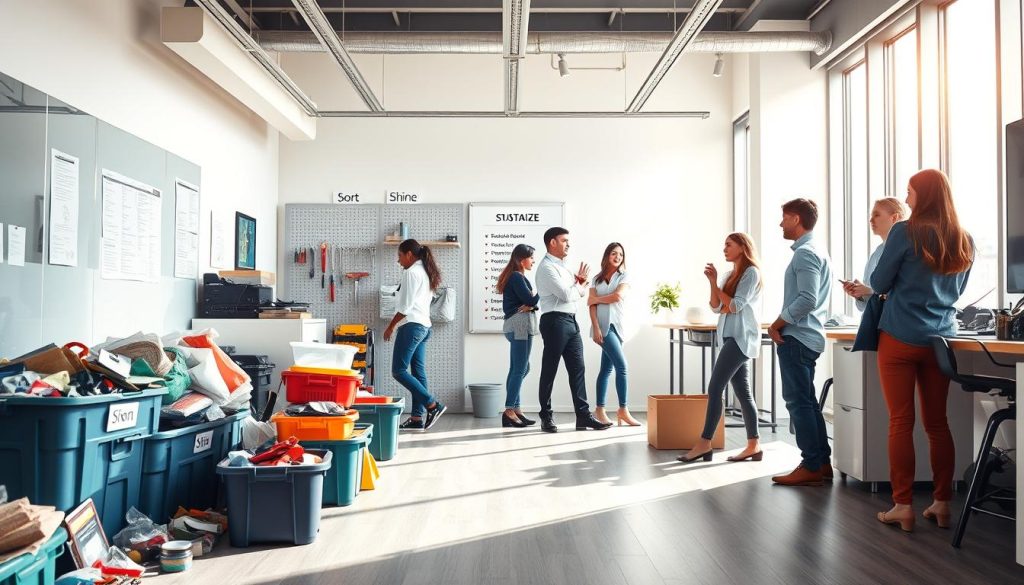
Manufacturing: Faster changeovers, fewer defects
In Manufacturing, the 5S Method reduces search time and unplanned downtime. It protects delicate components by removing risky tools and using anti-static storage. Textile lines benefit from streamlined layouts, reducing motion and setup time.
Beverage bottling plants maintain hygiene and efficiency through daily cleaning and checklists. Cosmetics operations standardize processes to ensure quality and reduce rework. Regular maintenance extends equipment life and shortens changeover times.
Healthcare and offices: Safer, more focused environments
In Healthcare, organized carts and color-coded bins reduce medication errors and speed up room turnover. Visual cues and point-of-use placement enhance sterile flow and reduce delays.
In Offices, decluttering and organizing digital folders improve focus and reduce distractions. Standardized templates and brief work instructions streamline document retrieval and prevent duplicates.
Cross-industry snapshots: Retail, warehouses, and construction
Retail sites use 5S to streamline checkout, reducing wait times and improving accuracy. Clear lane markings and scanner placement help manage peak traffic.
In Warehouses, standardized packing and verified labeling reduce shipping errors. Construction crews maintain safety and efficiency through daily checks and organized materials.
- Retail: consistent POS layouts; fewer voids and faster tendering
- Warehouses: pack audits and photo standards; lower mis-ship rates
- Construction: daily shine and hazard tags; safer access and fewer delays
These examples show how 5S practices lead to consistent improvements when integrated into daily routines and regularly audited.
Implementation Roadmap: Practical Steps for U.S. Operations
U.S. facilities can adopt a structured Implementation roadmap, adhering to PDCA and Lean manufacturing principles. This method establishes clear KPIs, maintains a rigorous cadence, and displays Audit scores to enhance Workplace organization on every shift.
Weekly cadence: photo, sort, organize, clean, audit, photo
Begin each week with a “before” photo of the target area. Sort items based on usage frequency and importance. Tag items for decisions on sell, donate, recycle, or disposal.
Organize by grouping tools, parts, and files with labels, color coding, and visual lines. Clean surfaces and equipment to remove dirt and contamination. This links cleaning with inspection to identify defects early.
Conduct a brief audit to review unresolved items and record actions. Capture an “after” photo to document gains and feed PDCA. Schedule iterative straighten reviews at one and two weeks to capture further improvements.
Roles: Trainers, supervisors, and team ownership
Assign trainers to demonstrate each task and apply supervise-to-solo coaching until proficiency is proven. Designate documentation ownership to maintain standards, photos, and checklists by role, shift, and frequency.
Supervisors or plant managers conduct monthly and quarterly audits to verify Workplace organization and equipment status. EPA national guidance supports this structured cadence and the use of visual controls for safety and sustainability in U.S. operations.
Metrics: Lead time, defect rate, and audit scores
Track KPIs tied to cycle time, lead time, and defect rate. Use Audit scores from weekly walk-throughs, plus monthly and quarterly reviews, to quantify adherence and highlight gaps.
Link results to PDCA: plan actions from findings, execute countermeasures, check trends, and adjust standards. When KPIs improve, standardize the method; when they stall, refine the Implementation roadmap and training plan.
- Operational KPIs: lead time reduction, queue time, first-pass yield
- Quality KPIs: defect rate, rework hours, out-of-box failures
- Discipline KPIs: 5S Audit scores, checklist completion, photo log currency
This structured flow embeds Lean manufacturing behaviors while sustaining Workplace organization through measurable performance and visible accountability.
Conclusion
The 5S Methodology offers a clear path from chaos to control. It establishes order, cleanliness, and visual management as daily habits, not one-time tasks. This approach enables teams to foster Kaizen, ensure safer tasks, and maintain reliable quality checks in both modern plants and offices.
Studies from various sectors, including factories, clinics, and construction sites, reveal consistent improvements. Organizations experience shorter lead times, fewer defects, enhanced hygiene, and better ergonomics. These advancements come from using checklists, labels, and audits to guide workplace organization. Weekly walk-throughs and periodic scorecards, linked to PDCA cycles and digital tools, keep standards visible and results consistent.
U.S. agencies, such as the Environmental Protection Agency, endorse 5S for its role in boosting efficiency, safety, and environmental performance. This endorsement mirrors the experiences of operators on the ground. They observe how visual management accelerates decision-making, standard work minimizes risk, and clean, organized areas increase uptime. With ongoing coaching and clear metrics, 5S can be scaled from pilot cells to widespread practices across an enterprise.
The approach is straightforward and disciplined. Begin with small steps, address what is immediately visible, and document successes. As routines evolve, Kaizen becomes a part of everyday work. This transforms workplace organization into a robust system for Lean manufacturing and service delivery.
FAQ
What is the 5S Methodology and why is it foundational to Lean manufacturing?
5S is a five-step system for workplace organization. It enables consistent quality, faster flow, and safer operations. The steps—Sort, Set in order (Straighten), Shine, Standardize, Sustain—originated in the Toyota Production System in the 1950s to eliminate muda (waste). By removing clutter, arranging tools for minimal motion, cleaning to inspect, codifying best practices, and maintaining discipline through audits, 5S builds the habits that power Kaizen and advanced Lean tools across factories, hospitals, offices, and warehouses. U.S. EPA resources recognize 5S as a core Lean practice that supports safety and environmental performance through visual management.
How do the Japanese and English 5S terms align, and what do they mean in practice?
The Japanese sequence—Seiri, Seiton, Seisou, Seiketsu, Shitsuke—maps to Sort, Set in order, Shine, Standardize, and Sustain. In practice: Sort removes nonessential items using red tags and a holding area. Set in order assigns ergonomic “homes” with labels, color coding, shadow boards, and floor markings. Shine cleans and inspects to find leaks, wear, and hazards. Standardize captures best methods with brief checklists and visual standards by role and frequency. Sustain embeds routines with KPIs, audits, PDCA, and coaching to preserve gains and drive continuous improvement.
What measurable business benefits does 5S deliver across industries?
Organizations report reduced lead times, fewer defects, and higher uptime in manufacturing; improved patient safety in healthcare; and fewer distractions with faster retrieval in offices. Standardized packing lowers warehouse shipping errors, while retail checkout standards reduce wait times and increase accuracy. Construction teams see safer sites through routine hazard checks. These outcomes stem from less motion, fewer searches, better visual management, and consistent adherence to standard work.
How does the Sort step work, and what decisions do red tags support?
Sort separates what is needed from what is not. Red tags capture item, reason, reviewer, and date, then move questionable items to a holding area organized by review month. Decision paths include: keep in area, move to another area, hold for review, or remove via recycle, donation, sale, or disposal. Electronics manufacturers reduce component damage and misplacement through precise sorting; offices gain focus by removing excess paperwork and outdated supplies.
What tools enable Set in order, and how do they improve ergonomics and speed?
Set in order uses shadow boards, peg boards, hooks, bins, labels, color coding, and floor markings to create clear homes and pathways. Frequently used items are placed within easy reach to cut motion and fatigue. Textile lines access trims faster, restaurant kitchens speed service with systematic layouts, and digital teams organize folders and naming conventions for quick file retrieval. The result is less search time, safer flow, and clearer communication.
Why is Shine tied to maintenance, and what does “clean to understand” mean?
Shine couples cleaning with inspection to detect early signs of failure such as leaks, cracks, and contamination, linking directly to Total Productive Maintenance. “Clean to understand” means using checklists, proper supplies, and scheduled routines to reveal sources of dirt or defects and address root causes. Beverage bottling lines maintain hygienic conditions and throughput by preventing residue and breakage, while shared workspaces improve health and morale with consistent cleaning standards.
How should teams Standardize without creating paperwork overhead?
Capture essentials with concise, version-controlled checklists organized by role, shift, and frequency. Use photos, infographics, and short videos for clarity. Assign ownership for updates, review periodically, and remove redundant steps. Warehouses benefit from standardized pack sequences to prevent errors, and retail operations use standardized checkout to stabilize service time and accuracy. Simplicity and visual guidance sustain compliance.
What sustains 5S over time and prevents backsliding?
Sustain relies on embedded routines, coaching, and verification. Schedule tasks by role and cadence, train with demonstrate-and-do methods, and use supervise-to-solo transitions to build habits. Track KPIs such as defect rates, cycle time, and audit scores. Apply PDCA and 5 Whys to correct gaps, and maintain 5S boards and digital tools for visibility. Monthly and quarterly audits by supervisors reinforce standards; construction and office teams use them to uphold safety and organization.
Which visual management tools accelerate adoption and safety?
Red tags streamline Sort decisions. Shadow boards and labeled storage support Set in order and Sustain through tool accountability. Floor markings define work zones, equipment footprints, and pedestrian paths. Color coding categorizes items, risks, or processes. 5S boards display standards, training, and progress. Digital apps and industrial printers help create consistent labels, run audits, and send reminders, reinforcing workplace organization and compliance.
What is a practical weekly 5S routine for U.S. operations?
Follow a simple cadence: take a “before” photo; Sort by essentiality and usage; Set in order with grouping, labels, and color coding; Shine to clean and inspect; Audit with a checklist to assign actions such as recycle, donate, sell, or dispose; then take an “after” photo to document results. Supervisors conduct monthly and quarterly audits to track standards, equipment status, and audit scores, maintaining momentum and continuous improvement.