

Efficient Kanban System in Manufacturing & Services
The Kanban System, rooted in the Toyota Production System by Taiichi Ohno, is a demand-driven method. It uses visual signals to authorize work only when necessary. This enhances manufacturing efficiency and minimizes waste. In the United States, it enables disciplined, real-time control over materials, tasks, and capacity.
Kanban employs cards, boards, bins, or digital signals to guide production workflow optimization. It moves from To Do to In Progress to Done. Clear policies and visual control reduce delays and prevent overburden, unevenness, and non-value-added work. This leads to shorter lead times, lower carrying costs, higher throughput, and more predictable schedules.
When combined with lean methodology, Kanban aligns output with actual demand, stabilizing quality. It limits work-in-progress, right-sizes inventory, and enhances communication across plants, suppliers, and service teams. This article explores practical use cases, including P-Kanban and T-Kanban, supplier and emergency triggers, and e-kanban links to ERP for U.S. manufacturers and service providers.
Leaders will discover a structured path to adoption, from change management to supplier integration. The focus is on measurable gains—cycle time, lead time, and first-pass yield. These are supported by disciplined execution across United States operations.
What Is Kanban and Why It Matters for Lean Operations
Kanban aligns work with actual demand, revealing delays early. It supports just-in-time production and reduces excess inventory with clear visual rules. In practice, the Kanban System in Manufacturing and Services enhances reliability and lowers costs. It keeps teams focused on flow.
Origin at Toyota and Taiichi Ohno’s contribution
Kanban emerged within the Toyota Production System under Taiichi Ohno. Inspired by supermarket shelf refills, Ohno created signal cards to pace work to consumption. This method synchronized steps, reduced idle time, and laid the groundwork for lean manufacturing techniques beyond automotive.
Kanban as a visual signal and pull system
The term “Kanban” means “signboard.” It uses cards, bins, or digital tickets as visible triggers. A card authorizes work only when an item is used, forming a pull system. This limits buildup, supports just-in-time production, and enhances cross-team coordination in the Kanban System in Manufacturing and Services.
Core goals: reduce waste, smooth flow, elevate quality
The approach aims to remove waste, level the workload, and prevent overburden. Work-in-progress limits curb multitasking and shorten cycle time. Visual queues reveal bottlenecks fast, improving first-pass quality and reinforcing lean manufacturing techniques within the Toyota Production System framework developed by Taiichi Ohno.
| Aspect | Operational Purpose | Measured Effect | Lean Link |
|---|---|---|---|
| Pull Signals | Authorize production after consumption | Lower inventory and fewer stockouts | just-in-time production |
| Visual Controls | Expose status and blockers in real time | Faster response and clearer priorities | Toyota Production System |
| WIP Limits | Constrain parallel work to match capacity | Shorter lead time and higher throughput | lean manufacturing techniques |
| Standard Policies | Define entry, exit, and quality criteria | Fewer defects and steadier flow | Principles from Taiichi Ohno |
| Feedback Loops | Review signals, adjust quantities, refine flow | Durable performance gains | Kanban System in Manufacturing and Services |
How a Kanban System Works on the Shop Floor and in Services
Effective flow begins with clear signals and strict limits. Teams use Kanban board visualization to align work with demand. This improves manufacturing process efficiency and optimizes service industry operations without adding complexity. The same principles guide both plants and service desks, enabling production workflow optimization across functions.
Kanban boards, cards, and stages like To Do, In Progress, Done
A board serves as the visual backbone. Columns like To Do, In Progress, and Done show the current state of each item. Cards represent parts, batches, or cases and move from left to right, creating a simple, auditable trail.
Swim lanes separate product families or service lines, aiding in prioritization. Color tags and due dates highlight urgency and dependencies, ensuring accurate Kanban board visualization.
Work-in-progress (WIP) limits to prevent bottlenecks
WIP caps per column match capacity and skills. This reduces queueing and rework, boosting manufacturing process efficiency and maintaining service delivery stability.
As stability grows, teams tighten limits. Tighter thresholds reveal hidden blockers, enabling step-by-step production workflow optimization.
Pull production driven by real customer demand
A customer order inserts a card at the queue. This signal moves upstream, authorizing only what is needed, when it is needed, in the right quantity.
Two-card systems separate production and movement for precise control. This pull logic scales from Toyota’s assembly cells to IBM’s digital service boards. It sustains service industry operations optimization while preserving throughput and quality.
Kanban System in Manufacturing and Services
The Kanban System in Manufacturing and Services aligns work with real demand and clear signals. It supports lean methodology implementation by limiting work-in-progress, visualizing tasks, and standardizing policies. Teams apply throughput analysis to expose delays and balance capacity with load.
Translating manufacturing practices into service industry operations optimization
Manufacturing practices translate well to services when tasks become visible work items. IT support, finance, healthcare, and contact centers map requests to cards and move them through defined steps. This drives service industry operations optimization by aligning staffing with arrival patterns and reducing hidden queues.
Visual signals authorize action, while WIP limits prevent overload. Standardized policies clarify entry criteria, handoff rules, and definition of done. The result is steadier flow under lean methodology implementation with fewer urgent escalations.
Common workflows: production lines vs. service queues
Production lines and service queues share staged progression. In plants, withdrawal signals trigger movement to the next cell; in services, a handoff cues the next role to start, such as underwriting after intake. Production signals mirror task authorization, like case preparation in insurance or patient triage in hospitals.
Both models rely on clear pull rules. When demand rises, teams throttle intake, adjust capacity, and apply throughput analysis to protect cycle time.
Shared KPIs: cycle time, lead time, throughput, first-pass yield
Cycle time measures active work; lead time spans request to delivery. Throughput counts items finished per period, and first-pass yield tracks quality at release. Under the Kanban System in Manufacturing and Services, limiting WIP stabilizes these KPIs and reveals bottlenecks early.
Evidence from companies like Toyota, Intel, and Kaiser Permanente shows faster turnaround and improved visibility. In services, this appears as higher SLA attainment and fewer rework loops under lean methodology implementation.
| KPI | Manufacturing Example | Service Example | Kanban Lever | Analytic Focus |
|---|---|---|---|---|
| Cycle Time | Machining a part on a CNC cell | Resolving a Level 2 IT ticket | WIP limits by cell or team | Queue length vs. service rate |
| Lead Time | Release to finished goods shipment | Customer request to case closure | Pull scheduling and cadence | Arrival variability and wait time |
| Throughput | Units completed per shift | Claims processed per day | Batch size and takt alignment | Throughput analysis by stage |
| First-Pass Yield | Assembly passing QA without rework | Loan file approved without defects | Quality-at-the-source checks | Error rate and rework fraction |
Lean Manufacturing Techniques Powered by Kanban
Kanban aligns daily operations with demand signals, keeping work visible. It supports lean manufacturing techniques, increasing throughput and stabilizing costs. This results in tighter flow control and disciplined decision-making.
Just-in-time production and inventory right-sizing
Kanban enables just-in-time production by replenishing only after consumption. Card quantities reflect average daily demand, end-to-end lead time, and a small buffer for variability. As reliability grows, teams reduce card counts to right-size stock while maintaining service levels.
Toyota, Bosch, and Caterpillar plants apply this method to reduce safety stock and free capital. Service desks stage parts or documents only when a request is in the queue.
Visual control and standardized work policies
Boards, bins, and clear signals provide visual control, reducing ambiguity. Standardized work defines entry and exit criteria for each step, including quality gates and priority rules. These policies ensure consistent flow across shifts.
Auditable policies enable rapid problem detection. If a card stalls beyond its takt-based limit, the team can investigate and correct the constraint before it spreads.
Integration with 5S, TPM, SMED, and value stream mapping
5S organizes tools and materials, keeping signals visible and errors apparent. Total Productive Maintenance improves OEE by reducing unplanned downtime that can disrupt Kanban loops. SMED reduces changeover time, enabling smaller batches that track demand more closely.
Value stream mapping exposes waste and identifies the best locations for Kanban signals. It clarifies lead time drivers, making it easier to set WIP limits, tune buffers, and align upstream and downstream cadence.
Key Kanban Signals and Card Types for Material Flow
Clear signals are essential for maintaining stable material flow across the supply chain. In a well-organized inventory management system, cards guide production, movement, and when to replenish from suppliers. Each card’s color, quantity, and priority ensure actions align with consumption needs.
Production Cards Authorize Fixed Quantities
P-Kanban ensures production only after downstream use confirms the need. This method prevents overproduction by linking production to actual demand. Companies like Toyota, Ford, and Bosch use it to maintain takt time and reduce changeover times.
As containers empty, the system reviews P-Kanban quantities and pitch. Tightening quantities when waste is low helps reduce cycle stock while maintaining service levels.
Withdrawal and Transport Cards Trigger Movement
T-Kanban controls the timing and location of container movement. In two-card systems, P-Kanban initiates production, while T-Kanban manages movement. This approach enhances material flow control, even on busy production lines.
Visual cues like lane color, icons, and barcodes streamline scanning and prevent early pulls. This minimizes travel, shrinkage, and dwell times between steps.
External Replenishment and Exception Signals
Supplier replenishment cards guide external orders, ensuring vendors like DENSO or Magna receive clear instructions. These cards include lead-time windows and minimums, supporting stable delivery cycles and fewer expedites.
Emergency signals handle quality issues, equipment downtime, or sudden demand increases. They ensure standard P-Kanban and T-Kanban processes remain intact and traceable.
| Signal Type | Primary Purpose | Typical Trigger | Key Data on Card | Operational Effect |
|---|---|---|---|---|
| P-Kanban | Authorize production | Downstream consumption returns card | Part number, fixed lot size, takt/interval | Prevents overproduction; aligns make rate to demand |
| T-Kanban | Authorize movement | Empty container available at next process | Source/target locations, container count, route | Reduces dwell and ensures right-time transfers |
| Supplier Kanban | Trigger supplier replenishment | Bin or rack hits reorder point | Vendor code, pack size, lead time, safety factor | Stabilizes inbound flow and lowers stockouts |
| Emergency Signal | Manage exceptions | Quality issue, disruption, or spike | Reason code, temporary quantity, approval path | Protects standards while resolving risks fast |
Designing a High-Visibility Kanban Board
High visibility is key to optimizing production workflows by clearly showing work status, risk, and ownership. An effective Kanban board combines a simple structure with reliable metrics. This allows teams to act swiftly and avoid delays.
Boards, lists (stages), cards, and service swim lanes
Organize the board with lists that reflect the actual process steps for manufacturing or service delivery. Include service swim lanes to distinguish between product families, customer tiers, or incident types. Each card should list the owner, due date, class of service, and acceptance criteria. This supports standardized work policies and ensures clear handoffs.
Use Kanban board visualization to highlight queue health. Visual aging tags alert when work approaches service-level thresholds, prompting action before deadlines are missed.
Setting WIP limits by capacity and skill constraints
Establish WIP limits based on available labor, skill coverage, and equipment uptime. Adjust limits based on observed bottlenecks and reliability, reviewing them weekly. This method prevents overloading and reduces context switching, optimizing production workflows.
When a station reaches its limit, upstream teams halt new starts and assist in clearing the blockage. Link limits to takt expectations from demand data to maintain flow across shifts.
Color-coding, priority lanes, and quality control columns
Use color-coding to indicate priority, risk, and blocked status. Reserve an expedite lane for urgent tasks with clear entry criteria. Implement quality control columns for inspection, rework triage, and first-pass yield checks. This makes defects visible and contained.
Establish governance: define pull criteria, handoff checks, and defect handling rules as standardized work policies. Conduct daily audits to ensure card data is up-to-date and ready for decisions.
Inventory Management System Alignment with Kanban
Kanban’s effectiveness increases when it’s linked to inventory management systems that respond to shop-floor signals. This connection, facilitated by e-kanban and ERP integration, ensures that demand data flows seamlessly across procurement, production, and logistics. Companies like Toyota, Ford Motor Company, and Bombardier Aerospace have adopted this approach. They automate moves and purchase orders, significantly reducing manual steps and cycle variance.
Digital boards provide real-time stock visibility, alerting teams as containers empty and orders are released. This immediate feedback helps set accurate reorder points and safety stock levels. The outcome is a more consistent material flow and tighter control over costs of goods sold (COGS). Teams can maintain just-in-time production, avoiding stockouts and excess inventory.
Process reliability improves as both suppliers and buyers see the same status. Limits at supply points are set, monitored, and adjusted as stability increases. Any breaches highlight bottlenecks, prompting managers to address cycle-time drift and lead-time swings before they impact service levels.
Commercial platforms consolidate live counts, consumption rates, and exception alerts. Integrated APIs ensure that e-kanban transactions are pushed to the ERP, closing the loop from demand to replenishment. This integrated system offers real-time stock visibility, reorder notifications, and auditable traceability. It supports just-in-time production without the delay caused by administrative tasks.
Continuous Improvement Strategies and Feedback Loops
Effective Kanban operations rely heavily on disciplined feedback. Teams employ continuous improvement strategies to enhance flow, reduce costs, and boost service reliability. Short review cycles help keep risks in check and ensure decisions are data-driven.
Kaizen culture: small, incremental changes
A kaizen culture advocates for frequent, small adjustments over drastic changes. Toyota and other manufacturers demonstrate how daily tweaks can lead to significant improvements. This approach places ownership close to the work, allowing operators, planners, and engineers to propose and test changes swiftly.
Leaders maintain a consistent rhythm: brief standups, rapid experiments, and clear standard work. Results are documented, compared, and scaled when proven stable. This method reduces resistance and ensures continuous uptime.
Using metrics to locate and eliminate muda, muri, mura
Decisions are based on lead time and cycle time metrics, along with WIP, first-pass yield, and throughput analysis. These metrics help identify waste, overburden, and unevenness that increase costs and delay orders. Predictable flow enhances customer commitments and improves capacity planning.
Analysts monitor week-over-week data to pinpoint bottlenecks. When variation increases, teams reassess policies, staffing, or setup methods to restore stability. Visual boards aid in early detection of defects before they spread.
Retrospectives and lowering Kanban quantities over time
Regular retrospectives evaluate policy effectiveness, WIP limits, and quality outcomes. Findings guide targeted trials to adjust lanes, card policies, or buffer sizes. Each change is time-boxed and verified against baseline data.
As reliability and OEE improve through TPM and SMED, leaders gradually reduce Kanban quantities. This frees up space and working capital. The reduction is paced by service-level targets and confirmed with throughput analysis and lead time and cycle time metrics to protect delivery performance.
Implementation Roadmap and Common Challenges
Effective lean methodology implementation starts with evidence-based mapping. Teams document current workflows end to end. They then define visual stages and standardized work policies that govern entry and exit. Initial Kanban quantities align with actual demand, lead time, and a modest safety stock to stabilize early cycles.
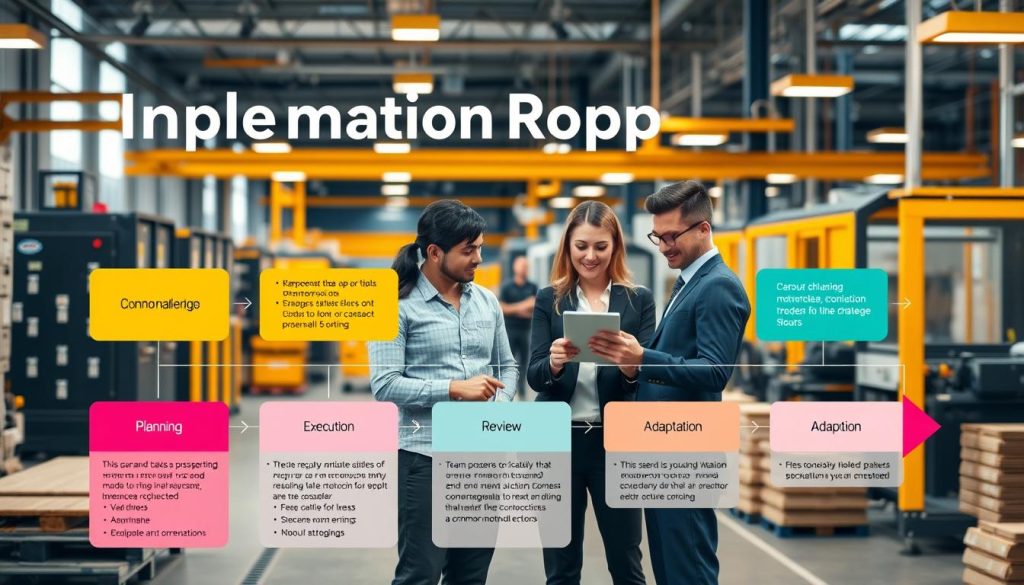
Start with Current Processes; Map Workflow and Define Policies
Map the value stream from order to shipment. Identify queues, setup time, and handoffs. Set clear card rules, replenishment signals, and audited checklists. Use a pilot area to test pull signals and validate sizing before wider rollout.
Calculate card counts using average daily demand, replenishment lead time, and variability buffers. Update counts as lead time shrinks. Tie each rule to measurable triggers to support change management and demand variability management without guesswork.
Training and Company-Wide Buy-In for Cross-Department Flow
Structured training covers WIP discipline, card handling, defect routing, and board maintenance. Supervisors coach on visual control and escalation paths. Procurement, operations, and finance align on takt, lot sizes, and service levels.
Leaders reinforce standardized work policies with routine audits and performance huddles. Transparent metrics on throughput, lead time, and first-pass yield build credibility. This approach reduces resistance and keeps change management on schedule.
Managing Demand Fluctuations, Reliability, and Supplier Integration
Pair Kanban with SMED to cut setup time and create flexible capacity. Use small capacity buffers and heijunka-style leveling to strengthen demand variability management. Reliability depends on TPM routines that lift equipment uptime and stabilize processes.
Deploy e-kanban with supplier integration to speed confirmations and reduce shortages. Clear replenishment windows and ASN synchronization improve response time for partners such as Toyota, Honda, and Bosch. Shared KPIs and orderly cadence reviews keep lean methodology implementation on track.
Conclusion
Kanban emerged within the Toyota Production System under Taiichi Ohno, showing its lasting impact across various industries. It serves as a visual, pull-based system that aligns work with actual demand. This approach reduces excess inventory and uncovers bottlenecks.
When applied in manufacturing and services, Kanban enhances process efficiency. It shortens lead times, boosts first-pass yield, and increases delivery reliability. On the shop floor and in offices, Kanban boards, cards, and clear policies foster transparency and rhythm.
Teams combine these practices with 5S, Total Productive Maintenance, Single-Minute Exchange of Dies, and value stream mapping. This combination stabilizes flow, supports just-in-time production, and ensures quality checkpoints are visible and auditable.
Electronic Kanban, linked to ERP and inventory management systems, sends signals to suppliers and automates restocking. As stability grows, companies can decrease Kanban quantities and inventory limits. This frees up working capital without compromising service levels.
For U.S. operations leaders, Kanban offers a practical route to continuous improvement. It aligns production and service with customer needs, fosters measurable progress, and cultivates a data-driven culture. By adopting, measuring, and refining, then repeating, you can sustain just-in-time production and stay competitive in the long run.
FAQ
What is Kanban and how does it support lean manufacturing techniques?
Kanban is a visual workflow method from the Toyota Production System. It uses boards, cards, and policies to manage production. This method aligns output with demand, reducing lead time and costs.
It improves throughput and quality, essential for lean manufacturing and service optimization.
How does a Kanban board visualization work in manufacturing and services?
A Kanban board shows stages like To Do, In Progress, and Done. Cards represent work items. Swim lanes separate different products or services.
Visual signals and WIP limits reveal bottlenecks and enforce flow. This structure optimizes production and service workflows.
What are P-Kanban and T-Kanban, and when should each be used?
P-Kanban authorizes making a fixed quantity when downstream use returns the card. T-Kanban allows moving containers between processes. The two-card system prevents overproduction and shortages.
Supplier Kanban extends signals to vendors. Emergency cards handle disruptions without breaking standard pull discipline.
How do WIP limits improve manufacturing process efficiency and service delivery?
WIP limits match load to available capacity and skills. This reduces queueing and errors, stabilizing cycle time and first-pass yield.
As reliability improves, teams tighten limits to expose hidden delays. This boosts throughput and service levels while lowering costs.
How does Kanban enable just-in-time production and inventory right-sizing?
Kanban triggers replenishment only on actual consumption. Card quantities are set using daily demand, lead time, and safety buffers.
As TPM improves OEE and SMED compresses changeovers, organizations lower Kanban quantities. This cuts carrying costs while maintaining service levels.
What KPIs should be tracked to evaluate Kanban performance across sectors?
Core metrics include cycle time, lead time, throughput, WIP, and first-pass yield. Additional indicators like OEE and SLA attainment quantify flow stability and cost efficiency.
Continuous improvement strategies use these measures to guide targeted actions. This confirms sustained gains.
How does electronic Kanban integrate with an ERP inventory management system?
E-kanban ties demand signals to ERP, automating orders and stock updates in real time. Manufacturers like Toyota and Ford Motor Company use e-kanban for synchronization.
This integration sharpens reorder points and reduces latency. It supports just-in-time production and inventory management system accuracy.
What governance and policies keep a Kanban system reliable at scale?
Effective governance defines pull rules, handoff criteria, and quality gates. Boards are audited to prevent stale work items.
Visual controls enforce consistent sequencing and inspection. Regular retrospectives review policy fit and WIP settings to preserve flow.
How can service industry operations optimization apply manufacturing Kanban practices?
Services map intangible work into visible items with standardized stages and WIP limits. Withdrawal signals become handoffs; production signals authorize task execution.
Digital boards improve coordination and remote work. Results include shorter queues, higher SLA performance, and fewer escalations.
What are the first steps to implement Kanban with lean methodology implementation?
Start by mapping the value stream end to end. Define stages, entry/exit criteria, and initial WIP limits based on capacity.
Calculate card counts using demand and lead time. Pilot in a contained area, train teams, then scale. Integrate 5S, TPM, SMED, and value stream mapping to strengthen flow.
How should organizations manage demand variability and supplier reliability in Kanban?
Combine Kanban with SMED to run smaller batches and adjust quickly. Maintain capacity buffers where volatility is high.
Use supplier Kanban and e-kanban links for real-time visibility. Clear replenishment signals and agreed container sizes are essential. Emergency cards address exceptions without undermining standard policies.