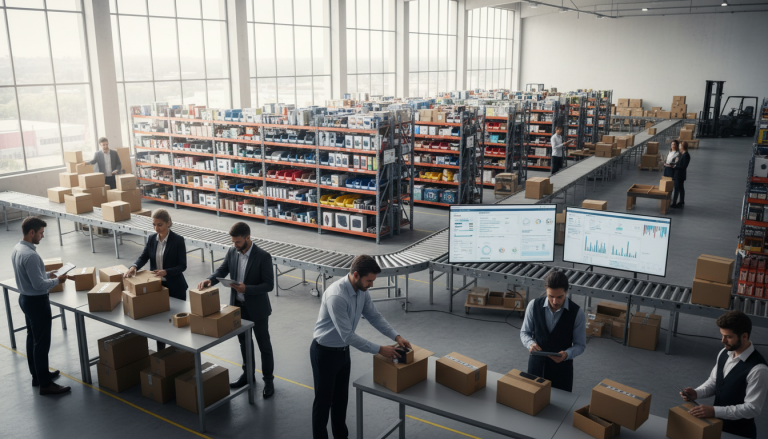
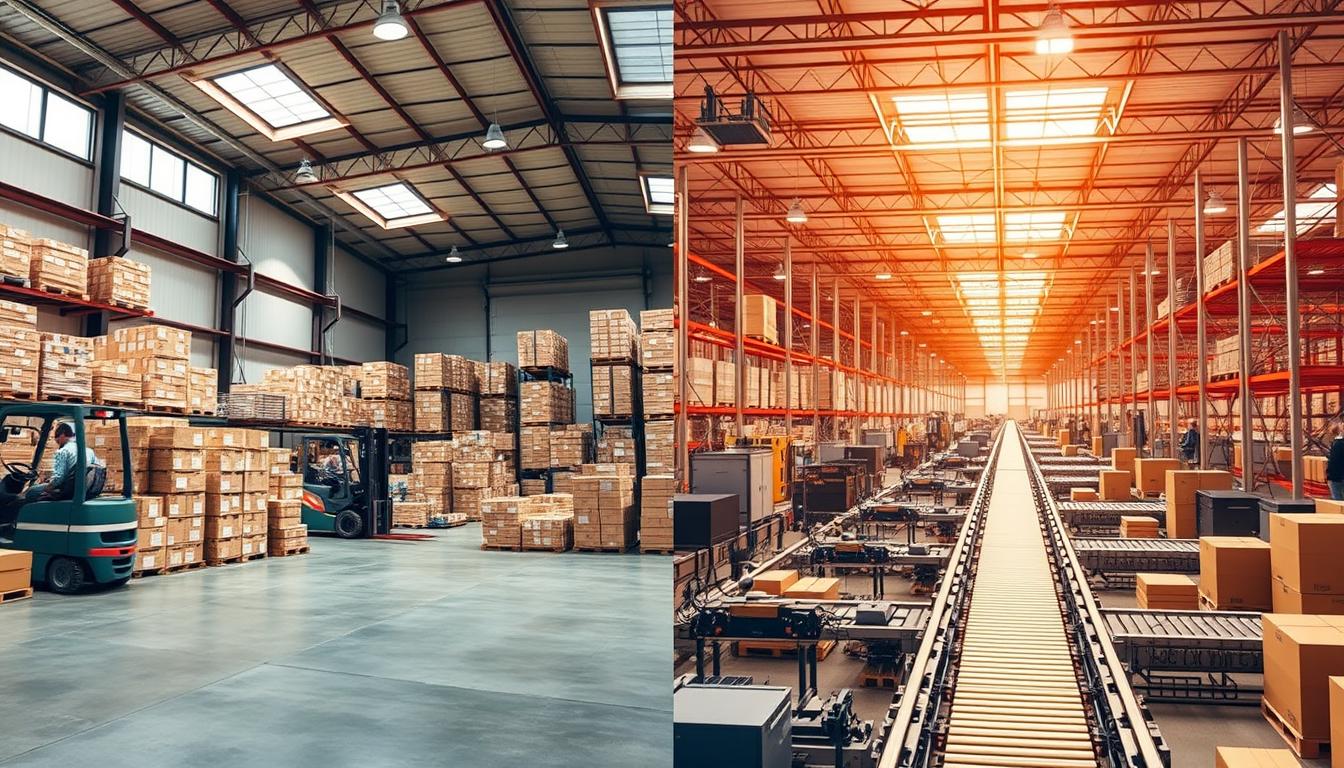
Warehouse vs Distribution Center: Key Differences
In the United States supply chain, executives face a critical decision: Warehouse vs Distribution Center. This choice impacts cost, speed, and visibility. A warehouse focuses on storage and inventory control for extended periods. On the other hand, a distribution center emphasizes quick processing, packing, and shipping to customers. Grasping these differences is key to better capital allocation, service levels, and risk management.
The distinctions between Warehouse and Distribution Center highlight the importance of flow velocity and customer focus. Warehouses act as buffers, stabilizing supply and demand and supporting bulk purchases. In contrast, distribution centers are dynamic hubs, often working with 3PL partners for daily carrier pickups and rapid delivery.
Modern strategies for Warehouses and Distribution Centers rely on real-time WMS data, predictive analytics, and network optimization. Amazon and leading third-party logistics providers have shown the benefits of robotics, computer vision, and AI-powered scanning. These technologies reduce errors and speed up throughput. Market Research Future forecasts the Global Warehousing and Distribution Logistics Market to hit USD 30.78 billion by 2034, with a CAGR of 8.20%. This indicates ongoing investment in automation and software.
The pandemic revealed the importance of resilient Warehouse vs Distribution Center logistics. Companies that matched storage with fulfillment speed protected their margins and maintained service levels. The following sections will outline each facility, compare their operations, and explain how integrated design enhances performance in the United States supply chain.
What Is a Warehouse? Definition, Purpose, and Typical Use Cases
A warehouse is a commercial facility designed for storing and managing goods. It supports procurement and production, ensuring secure and compliant conditions. In the context of United States warehousing, it plays a key role in inventory management, focusing on cost control and stability.
Enterprises use warehouses to pool stock, reducing transport frequency and purchase price variance. While some sites now support basic fulfillment due to e-commerce, the core remains safe, efficient storage with accurate records. These roles underpin Warehouse vs Distribution Center similarities even as operational tempo differs.
Core function: long-term and short-term storage of goods
Warehouses hold safety, cycle, and seasonal stock to meet planned demand and unplanned shocks. Inventory may dwell for days or months, depending on forecast strategy and replenishment cadence. This position clarifies Warehouse vs Distribution Center functions by highlighting storage, care, and controlled handling over rapid order turns.
How warehouses stabilize supply and demand as buffer stock
By carrying buffer stock, warehouses smooth upstream production and downstream sales. They support bulk procurement during favorable pricing, then release goods in line with demand. This buffer reduces expedite costs and protects service levels during port delays, strikes, or storms common in United States warehousing.
Common warehouse types: cross-dock, seasonal, refrigerated
- Cross-dock sites move receipts to outbound doors with minimal dwell, cutting handling and linehaul time.
- Seasonal facilities store time-bound goods, such as apparel for peak quarters or lawn care products for spring.
- Refrigerated and freezer warehouses preserve perishables at controlled temperatures for food, pharma, and biotech.
Where warehouses fit in traditional supply chains
In classic networks, warehouses sit between factories and wholesalers or retailers. They often serve as the second-to-last stop before store allocation or as pre-stage storage for manufacturing. This placement shows Warehouse vs Distribution Center similarities in receiving and shipping, yet the warehouse retains longer dwell by design.
Technology basics: WMS, docking areas, location near transport hubs
Modern sites deploy a warehouse management system for location control, put-away, replenishment, and cycle counting. Extensive docking areas support inbound and outbound throughput. Strategic siting near interstate highways, Class I rail ramps, airports, and seaports lowers transit time and cost across United States warehousing.
| Aspect | Warehouse Role | Operational Implication | Relevance to Warehouse vs Distribution Center functions |
|---|---|---|---|
| Primary Objective | Secure, efficient storage with accurate inventory | Longer dwell, emphasis on care and compliance | Highlights storage focus versus rapid fulfillment |
| Inventory Profile | Safety, cycle, and seasonal stock | Buffers volatility and supports bulk buying | Explains buffer-stock capability and planning |
| Processing Speed | Measured handling, scheduled dispatch | Lower velocity, predictable workflows | Contrasts with high-velocity DC operations |
| Technology | WMS, barcode/RFID, dock scheduling | Accurate counts, fewer errors, stable cadence | Shows Warehouse vs Distribution Center similarities in core systems |
| Location Strategy | Near highways, rail, airports, and ports | Reduced transport cost and lead time | Shared siting logic across the network |
| Use Cases | Raw materials staging, finished goods storage | Supports production and store replenishment | Informs Warehouse facility vs Distribution Center network decisions |
Professionals compare Warehouse facility vs Distribution Center options by weighing dwell time, handling scope, and service goals. A warehouse’s structure, from dock layout to WMS rules, is built for stability and cost efficiency. These attributes form the baseline for network design in United States warehousing.
What Is a Distribution Center? Definition and Modern Role in Fulfillment
A distribution center is built for speed, precision, and high volume. It handles incoming goods, quick order fulfillment, and shipping out to retailers, wholesalers, and consumers. Unlike traditional warehouses, a DC focuses on swift service and customer satisfaction across e-commerce and retail platforms.
At the heart of Distribution Center logistics, it offers real-time inventory and transportation control. In contrast to warehouses, DCs prioritize fast order processing, on-time delivery, and network visibility for brands like Amazon, Walmart, and Target.
Dynamic hub for fast processing, picking, packing, and shipping
DCs streamline the process from receiving to dispatch. Teams use wave or waveless picking, cartonization, and pack-out to meet carrier deadlines. This model emphasizes throughput, slotting efficiency, and dock-to-stock speed, unlike traditional warehouses.
Coordination with 3PLs for daily pickups and faster delivery
Many DCs are run by third-party logistics providers like DHL Supply Chain, XPO, and GXO. They work with merchant platforms and schedule daily pickups with UPS, FedEx, and USPS. This collaboration enables same-day tendering and next-day delivery, essential in competitive markets.
Types of distribution centers: conventional, mechanized, automated
- Conventional: labor-driven with forklifts and mobile scanners; flexible but lower throughput.
- Mechanized: conveyors and sortation systems increase flow and reduce touches.
- Automated: robotics, AMRs, and goods-to-person systems accelerate picking and accuracy.
The choice of model depends on SKU velocity, order profiles, and the broader Warehouse vs DC strategy.
Value-added services: kitting, packaging, light assembly
DCs perform kitting, labeling, postponement, and light assembly to meet demand. These steps reduce total landed cost by delaying customization until the last mile. They also support retail compliance, reducing chargebacks and improving shelf readiness.
WMS-driven, real-time visibility for speed and accuracy
Modern DCs operate on WMS platforms with API and EDI connectivity for instant updates. Real-time data powers slotting, replenishment, and labor planning, lowering error rates and improving OTIF. In a Warehouse and Distribution Center comparison, the DC relies on analytics to prevent stockouts and maintain service levels across omnichannel networks.
These capabilities define Distribution Center logistics as a fast, integrated fulfillment engine. They highlight the practical differences between Warehouse vs Distribution Center operations and guide data-backed decisions for high-velocity commerce.
Warehouse vs Distribution Center
The differences between Warehouse and Distribution Center operations is key to optimizing supply chain performance. Each facility has a unique focus, flow velocity, and service scope. These distinctions influence capital planning, labor models, and delivery promises in the U.S. market.
Primary focus: storage and inventory management vs rapid order fulfillment
Warehouses focus on secure storage, cycle counting, and maintaining availability. They ensure inventory accuracy and manage buffer stock. In contrast, Distribution Centers prioritize rapid order fulfillment, handling receiving, picking, packing, and shipping within tight service windows.
This distinction is critical for brands like Amazon, Walmart, and Target, which use these facilities across their regional networks.
Flow velocity: longer dwell times vs quick turnover
Flow velocity is a key differentiator between Warehouses and Distribution Centers. Warehouses hold goods for weeks or months to stabilize demand. On the other hand, Distribution Centers aim for quick turns, measured in hours or days, to meet omnichannel cutoffs.
This difference impacts dock scheduling, slotting, and replenishment cadence in each facility.
Operational complexity: fewer functions vs multi-function logistics hub
Warehouses manage put-away, storage, and replenishment with simpler workflows. In contrast, Distribution Centers operate as multi-function hubs, incorporating cross-docking, product mixing, kitting, and transportation management.
This scope reflects the logistics choices made in each facility, including WMS rules, yard management, and carrier coordination.
Customer orientation: supplier-focused vs customer-centric operations
Warehouses align with supplier and manufacturer needs, focusing on stable inventory pools. Distribution Centers, on the other hand, are customer-centric, designed to meet retail SLAs and e-commerce delivery promises.
This split affects cut-off times, order minimums, and packaging standards across different channels.
Use cases: raw materials and bulk storage vs finished goods for swift distribution
Warehouses are suitable for raw materials, large lots, and seasonal goods held for future production or sale. Distribution Centers, by contrast, optimize finished goods for swift allocation to stores and direct-to-consumer orders.
These patterns highlight the core differences in planning and functions between Warehouses and Distribution Centers, embedded in network design.
Key Differences Between Warehouse and Distribution Center Operations
In the United States, logistics operations vary based on activity scope and system design. A detailed comparison between warehouses and distribution centers reveals distinct workflows, technology levels, and service commitments. These differences impact cost, speed, and accuracy across networks.
Activities: storage vs cross-docking, product mixing, packaging
Warehouses and distribution centers differ significantly at the dock. Warehouses focus on storage, inventory control, and security, with goods dispatched periodically. They also manage temperature when necessary. In contrast, DCs prioritize cross-docking to avoid storage, mix products for multi-SKU orders, and package goods for carrier readiness.
Warehouses build buffer stock to stabilize supply, while DCs sequence goods for rapid dispatch. This distinction affects daily operations, staging space, and labor planning.
Order processing: limited vs end-to-end fulfillment and transportation management
Warehouses typically pick in batches and release goods on a scheduled basis. DCs, on the other hand, handle end-to-end fulfillment. They manage order capture, picking, packing, labeling, and transportation coordination with carriers like UPS, FedEx, and USPS for same-day or next-day service.
DCs often integrate WMS-TMS deeply, linking slotting, wave planning, and dock scheduling to outbound transportation. This integration defines the gap in cycle time and accuracy between warehouses and DCs.
Role in the supply chain: intermediary storage vs liaison between suppliers and consumers
Warehouses serve as intermediary storage nodes, supporting production runs and retail replenishment. DCs act as liaisons between suppliers and consumers, converting orders into shipments quickly and efficiently.
This comparison highlights the different value creation points. Warehouses stabilize supply, while DCs rapidly convert demand into deliveries within United States logistics operations.
Staffing and systems: manual workflows vs automation and robotics
Traditional warehouses rely on forklifts, RF scanners, and manual putaway. DCs, on the other hand, increasingly use automation and robotics. This includes goods-to-person systems, automated storage, sortation, and AI-enabled scanning, which enhance throughput and reduce errors.
Both types use modern WMS, but DCs integrate more closely with transportation networks and yard systems. This results in a distinct profile in labor mix, training needs, and capital utilization for Warehouse vs DC operations.
| Dimension | Warehouse | Distribution Center (DC) | Operational Implication in United States Logistics Operations |
|---|---|---|---|
| Primary Activity | Storage, inventory management, security, temperature control | Cross-docking, product mixing, packaging, rapid dispatch | Warehouses buffer supply; DCs accelerate flow to market |
| Order Processing Scope | Limited picking and scheduled releases | End-to-end fulfillment with carrier coordination | DCs support tight delivery windows and higher order lines |
| Supply Chain Role | Intermediary storage between production and retail | Liaison between suppliers and consumers | DCs convert demand signals into shipments quickly |
| Systems Integration | WMS with RF scanning and basic yard control | WMS plus TMS, advanced slotting, dock scheduling | Greater visibility and velocity in Warehouse vs Distribution Center operations |
| Labor and Equipment | Manual workflows, forklifts, pallet jacks | Automation, robotics, conveyor and sortation | DCs trade higher capex for throughput and accuracy |
| Typical Dwell Time | Days to months | Hours to days | Short dwell in DCs supports fast-moving demand |
| Outbound Profile | Full pallets, bulk replenishment | Mixed cases, each picks, parcel and LTL | DCs align with omnichannel and parcel growth |
| Network Commitment | Stability and capacity assurance | Speed and service-level adherence | Clear Warehouse and Distribution Center comparison for SLAs |
Reviewing these dimensions provides a clear understanding of where each facility type excels. It helps align assets with demand profiles in United States logistics operations.
Similarities That Matter: Shared Logistics Foundations
The core similarities between Warehouses and Distribution Centers are key to efficient operations. They both rely on shared logistics foundations. These foundations ensure stable throughput, compliant handling, and clear visibility for planning and execution.
Receiving, storing, managing, and shipping goods in both facilities
Inbound receiving, putaway, storage, cycle counting, and outbound shipping are fundamental. Both sites follow documented standard operating procedures. They schedule dock activities and manage carrier appointments to prevent congestion.
Cross-functional checks ensure quality, labeling, and pallet configuration. This maintains unit integrity and speeds up loading processes.
Dependence on accurate inventory management and WMS
Both rely on inventory accuracy supported by barcodes or RFID. Directed picking and replenishment rules are key in a WMS from providers like Manhattan Associates, Blue Yonder, or SAP. Real-time location control and lot and serial tracking keep variances low.
Exception alerts maintain stable service levels within Warehouse vs Distribution Center logistics. Continuous cycle counting, ABC programs, and audit trails protect data quality.
Strategic locations to optimize transportation and lead times
Facilities are strategically located near interstates, ports, rail ramps, and airports. Examples include the Port of Los Angeles, Chicago’s rail hub, and Atlanta’s Hartsfield-Jackson. This reduces linehaul miles and last-mile time.
This placement supports mode flexibility, fuller trailers, and faster parcel injection. It reinforces Warehouse vs Distribution Center logistics goals while honoring shared logistics foundations. This reduces total landed cost and variability.
These shared capabilities create a reliable baseline for inventory control, labor planning, and carrier performance. They highlight the practical Warehouse vs Distribution Center similarities that matter for service and cost.
How Warehousing and Distribution Work Together in a Unified Network
Modern logistics operators connect storage facilities with fast-turn hubs, forming a unified network. This strategy aligns inventory buffers with rapid dispatch, creating a seamless flow from stock arrival to final delivery. It enables a precise comparison between warehouses and distribution centers, based on measurable performance.
Upstream warehouses manage cycle, safety, and seasonal stock. Downstream DCs handle quick picks, pack-outs, and carrier tenders. This setup clarifies the roles of warehouses and DCs, allowing for shared KPIs across planning, transport, and service levels.
Seamless flow from storage to order fulfillment and delivery
Inventory moves from storage to pick lines with WMS-directed tasks and ASN timestamps. DCs stage orders by carrier cutoffs, while warehouses replenish in sync with demand signals. This structure enhances logistics by reducing dwell time between put-away and ship confirmation.
Cost reduction through consolidation, cross-docking, and full truckloads
Warehouses consolidate SKUs to build full truckloads for efficient line-hauls. DCs apply cross-docking to bypass storage, lowering handling and cycle time. The combined model advances a practical comparison, improving cube utilization and line-haul yield.
Boosting customer satisfaction with product availability and on-time delivery
Strategic DC placement near demand centers cuts transit time and final-mile expense. Accurate WMS data across nodes sustains high availability and on-time delivery targets such as OTIF used by Walmart and Target. The framework reinforces Warehouse vs DC alignment in service metrics.
Adaptability to demand shifts through integrated planning
S&OP and network planning coordinate inventory positioning before seasonal peaks. Shared forecasts inform labor, slotting, and carrier capacity at both nodes. This integration strengthens logistics and supports a resilient, unified network during market shocks.
Impact on Supply Chain Performance: Cost, Speed, and Visibility
Design and location of facilities significantly impact cost, speed, and visibility in supply chains. Warehouse vs Distribution Center logistics vary based on inventory management, processing speed, and demand proximity. The optimal mix enhances last-mile efficiency while managing inventory costs effectively.
Performance metrics include order cycle time, fill rate, and logistics costs. Modern systems from Manhattan Associates, Blue Yonder, and Körber offer real-time control. They ensure consistent performance across different regions.
Inventory optimization: safety stock, cycle stock, seasonal stock
Centralized warehousing holds safety, cycle, and seasonal stock to prevent stockouts and avoid rush freight. Slotting rules and ABC segmentation reduce handling and shrinkage. Warehouse vs Distribution Center logistics benefit from upstream storage and downstream inventory release based on demand.
Reorder points, informed by POS data and ERP, stabilize replenishment. This approach boosts supply chain visibility and capital efficiency without compromising service levels.
Lead-time reduction via proximity and fast processing
Distribution centers near major cities shorten delivery times and improve SLA performance. Cross-docking, wave and waveless picking, and pre-pack strategies reduce dwell time. These methods align Warehouse vs Distribution Center operations for rapid deployment during demand spikes.
Proximity to ports, intermodal ramps, and parcel hubs minimizes handoffs and distance, elevating on-time delivery rates in last-mile logistics.
Analytics and forecasting powered by real-time data
Scanning, RFID, and IoT sensors feed WMS and TMS for accurate inventory and proactive replenishment. Unified data enhances forecasting, procurement, and transportation planning. Exception alerts for cycle count, dock throughput, and carrier performance enable real-time adjustments.
Teams adjust labor and mode selection to protect service and cost levels.
Strategic location advantages and last-mile efficiency
Nodes near interstates, rail spurs, and parcel hubs reduce linehaul miles and emissions. Consolidation into full truckloads and cross-docking cut costs while supporting fast regional delivery.
Balanced networks place inventory closer to customers to limit split shipments and improve last-mile logistics density. This design enhances visibility across lanes and aligns Warehouse vs Distribution Center logistics with demand patterns.
| Performance Lever | Primary Driver | Typical Metric | Warehouse Role | Distribution Center Role |
|---|---|---|---|---|
| Inventory Optimization | Safety, cycle, seasonal stock policies | Carrying cost %, stockout rate | Centralized buffers and slotting control | Demand-triggered release and rapid turns |
| Lead-Time Reduction | Proximity and fast processing | Order cycle time, on-time SLA | Stage bulk and pre-build assortments | Cross-dock, pick-pack-ship at speed |
| Real-Time Analytics | WMS, RFID, scanning, IoT | Inventory accuracy %, pick rate | Accurate counts and replenishment signals | Exception-driven labor and carrier planning |
| Network Positioning | Strategic node placement | Linehaul miles, cost per order | Near ports and production for intake | Near end markets for last-mile density |
Aligned design and disciplined execution connect Warehouse vs Distribution Center operations into a cohesive network. This results in measurable control over cost and speed with sustained supply chain visibility across all stages.
Technology Trends Transforming Warehouse and Distribution Center Logistics
Investment in Warehouse vs Distribution Center technology is reshaping daily decisions across receiving, picking, and shipping. Operators evaluate automation in logistics and WMS visibility to improve accuracy, compress lead times, and stabilize costs within diverse Warehouse vs Distribution Center operations.
AI-powered scanning and real-time tracking for error reduction
Computer vision and AI-driven barcode scanning digitize paperwork at the dock and on the floor, cutting manual entry and misreads. Real-time tracking updates order status during putaway and picking, improving ETA messages and exception alerts. Firms citing gains include Amazon and DHL, where automated capture reduces shrink and rework while supporting compliant labeling.
Automation and robotics in picking, sorting, and material movement
Autonomous mobile robots, goods-to-person systems, and vision-guided robotic arms raise throughput in high-velocity nodes. Amazon’s AI-enabled sortation and robotic picking illustrate scale as facilities process millions of units with consistent cycle times. These advances align Warehouse vs Distribution Center technology choices with labor availability and demand swings, expanding automation in logistics without sacrificing safety and quality.
Modern WMS integration for end-to-end visibility
Cloud WMS platforms integrate with TMS, carrier networks, and yard systems to deliver WMS visibility from receipt to last-mile handoff. Unified data supports slotting, inventory accuracy, and faster exception handling across multi-node networks. This alignment enhances Warehouse vs Distribution Center operations by synchronizing replenishment, wave planning, and service-level adherence.
Market growth outlook: warehousing and distribution logistics CAGR
Market Research Future projects the Global Warehousing and Distribution Logistics Market to reach USD 30.78 billion by 2034 at an 8.20% CAGR, driven by automation, analytics, and network optimization. Adoption remains uneven in the United States, where a minority of facilities use advanced automation today, indicating runway for productivity improvements and wider WMS visibility deployment.
| Capability | Business Impact | Typical Use Case | Key Metric Improved |
|---|---|---|---|
| AI Scanning & Real-Time Tracking | Reduces errors and accelerates confirmations | Inbound receiving, proof-of-pick, and outbound verification | Dock-to-stock time; order accuracy |
| Autonomous Mobile Robots | Cuts travel time and raises pick density | Zone picking and dynamic replenishment | Lines picked per labor hour |
| Robotic Picking with Vision | Stabilizes throughput during peak demand | Piece picking for e-commerce SKUs | Order cycle time; error rate |
| Integrated WMS-TMS | Synchronizes inventory and transportation | Wave planning and carrier selection | On-time shipment; dwell reduction |
| Predictive Slotting Analytics | Optimizes space and travel paths | Seasonal SKU re-slotting | Pick path length; space utilization |
Collectively, these developments anchor a measurable approach to Warehouse vs Distribution Center technology, aligning automation in logistics and WMS visibility with practical throughput goals across Warehouse vs Distribution Center operations.
Common Logistics Challenges and How Facilities Address Them
Operations leaders monitor Warehouse vs Distribution Center challenges through rigorous logistics risk management and strict process control. They strive for high inventory accuracy while managing cost, speed, and resilience in Warehouse vs DC networks.

Theft prevention with barcode/RFID and tighter controls
Shrink is a result of internal and external theft, affecting docks, staging, and high-value zones. Facilities use barcode and RFID at all stages to secure the chain-of-custody. Role-based access, CCTV, and serialized audit trails in systems like SAP, Oracle NetSuite, or Manhattan Associates help prevent loss and aid in recovery.
Cycle counts and forensic slotting identify anomalies early. These measures reduce Warehouse vs Distribution Center challenges related to shrink, strengthening logistics risk management in mixed-mode networks.
Receiving accuracy to avoid stockouts and overstocking
Miscounts at inbound can lead to lost sales and excess carrying costs. AI-enabled scanning, weigh-in-motion, and WMS-directed receiving enhance verification and putaway. Perpetual inventory with location control ensures accurate reconciliation between ASN, purchase order, and count.
Barcode and RFID improve inventory accuracy at all levels. Real-time variance alerts enable Warehouse vs DC teams to correct errors before they affect planning and fulfillment.
Manual process bottlenecks and the move to automation
Manual counting, paper pick lists, and non-directed putaway slow down operations. Facilities introduce mobile-first scanning, voice picking, and mechanized sortation to increase throughput per labor hour. Autonomous mobile robots from Locus Robotics and Zebra systems assist in high-velocity picking without altering aisle configurations.
Standard work, slotting analytics, and labor management systems reduce touches and queue time. These upgrades tackle Warehouse vs Distribution Center challenges related to latency and variability.
Rising costs, seasonal demand, customer expectations, sustainability
Fuel and transportation costs strain margins, while peak seasons test dock and yard capacity. Customers demand fast delivery and clear tracking, pushing facilities to enhance visibility and service-level adherence.
Carbon targets lead to load consolidation, modal shifts, and energy-efficient equipment. Real-time dashboards covering containers, shipments, assets, and manifests speed up root-cause analysis. This reinforces logistics risk management and preserves inventory accuracy across Warehouse vs DC operations.
Choosing the Right Facility: Warehouse Facility vs Distribution Center Strategy
Effective network design hinges on clear economic goals and service targets. A strategic approach to Warehouse vs Distribution Center selection considers flow velocity, service levels, and cost-to-serve. This guidance aids in making informed decisions for U.S. operations.
When long-term storage and buffering are strategic
Opt for a warehouse-centric strategy when inventory stability and volume purchasing are key to margin. This approach is suitable for long dwell times, seasonal build-ahead, and specialized environments. It aligns with a Warehouse facility vs Distribution Center evaluation, where buffer stock protects service during demand spikes.
Industries with volatile lead times or heavy inbound from Asia—such as apparel, consumer electronics, and frozen foods—benefit from reserve stock. Tight WMS controls are essential. The Warehouse and Distribution Center comparison in these cases emphasizes storage capability, slotting discipline, and cost-efficient cubic utilization.
When rapid fulfillment and speed-to-customer drive value
Choose a DC-centric model for frequent small orders, retail replenishment, and direct-to-consumer shipping. End-to-end fulfillment, cross-docking, kitting, and carrier orchestration are core competencies. Same-day cutoffs, parcel optimization, and real-time visibility are the norm in a Warehouse vs Distribution Center strategy focused on speed.
Brands with short product life cycles or promotions—such as Nike drops or Apple accessory refreshes—prioritize quick turns. Here, Warehouse vs DC selection favors downstream positioning near interstates and last-mile routes. Automation, put-to-light zones, and labor planning by wave are key.
Blended models: Warehouse and Distribution Center comparison for omnichannel
Many enterprises use upstream warehouses for reserve stock and downstream DCs for fast cycle fulfillment. This blended approach balances cost and service. Cross-dock flows are used during peaks while preserving safety stock upstream. In a rigorous Warehouse and Distribution Center comparison, omnichannel gains emerge when inventory segmentation matches demand patterns by region.
Retailers like Walmart and Target illustrate the model: regional warehouses buffer core SKUs while DCs near metros execute rapid e-commerce and store replenishment. Such alignment reduces empty miles, improves OTIF, and limits markdown exposure.
Evaluating operations, functions, and similarities for your network
Assess operational needs through measurable criteria—flow velocity, customer orientation, value-added services, technology depth, and location strategy. Both facility types rely on accurate WMS data, but capital emphasis differs: warehouses invest in space efficiency; DCs invest in throughput and orchestration. A structured Warehouse vs Distribution Center strategy clarifies trade-offs and supports defensible Warehouse vs DC selection.
| Decision Criterion | Warehouse-Centric Fit | DC-Centric Fit | Metrics to Monitor |
|---|---|---|---|
| Primary Objective | Inventory stability, demand buffering, bulk buys | Rapid fulfillment, frequent small orders | Turnover, OTIF, order cycle time |
| Flow Velocity | Long dwell, periodic releases | Quick turns, cross-dock capable | Dwell days, dock-to-stock minutes |
| Value-Added Work | Minimal; compliance prep, case picking | Kitting, labeling, e-com pack, postponement | Orders per labor hour, defect rate |
| Technology Stack | WMS with slotting, inventory integrity | WMS + OMS, real-time visibility, automation | Scan accuracy, WMS uptime, picks per hour |
| Location Strategy | Near ports/rail for inbound consolidation | Near demand centers for last-mile speed | Transit time, cost-to-serve by zone |
| Cost Structure | Lower handling cost, high cubic efficiency | Higher handling, premium on speed | Handling cost per unit, parcel mix |
| Best Use Cases | Seasonal build-ahead, cold chain reserves | Retail replenishment, DTC peaks | Backorder rate, fill rate |
Integrate these factors into a phased roadmap and revisit the Warehouse and Distribution Center comparison as product mix and channels evolve. Matching facility type to demand pattern and service objective sustains performance as volumes shift.
Conclusion
The comparison between Warehouses and Distribution Centers reveals two distinct yet complementary roles. Warehouses prioritize storage, inventory precision, and buffer capacity to stabilize supply and costs. In contrast, Distribution Centers focus on swift, customer-centric fulfillment through cross-docking, product mixing, and packaging. This understanding allows leaders to align facility design with specific demands, service levels, and financial objectives.
Both types share fundamental logistics principles: structured receiving, secure storage, and reliance on modern Warehouse Management Systems (WMS). They are strategically located near ports, intermodal hubs, and populous areas. When combined, these elements significantly reduce lead times, lower costs, and enhance network visibility. A data-driven approach to logistics connects stocking points to flow-through nodes, boosting availability and punctuality.
Advancements in technology further enhance these benefits. AI, real-time tracking, robotics, and cloud-based WMS systems streamline processes and minimize errors. The market outlook is promising, with the warehousing and distribution logistics sector expected to reach USD 30.78 billion by 2034, growing at an 8.20% CAGR. Companies that align their warehouse and distribution strategies with SKU velocity and service standards will maintain profitability and enhance customer satisfaction.
In practical terms, the distinction between Warehouses and Distribution Centers influences capital allocation and operational strategies. Use warehouses for stable stock, safety stock, and cost management. Deploy Distribution Centers for quick order fulfillment and last-mile efficiency. A strategic blend of Warehouse and Distribution Center logistics, based on demand analysis and network optimization, ensures robust capacity and competitive delivery performance in the U.S. and worldwide.
FAQ
What is the main difference between a warehouse and a distribution center?
A warehouse focuses on secure storage and inventory management, often holding goods for weeks or months. In contrast, a distribution center (DC) prioritizes rapid order fulfillment, aiming for quick shipping to retailers or end consumers. This difference highlights the trade-off between storage and speed, cost, and customer service.
How do warehouses stabilize supply and demand?
Warehouses act as buffers, holding safety, cycle, and seasonal stock. This enables bulk purchasing and protects availability during peaks or disruptions. By doing so, warehouses reduce stockouts and smooth out production and procurement schedules.
What types of warehouses are most common?
Common types include cross-dock sites for quick transfers, seasonal warehouses for time-bound goods, and refrigerated or freezer facilities for temperature-sensitive products. Each type supports distinct storage needs and handling requirements.
Where do warehouses fit in traditional supply chains?
Historically, warehouses were static nodes near plants or ports, supporting bulk storage with manual workflows and slower information flow. Inventory often dwelled for months before dispatch to retail or production lines.
What core technologies do warehouses use?
Most use a warehouse management system (WMS) for putaway, replenishment, and inventory accuracy, supported by RF scanning, docking areas, and locations near highways, rail, airports, or ports to cut transport time and cost.
How is a distribution center defined today?
A DC is a dynamic fulfillment hub optimized for fast processing from receiving to shipping. It supports omnichannel operations, short order cycles, and high OTIF (on-time, in-full) performance under tight service-level agreements.
How do DCs work with 3PLs?
Many DCs are operated by third-party logistics providers that integrate with merchants’ platforms, schedule daily carrier pickups, and coordinate transportation to accelerate delivery and improve cost-to-serve.
What are the main DC types?
DCs range from conventional (labor-driven) to mechanized (conveyors, sortation) to automated (robotics and computer vision). The chosen model aligns with volume, SKU complexity, and service speed targets.
Which value-added services do DCs provide?
Typical services include kitting, packaging, labeling, light assembly, returns processing, and transportation planning. These extend beyond storage to full-cycle fulfillment.
Why is real-time visibility critical in DC operations?
WMS-driven, real-time data supports accurate stock control, proactive replenishment, and exception handling. It boosts picking accuracy and reduces cycle times in Warehouse vs Distribution Center operations.
What is the primary focus in Warehouse vs Distribution Center functions?
Warehouses emphasize storage and inventory control. DCs emphasize rapid order fulfillment, customer service metrics, and outbound throughput.
How does flow velocity differ between warehouses and DCs?
Warehouses feature longer dwell times and lower turns. DCs push quick turnover, often moving goods same day through cross-docking or fast picking.
Why are DCs considered more complex operationally?
DCs run multiple services—picking, sorting, packaging, product mixing, and transportation orchestration—requiring deeper systems integration and tighter labor planning.
How does customer orientation vary?
Warehouses are typically supplier/manufacturer-facing. DCs are customer-centric, serving retailers and end consumers with strict delivery windows and OTIF compliance.
When should businesses use a warehouse vs a DC?
Use warehouses for raw materials, bulk lots, and long-term or seasonal storage. Use DCs for finished goods that require swift distribution to markets or consumers.
What activities distinguish Warehouse vs DC operations?
Warehouses focus on storage, security, and periodic dispatch. DCs execute cross-docking, product mixing, kitting, packaging, and carrier coordination for outbound shipments.
How does order processing differ?
Warehouse order handling is limited. DCs manage end-to-end fulfillment with pick-pack-ship workflows, slotting optimization, and transportation management integration.
What roles do they play in the supply chain?
Warehouses serve as intermediary storage nodes that support production and replenishment. DCs serve as the liaison between suppliers and customers, translating orders into shipments rapidly.
How do staffing and systems compare?
Warehouses often rely on manual workflows with forklifts and RF scanning. DCs deploy automation, robotics, advanced sortation, and AI-enabled scanning to lift throughput and accuracy.
What similarities do warehouses and DCs share?
Both receive, store or stage, manage inventory, and ship. Both depend on accurate records, cycle counting, and WMS, and both locate near major transport corridors to reduce lead times.
Why do networks combine warehouses and DCs?
Unified networks link upstream storage with downstream fulfillment. This enables a seamless flow from reserve stock to delivery, balancing availability with speed and cost.
How does consolidation and cross-docking reduce cost?
Upstream warehouses support full truckloads and lower linehaul expense, while DC cross-docking bypasses storage, cutting handling costs and cycle time.
How do integrated networks raise customer satisfaction?
High product availability from warehouses, paired with fast DC fulfillment, improves on-time delivery and OTIF metrics across channels.
How do networks adapt to demand shifts?
Integrated planning across facilities, supported by real-time WMS data, reallocates stock, labor, and transportation to meet seasonal peaks or disruptions.
How do warehouses optimize inventory costs?
By centralizing safety, cycle, and seasonal stock, warehouses reduce stockouts and avoid excess carrying costs, improving cash flow and service resilience.
How do DCs cut lead times?
Proximity to demand centers and fast processing reduce order-to-delivery time, supporting same-day or next-day commitments.
What role do analytics and forecasting play?
Real-time data from WMS and connected systems supports demand planning, proactive replenishment, and accurate procurement decisions.
Why is location strategy critical?
Facilities near highways, ports, rail, and airports shorten linehaul and last-mile routes, reducing freight cost and emissions while improving service speed.
How does AI-powered scanning improve accuracy?
It digitizes receiving and fulfillment data, reduces manual entry errors, speeds putaway and picking, and provides real-time tracking for customers.
Where are automation and robotics most used?
DCs and high-velocity warehouses use conveyors, autonomous mobile robots, and robotic picking with computer vision. Amazon’s large-scale deployments show the impact on throughput.
What does modern WMS integration deliver?
End-to-end visibility across facilities and carriers, accurate inventory, faster exception handling, and better OTIF performance in Warehouse vs Distribution Center logistics.
What is the market growth outlook for warehousing and distribution logistics?
Market Research Future projects the global market to reach USD 30.78 billion by 2034 at an 8.20% CAGR, reflecting investment in automation, software, and network optimization.
How do facilities reduce theft and shrink?
They implement barcode and RFID tracking, tighter access controls, CCTV, and audit trails to deter internal and external loss.
How is receiving accuracy improved?
AI-enabled document and barcode scanning, WMS-directed receiving, and perpetual inventory systems verify quantities and locations to prevent stockouts and overstock.
How are manual bottlenecks addressed?
Facilities introduce mechanized sortation, mobile-first scanning, and robotics to streamline counting, putaway, and picking, reducing labor per order.
What external pressures shape Warehouse vs DC operations?
Rising transportation and fuel costs, seasonal demand volatility, tighter customer expectations for speed and transparency, and sustainability goals to cut emissions.
When is a warehouse-centric strategy the right choice?
When the business needs long-term storage, bulk purchasing advantages, and specialized environments like refrigeration to stabilize supply and protect inventory.
When should organizations choose a DC-centric model?
When frequent small orders, direct-to-consumer shipping, and rapid retail replenishment dominate economics, requiring cross-docking, kitting, and transportation orchestration.
How do blended networks compare in Warehouse vs Distribution Center strategies?
Omnichannel networks pair upstream warehouses for reserve stock with downstream DCs for rapid fulfillment near demand centers, optimizing total cost and service.
What criteria help evaluate Warehouse and Distribution Center options?
Assess flow velocity, customer orientation, value-added services, technology stack depth (WMS, real-time visibility, automation), location relative to transport hubs, and cost-to-serve by channel.