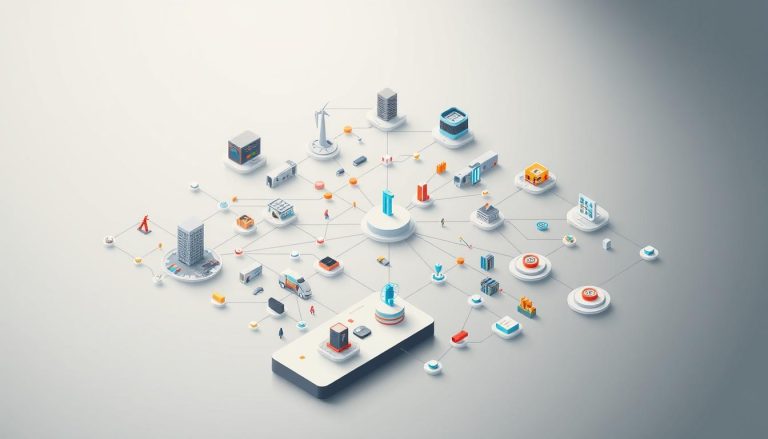

Enhancing Supply Chain Clarity with Blockchain
U.S. supply chains are complex networks of companies moving products, services, and cash across borders. Each transaction creates records in various systems. Disagreements between these records lead to time-consuming reconciliations, chargebacks, and disputes.
COVID-19 highlighted the gap in supply chain visibility. During the pandemic, delivery times increased, and essential items were often late or missing. This shift underscored the importance of supply chain execution in determining service levels and working capital performance.
Blockchain is now seen as a practical tool for supply chain transparency, not just a trend. It acts as a shared ledger that ensures transactions are tamper-evident. This allows partners to record, validate, and view transactions across multiple parties. It’s essential in ecosystems where trust is lacking but coordination is necessary for shipments, inspections, and documentation.
While blockchain can’t eliminate disruptions like macro issues or inflation, it can enhance data integrity and traceability. It’s an enterprise tool that integrates with systems like SAP and Oracle, improving efficiency without replacing them.
Executives are prioritizing blockchain for its ability to predict supply chain risks, enhance ESG traceability, and build trust in multi-stakeholder networks. The following sections will explore blockchain’s fundamentals, its role in chain of custody, smart contract automation, IoT-enabled visibility, and its applications in various industries. We will also provide an implementation roadmap with a focus on governance and privacy controls.
Why Supply Chain Clarity Matters in a Disrupted Global Economy
Global supply networks face constant shocks, tighter margins, and higher customer expectations. Executives now view clarity as a key performance metric, not just a reporting task. Supply chain visibility with blockchain is seen as a way to reduce blind spots across suppliers, carriers, and inventory positions.
Clarity is also critical for risk planning, ESG documentation, and dispute resolution in partner ecosystems. Many teams now evaluate blockchain benefits for supply chain alongside compliance tools, forecasting, and procurement controls.
How COVID-19 exposed bottlenecks, delays, and fragile just-in-time models
The 2020 pandemic tested just-in-time planning and lean inventory buffers. Shortages and lead-time swings affected everyday items like toilet paper and mobile phones. Delays spread from upstream suppliers through carriers and distribution nodes.
As volatility increased, firms reassessed their workflows and data handoffs. The debate shifted to tighter controls on order status, supplier confirmations, and exception handling. Here, blockchain is seen as a shared record for cross-company coordination.
Common disruption drivers: geopolitical tension, cyberattacks, inflation, drought, and stockouts
Post-pandemic operations faced recurring disruption drivers that damaged availability and lead times. Geopolitical tension can limit trade lanes and raise compliance friction. Cyberattacks can disrupt logistics systems and halt operations.
Inflation changes purchasing behavior and increases working-capital pressure. Drought and low water levels can limit shipping routes’ throughput. These factors increase stockout frequency and the value of verified, near-real-time records—often cited among blockchain benefits for supply chain.
| Disruption driver | Typical operational impact | Clarity signal leaders track |
|---|---|---|
| Geopolitical tension | Rerouted shipments, longer customs cycles, higher documentation burden | Lane-level lead-time variance and document status by handoff point |
| Cyberattacks | System outages, delayed releases, invoicing and settlement backlogs | Exception queues, recovery time, and data reconciliation volume |
| Inflation | Cost escalation, service-level tradeoffs, constrained cash-to-cash cycle | Inventory turns, expedite spend, and supplier price-change cadence |
| Drought and low water levels | Reduced vessel loads, port congestion, schedule instability | On-time departure/arrival rates and container dwell time |
| Critical stockouts | Lost sales, backorders, production stoppages | Fill rate, backorder aging, and component-level availability |
What “clarity” means in practice: transparency, traceability, and faster decision-making
Clarity is measurable in daily operations. Transparency means shared visibility across nodes, with consistent status data from purchase order to delivery. Traceability means a verifiable chain of custody and provenance for items or batches, supported by standardized events and time stamps.
Faster decision-making comes from fewer data silos and fewer disputes over which record is correct. Blockchain is often discussed for its role in aligning partners on shipment milestones, transfers, and exceptions. It supports audit readiness, cleaner reconciliations, and stronger multi-party trust under pressure.
Blockchain for Supply Chain Transparency: The Core Concept of a Shared Ledger
In today’s supply chains, data flows through numerous firms and systems. This leads to mismatched records, slow reconciliations, and costly disputes. Blockchain technology addresses this issue by creating a shared ledger. This ledger is accessible to all approved parties, ensuring transparency.
Blockchain is often integrated with ERP, WMS, and TMS platforms. It doesn’t replace these systems but enhances them. It ensures that all partners have a unified view of goods and payments moving across the network.
Decentralized, immutable transaction history
Blockchain functions as a distributed database shared among multiple participants. Transactions are grouped into blocks, linked through cryptography. Once recorded, these blocks cannot be altered without consensus, ensuring immutability and a consistent audit trail.
For supply chains, these entries can include physical and financial events. Examples include shipment handoffs, quality inspections, and receipt confirmations. Blockchain ensures these events are recorded consistently across organizations, even with differing internal systems.
A single source of truth that reduces disputes
Many disputes arise from fragmented data silos and manual paperwork. Inconsistencies, like a bill of lading not matching a warehouse receipt, can cause delays and rework. These issues affect procurement, logistics, and finance teams.
Blockchain for supply chain transparency provides a unified record set for agreed events. This reduces data asymmetry, allowing exceptions to be reviewed against a shared timeline. This approach minimizes the need for competing versions stored in separate databases.
Permissioned networks for enterprise control
Most enterprise ecosystems use permissioned blockchain networks. These networks have defined membership and governance. Access controls limit who can read, write, or validate data, ensuring security and immutability. This model supports compliance and reduces operational risk.
Enterprises also consider throughput, scalability, and energy use. Permissioned designs can use lighter-weight consensus and high-performing infrastructure. This meets transaction-volume requirements without requiring blind trust or excessive manual reconciliation.
| Design choice | How it operates | Why it matters for supply chains |
|---|---|---|
| Shared ledger | Multiple parties maintain the same synchronized record of agreed events | Reduces conflicting documents and shortens dispute cycles in logistics and procurement |
| Immutability | Cryptographic linking and consensus make past records resistant to alteration | Supports audit readiness for chain-of-custody, quality, and compliance documentation |
| Permissioned access | Defined membership with role-based rights to read, write, and validate | Protects sensitive pricing, volume, and supplier data while enabling collaboration |
| Integration layer | Connects to ERP and logistics systems to publish selected events to the ledger | Improves data consistency without forcing a full system replacement |
How Blockchain Technology Improves Traceability and Chain of Custody
Traceability fails when records are scattered across emails, spreadsheets, and separate systems. To address this, many companies are turning to blockchain technology. This enhances supply chain transparency, ensuring all partners are aligned on the same event history. The outcome is more accurate chain-of-custody data, essential for audits, compliance, and resolving disputes.
Logging transfers, checks, and milestones
Every handoff is documented as a time-stamped event, from pickup to release. This is made possible by a shared, permissioned ledger. Such a system makes the audit trail tamper-evident, as any changes require agreement from the network, not just one user. This structure is invaluable for supply chain teams dealing with tight deadlines and reconciling various documents.
It also minimizes common loss points. A consistent ledger reduces errors from manual re-keying and flags issues like grey-market diversion. For regulated goods, it strengthens evidence for internal controls and supplier performance reviews.
Digital identities to verify provenance
Assigning a digital identity to items like lots or pallets links physical movement to verified data. This allows stakeholders to verify origin claims and detect any route changes that suggest diversion. This method enhances supply chain transparency without exposing sensitive information to all parties.
QR codes on products can reveal specific provenance details, such as harvest region or cold-chain milestones. This transparency supports brand credibility by providing proof of authenticity and ethical sourcing.
Faster, more precise recalls
Recalls can be slow when product lineage is scattered across different databases. With end-to-end traceability, teams can quickly identify affected lots and narrow the scope of removals. This reduces strain on retailers and carriers. Many blockchain solutions focus on this operational gain, enabling quicker identification and fewer days lost to administrative tasks.
| Operational need | Ledger record captured | Chain-of-custody impact | Recall and risk response |
|---|---|---|---|
| Supplier handoff control | Shipment ID, lot/serial, time stamp, sender/receiver role | Clear custody transitions and fewer missing handoff records | Faster lot isolation and reduced dispute time during retrieval |
| Quality assurance verification | Inspection result, temperature threshold pass/fail, certificate reference | Auditable proof of handling steps across facilities | Quicker root-cause triage and fewer precautionary pulls |
| Anti-counterfeit screening | Serialization match, packaging scan event, authorized distribution node | Improved detection of duplicate identities and out-of-channel movement | Lower exposure to counterfeit and grey-market diversion |
| Customer and regulator reporting | Product lineage summary, key milestones, exception notes | Consistent documentation across partners and sites | Faster notifications with verified scope and supporting evidence |
Smart Contracts and Automation in Supply Chain Management with Blockchain
Smart contracts bring structure to shared data by converting agreed rules into software. In the realm of supply chain management with blockchain, these rules can significantly reduce cycle times. They also minimize the need for manual checks across procurement, logistics, and finance.
Blockchain integration in supply chain management reveals its value when milestone data transitions from emails and PDFs to a ledger entry. This entry is verifiable by all approved parties.
Self-executing rules tied to shipment milestones
A smart contract is a piece of code stored on a blockchain that executes when specific conditions are met. These conditions often include arrival scans, inspection pass results, and delivery confirmation.
In the context of supply chain management with blockchain, these events can update inventory status, release a hold, or notify downstream planners. The record is time-stamped, consistent, and resistant to alteration after the fact.
Blockchain integration in supply chain also supports multi-party handoffs. Here, carriers, 3PLs, and buyers rely on the same event history to manage exceptions.
Automated settlements that reduce disputes and payment lag
Disputes often stem from mismatched documents, late approvals, or unclear proof of performance. Automated milestone validation reduces the room for disagreement. It aligns contract terms with a shared audit trail.
When settlement logic is automated, invoice matching and payment release can occur faster with fewer touches. This results in lower administrative overhead and fewer delays that restrict working capital for many firms.
In blockchain integration in supply chain, the finance team can tie payment timing to objective proofs. These proofs include an inspection result or a signed delivery event, not informal status updates.
Workflow modernization from paper reconciliations to real-time updates
Paper-based reconciliations lead to rework, version conflicts, and slow exception handling. A ledger-based workflow records transactions in near real time. This improves accountability and reduces common entry errors.
In supply chain management with blockchain, teams can standardize how milestones are logged. They can then route exceptions to the right owner with clearer context and fewer follow-up emails.
To enhance reliability, many programs use contract libraries and formal audits before rollout. OpenZeppelin patterns, CertiK audit practices, ERC guidelines, and bug bounty programs are often employed to reduce smart contract risk.
| Automation point | Trigger data captured on-chain | Smart contract action | Operational impact | Assurance practice used in production |
|---|---|---|---|---|
| Arrival at port or DC | Time-stamped scan event, location ID, shipment ID | Status update and automated notification to buyer and warehouse | Faster dock scheduling and fewer ETA disputes | Pre-deployment audit and regression testing of event handlers |
| Quality inspection | Inspection pass/fail result, lot or batch reference, inspector ID | Release hold, approve receipt, or open an exception workflow | Reduced rework from unclear acceptance criteria | Standardized contract libraries such as OpenZeppelin and code review gates |
| Delivery confirmation | Proof-of-delivery event, time stamp, receiving party ID | Authorize invoice approval and initiate payment terms | Shorter payment cycles and fewer manual follow-ups | Audit logs, access controls, and bug bounty programs for critical functions |
| Freight charge validation | Rate table reference, weight/dimension entry, lane ID | Auto-calculate charges and flag out-of-policy variances | Lower overbilling risk and fewer reconciliation tickets | Independent audit firms and rule-set testing against historical shipments |
Supply Chain Visibility with Blockchain When Integrated with IoT and Track-and-Trace
Real-time logistics data often resides in carrier portals and vendor dashboards. This fragmentation hinders swift action when temperature issues arise, routes change, or handoffs fail. Blockchain addresses this gap by sharing a verified shipment record across all trading partners.
Writing sensor data to the ledger for real-time shipment visibility
IoT devices capture location, temperature, and humidity at regular intervals during transit. These readings are then written to a shared ledger, creating a time-stamped event that’s hard to alter later. This approach reduces reliance on manual updates and conflicting carrier feeds.
It also enhances audit readiness. Stakeholders can review the same chain-of-custody record without the need for reconciling spreadsheets or emailed PDFs.
Early anomaly detection to reduce spoilage and improve quality compliance
Continuous monitoring supports early detection of excursions, delays, and unplanned dwell time. Alerts can be set based on thresholds used in food, life sciences, and cold-chain handling policies. With blockchain, the anomaly record stays attached to the shipment history, aiding quality reviews and CAPA workflows.
Operational teams can differentiate true exceptions from sensor noise by comparing readings across time and route segments. This reduces false holds and avoids unnecessary rework.
Case example approach: blockchain plus GSM-enabled trackers for an immutable shipment history
Deloitte developed a real-time shipment tracking prototype. It combined Hyperledger Fabric, the platform underpinning Deloitte’s Track and Trace, with Thingstream and AWS technology. A sensor strapped to a pallet records shipment location internationally over any GSM network. Events are recorded immutably on a distributed ledger, allowing the sender, shipper, and receiver to build a trusted shipment life-cycle history without human intervention for updates.
The distributed design also limits data tampering at scale. No single actor controls the full record, supporting cross-border transparency and tighter dispute management in multi-party moves. This is a practical example of blockchain solutions for supply chain in high-velocity logistics.
| Capability | What IoT captures | What the ledger preserves | Operational use in transit |
|---|---|---|---|
| Location tracking (GSM) | Latitude/longitude pings across international GSM coverage | Time-stamped movement events linked to shipment ID | ETA validation, route deviation review, handoff verification |
| Temperature control | Continuous temperature readings and excursion duration | Immutable condition log for each milestone | Cold-chain holds, disposition support, carrier performance analysis |
| Humidity monitoring | Humidity levels and exposure windows | Traceable environmental profile tied to custody changes | Packaging suitability checks, mold/spoilage risk screening |
| Tamper resistance at scale | Device events and custody timestamps from multiple parties | Distributed record that limits unilateral edits | Dispute reduction, cross-border reporting, stronger partner accountability |
Blockchain Benefits for Supply Chain: Risk Prediction, Trust, and ESG Traceability
Disruption is now the norm, and companies must anticipate and document issues early. Delays often stem from missing documents, late updates, or unverified handovers. Blockchain enhances transparency, ensuring consistency across partners and reducing rework when information changes.

Reducing supply chain risk through better transparency and proactive issue detection
By time-stamping each scan, inspection, and transfer, planners can identify vulnerabilities sooner. This approach supports proactive risk management, based on real-time exceptions, not just monthly summaries. The result is fewer unexpected shortages and quicker responses to quality issues.
As technology advances, ledgers can integrate data from IoT sensors, smart contracts, and AI. The aim is to predict based on verified shipment histories, not guesses. Blockchain strengthens the data foundation, ensuring transparency in disputes.
Enhancing trust in multi-stakeholder networks where data quality and visibility often degrade upstream
Global supply chains involve various stakeholders with different interests. Data can be delayed, altered, or lost as it moves upstream. Shared ledger records provide a reliable audit trail, boosting confidence in transactions.
Blockchain offers more than just speed. It ensures a consistent audit trail, reducing chargebacks and manual matching costs. It also fosters clearer accountability across handoffs.
Enabling ESG and Scope 3 tracking with verifiable traceability records across partners
For ESG reporting, procurement teams need specific, supplier-provided data, not estimates. In complex categories, Scope 3 accounting requires traceability across numerous partners and regions. Blockchain preserves supporting documents and process events as verifiable records for audits.
Immutable logs support compliance by providing proof of origin, handling conditions, and labor attestations. Blockchain enhances documentation control, ensuring compliance without requiring all partners to use the same system.
| Operational need | How shared-ledger records support it | Primary metric supply chain teams track |
|---|---|---|
| Early risk detection | Exception flags tied to time-stamped milestones and sensor inputs for consistent root-cause analysis | Time to detect and time to respond |
| Partner trust and dispute control | Single, tamper-evident event history across custody transfers to reduce reconciliation cycles | Dispute rate and cost per dispute |
| ESG and Scope 3 traceability | Verifiable evidence chain for origin, processing steps, and supplier declarations across tiers | Audit pass rate and data completeness |
Real-World Use Cases and Industry Applications of Blockchain Solutions for Supply Chain
Blockchain technology is gaining traction where multiple parties share data but lack a unified system. It enables a shared record for events, documents, and sensor readings across different systems.
Blockchain solutions for supply chain also play a key role in making working capital decisions. By verifying shipment status and custody, lenders and trade finance teams can assess risk more accurately.
Food traceability and faster contamination response
The food supply chain involves various stages, from farms to retailers. Each stage introduces gaps in tracking and time stamps.
Blockchain technology offers a tamper-evident chain of custody for farm-to-retailer events. This allows operations teams to trace suspect lots in seconds, limiting shelf pulls and brand exposure.
These solutions also enhance quality controls. Temperature checks, inspection results, and decisions on holds can be linked to batch records.
Pharmaceutical integrity, anti-counterfeiting, and DSCSA alignment
Counterfeit and diverted medicines pose significant risks to patient safety and incur high recall costs. They also raise liability concerns for manufacturers, distributors, and pharmacies.
Blockchain technology can record serial numbers, production data, and temperature logs at the batch or unit level. Its immutability ensures authenticity checks across trading partners, strengthening audit readiness.
In the U.S., these solutions can meet data exchange and traceability requirements of the U.S. Drug Supply Chain Security Act. The same ledger history aids in handling exceptions when a product is quarantined.
Global logistics documentation and coordination
International freight relies heavily on documents and fragmented status messages. Carriers, freight forwarders, port operators, and customs authorities often re-key the same details.
Blockchain technology can maintain shared manifests, milestone updates, and document versions on one ledger. This reduces disputes over “latest” files and minimizes delay risk at handoffs.
When combined with IoT trackers, blockchain solutions for supply chain add location and condition signals to shipment records. Smart-contract rules can automate payments after arrival or inspection, improving coordination and cash-flow timing.
| Industry workflow | Primary ledger record | Operational impact | Financing and compliance relevance |
|---|---|---|---|
| Food traceability | Lot IDs, custody transfers, inspection results, temperature checkpoints | Faster root-cause tracing, narrower recalls, tighter cold-chain control | Cleaner audit trail for quality programs and lower brand-risk exposure used in supplier reviews |
| Pharmaceutical distribution | Serialized identifiers, manufacturing data, verification events, temperature logs | Reduced counterfeit risk, faster exception resolution, stronger partner verification | Supports DSCSA-aligned traceability and improves evidence for chargebacks, disputes, and audits |
| Global logistics documentation | Manifests, status milestones, document versions, sensor-based condition data | Fewer paperwork delays, better routing decisions, improved on-time performance | More reliable shipment proof for trade finance, plus clearer records for customs and compliance checks |
Blockchain Integration in Supply Chain: Implementation Roadmap and System Fit
Effective blockchain integration in supply chains begins with a clear scope and measurable goals. Most teams view the ledger as a tool to enhance data integrity, not replace existing systems. This approach ensures a seamless integration process.
Aligning early across procurement, logistics, quality, finance, and IT is key. This alignment minimizes rework and exceptions that can undermine traceability. A well-defined operating model is essential for maintaining traceability value.
Define objectives and map pain points
Designing with objectives in mind starts with identifying specific failure points. These include counterfeit exposure, fraud risk, shipment delays, and inaccurate documentation. Teams focus on areas where manual reconciliations and siloed databases cause disputes, chargebacks, or recall issues.
Controls should be defined at the event level. This includes handoff scans, quality hold releases, temperature breaches, and customs document approvals.
Choose a network model that matches risk and privacy
Network selection hinges on who can read, write, and validate records. Permissioned and consortium networks are common due to their restricted participation and shared visibility. This ensures only known firms can access the network.
Public networks offer openness but come with privacy, throughput, and cost constraints. Many use off-chain storage for sensitive data. They apply cryptographic proofs or selective disclosure to protect commercial terms without compromising traceability.
| Design choice | Best fit in operations | Typical trade-offs |
|---|---|---|
| Permissioned/consortium network | Multi-party workflows with known partners, controlled access, audit-ready traceability | Requires governance, onboarding rules, and agreed data standards across members |
| Public blockchain anchoring | Proof of existence for key events, broader verifiability for external stakeholders | Higher privacy burden, variable fees, and scalability limits under heavy transaction loads |
| Consensus mechanism selection (e.g., Proof-of-Authority) | High-throughput validation for enterprise participants with defined roles | Relies on trusted validators and strong identity controls to maintain integrity |
Pilot narrowly, integrate systems, then scale
Pilots are most effective when targeting a narrow lane. This could be tracking a high-value product line or automating a single document workflow. The goal is to validate data quality, cycle-time reduction, and dispute rates before expanding.
Blockchain integration in supply chains relies on clean inputs. ERP and WMS integrations provide master data and transaction context. IoT feeds add location and condition signals. Oracle services bring off-chain data onto the ledger with defined validation rules.
Set governance, compliance, and risk controls
Governance defines who can see what, who can correct errors, and how audits are executed. It includes data access rules, privacy controls, audit rights, and compliance alignment for regulated flows. A written dispute resolution process is also essential.
Risk management covers interoperability and scaling limits. Bridges and relayers connect networks but introduce trust and performance trade-offs. Some ecosystems approve trusted relayers to reduce on-chain validation load. Security work includes consensus review, key management, smart contract testing, and continuous monitoring led by IT and cybersecurity teams.
Conclusion
Modern supply chains rely on collaboration among shippers, brokers, ports, carriers, and suppliers. Without a unified system, data gaps widen, and manual processes hinder efficiency. Industry research highlights blockchain as a solution for supply chain transparency, ensuring all parties share the same transaction history.
Blockchain enhances supply chain transparency by creating a shared, tamper-proof ledger. It records every transaction, inspection, and exception, ensuring the integrity of goods. Digital identities verify the origin of products and detect any diversion attempts. Smart contracts automate actions and expedite settlements, reducing administrative tasks and payment delays.
Measuring success in blockchain adoption is key. IoT data, such as location and temperature, is written to the ledger, providing real-time insights and early detection of issues. Deloitte’s prototype, built on Hyperledger Fabric with Thingstream and AWS, showcases an immutable shipment history accessible to all stakeholders.
Implementing blockchain requires a structured approach. Success hinges on setting clear goals, selecting the right network, and integrating with existing systems. Establishing governance is essential for privacy, audit rights, dispute resolution, interoperability, and cybersecurity. With these steps, blockchain becomes a valuable tool for managing risks, fostering trust, and tracking environmental impact.
FAQ
What does “supply chain clarity” mean, and why is it now an executive mandate?
“Clarity” refers to the transparency, traceability, and swift decision-making in supply chains. It ensures shared visibility, a verifiable chain of custody, and fewer disputes due to fragmented records. The COVID-19 pandemic highlighted the need for better risk prediction, ESG traceability, and data sharing among partners.
What is blockchain for supply chain transparency in practical terms?
Blockchain is a shared ledger for recording transactions related to goods, documents, and payments. It links batches of transactions in a tamper-evident, auditable history. This technology supports trust among parties, even when they don’t inherently trust each other.
Is blockchain technology a replacement for ERP, WMS, or existing supply chain systems?
No, blockchain is an enhancement, not a replacement. It improves record integrity, traceability, and efficiency while integrating with ERP and WMS. Its value is greatest where data fragmentation and manual paperwork hinder operations.
How does blockchain improve traceability and chain of custody?
Blockchain logs supply chain events like transfers and quality checks, creating an immutable audit trail. It assigns digital identities to items for origin verification and diversion detection. This supports faster recalls by reducing investigation time.
What are smart contracts, and how do they reduce disputes and payment delays?
Smart contracts are automated rules on a blockchain that execute when conditions are met. They can trigger payment or updates, reducing manual reconciliations. This leads to fewer disputes, less overhead, and faster settlement, improving working capital.
How does supply chain visibility with blockchain work when combined with IoT and track-and-trace?
IoT devices capture data like location and temperature, which is then logged on the blockchain. This creates a shared, real-time view. Continuous monitoring helps detect anomalies early, reducing spoilage and ensuring compliance.
What should leaders evaluate first when planning blockchain integration in supply chain programs?
Leaders should first identify traceability gaps and other issues. Then, choose a network architecture that balances visibility with controlled participation. Successful integration also depends on ERP/WMS and IoT integration, data quality, privacy, and compliance.